.png)


How German Companies Hire Contract ML Engineers from India?

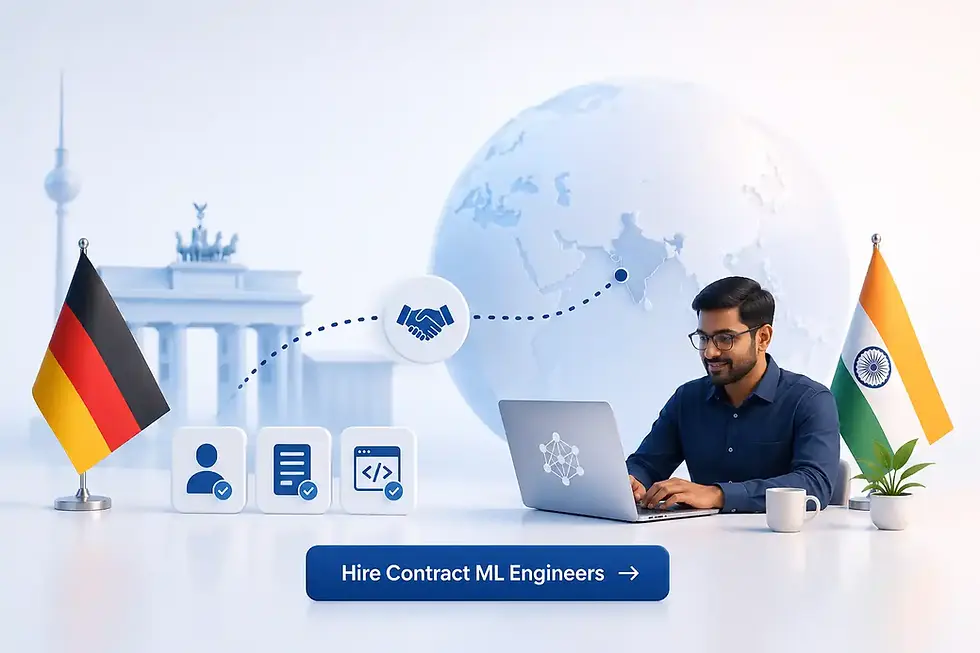
A senior ML engineer in Munich commands between €90,000 and €130,000 in gross annual salary before you add the employer's social contribution burden of roughly 20 percent. That puts the total employment cost for a single senior ML hire in Germany between €108,000 and €156,000 per year. German companies hire contract ML engineers from India precisely because the same seniority level, placed through an EOR on a contract basis, costs between $30 and $50 per hour all in. At that rate, companies can engage almost any type of technology professional including ML engineers, cloud architects, DevOps specialists, data scientists, cybersecurity analysts, SAP consultants, and niche AI engineers without the overhead of permanent employment.
Germany's KI-Strategie committed €5 billion toward AI deployment across industry and the talent supply has not kept pace. The Bundesagentur für Arbeit has flagged MINT roles as critically undersupplied for several consecutive reporting cycles. For ML specifically, the shortage sits in production-grade profiles: engineers who can take a model from experiment to deployment, manage drift, and build retraining pipelines. That is the gap Indian engineers fill.
Why German Industry Cannot Fill ML Roles Locally
Germany's ML hiring problem is structural. The sectors generating the most mandates we receive are not startups chasing hype. They are automotive OEMs and Tier-1 suppliers in Munich, Stuttgart, and Wolfsburg building computer vision and predictive maintenance systems. Insurance and financial services firms in Frankfurt running fraud detection and underwriting automation. Logistics companies in Hamburg and Dusseldorf building demand forecasting models. Industrial automation firms in the Rhine-Ruhr corridor working on sensor fusion and anomaly detection.
German universities produce excellent ML researchers. The gap opens at the transition from research to production: model serving, feature stores, drift monitoring, and CI/CD pipelines for models. This is precisely where engineers from Bengaluru and Hyderabad, shaped by GCC and product company environments, perform strongly.
The pattern we see repeatedly across German mandates is that the client spends three to five months searching through local channels, closes nothing, then opens a parallel contract hiring track from India. In most cases the contract engineer is active in sprints before the permanent search reaches final interviews.
Which Indian Cities Produce the Strongest ML Talent for German Clients
Not every Indian tech city delivers the same ML profile. From mandates we have run for German clients specifically, here is what the ground reality looks like.
Bengaluru carries the deepest pool for production ML. Engineers from product companies here, particularly those with Kubeflow, MLflow, and PyTorch experience at scale, are the closest match to what German automotive and fintech clients need. The Bengaluru talent market has matured significantly in MLOps, driven by the GCC ecosystem that now spans over 150 global capability centres in the city.
Hyderabad has a strong concentration of ML engineers with data engineering foundations including PySpark, Databricks, and Azure ML. For German clients in logistics and manufacturing who need ML engineers who can also own their feature pipelines.
Pune has a growing ML community in computer vision, fed by engineers transitioning from embedded systems and signal processing backgrounds, which makes them a natural match for German industrial automation clients.
What Indian ML engineers typically lack for German clients is familiarity with GDPR-compliant model training, specifically data minimisation, explainability under Article 22, and auditability of automated decisions. Engineers who have worked in GCCs with European client exposure usually handle this well. Those who have not need a structured onboarding briefing, which AnjuSmriti provides as a standard step before the engineer joins the client's sprint cycle.
For German regulated-sector clients specifically, we include one scenario question in every technical assessment. The candidate is given a credit-scoring model and asked to describe how they would document its decisions for a compliance audit. The answer tells us more about German-readiness than any algorithm question.
Legal and Compliance Reality When German Companies Hire Contract ML Engineers from India
The governing law is the Arbeitnehmerüberlassungsgesetz, known as AUG, which is Germany's Act on Temporary Agency Work. Every German company hiring contract ML engineers from India needs to understand three provisions before signing anything.
The 18-month deployment limit means a contract worker placed through a staffing agency cannot work at the same German client site for more than 18 consecutive months. After that threshold, the client must either offer permanent employment or end the engagement. This clock runs even when the engineer is on an Indian payroll through an EOR.
The equal pay obligation activates at 9 months. From that point, the contract worker is entitled to the same compensation as comparable permanent employees at the German entity. German clients who assume the Indian contract rate is fixed for the full engagement duration are regularly surprised by this provision.
Scheinselbstandigkeit, which means false self-employment, is the most common and most costly mistake we see. Companies attempt to engage Indian ML engineers directly as freelancers to avoid AUG. German tax authorities and the Deutsche Rentenversicherung actively audit such arrangements. If the engineer works regular hours, follows client instructions, and uses client tools, reclassification as an employee triggers back-payment of social contributions plus fines.
The clean structure is an Employer of Record in India. The engineer is employed by the EOR in India and the German entity contracts with the EOR through a B2B service agreement. AUG compliance, IP assignment, and GDPR obligations are all managed within that structure. For payroll management, we use EOR partners with direct experience in German-India arrangements.
The Contract Hiring Advantage: Flexibility, Speed, and Access to Specialized Skills
Contract hiring gives German companies something permanent hiring structurally cannot: the ability to match headcount precisely to project demand. An ML model build has a beginning and an end. A fraud detection system goes to production and then enters a maintenance phase with different skill requirements. Contract engineers can be engaged for the build phase, extended if needed, and closed out when the project scope changes without redundancy obligations or notice period constraints that apply to permanent employees under German law.
The speed advantage is equally significant. A permanent ML hire in Germany, from job posting to first day, typically takes four to six months when you account for notice periods alone, as most senior German engineers are on three-month notice. A contract ML engineer from India, placed through an EOR, can be active within five to seven weeks of mandate receipt.
The $30 to $50 per hour all-in rate opens access to a wide range of technology specialists that would be financially out of reach on permanent German salaries. At this range, companies can hire software engineers, cloud architects, DevOps professionals, AI engineers, data scientists, cybersecurity specialists, SAP consultants, and niche ML engineers, often simultaneously, building cross-functional contract teams that would cost three to four times as much through local permanent hiring. AnjuSmriti Global regularly places multi-role contract teams for German clients where the combined cost of five engineers from India is lower than the salary of a single senior permanent hire in Munich.
The contract model also gives German engineering leads the ability to test a professional's working style, communication quality, and technical depth before committing to a longer engagement or a permanent conversation. This matters particularly for ML roles, where the difference between a strong candidate and a strong performer only becomes visible over three to four sprint cycles.
For German companies exploring remote contract hiring, the contract model is increasingly the first choice rather than the fallback option.
German-India Contract ML Hiring Compliance Checklist
Use this before signing any contract with an Indian ML engineer through an agency or EOR.
Checkpoint | What to Verify |
AUG Licence | Confirm your agency holds a valid Arbeitnehmeruberlassungserlaubnis |
EOR Structure | B2B service agreement between German entity and Indian EOR, not a direct employment contract |
Scheinselbstandigkeit Risk | No direct daily instruction from German managers without EOR intermediary documentation |
GDPR Model Training | Engineer briefed on Article 22, data minimisation, and model explainability obligations |
IP Assignment | Work-for-hire clause in service agreement, explicit under German Urheberrechtsgesetz |
IST to CET Overlap | Minimum 4-hour daily overlap confirmed and sprint ceremonies scheduled within it |
18-Month Deployment Tracker | Start date logged, review planned at month 12 for AUG threshold |
Technical Stack Alignment | PyTorch or TensorFlow, MLflow or Kubeflow, cloud platform confirmed |
Notice Period | Indian contract notice period aligned with sprint cycle, typically 30 days |
Background Verification | Credentials verified, references completed for regulated-sector mandates |
On timezone management, the working overlap between IST and CET in winter runs from roughly 12:30 PM to 5:00 PM IST. German clients who front-load sprint ceremonies into this window and use async tools such as Linear, Notion, and Loom for the remaining hours consistently report better collaboration quality than those who try to run synchronous working across the full German day.
How We Place ML Engineers for German Clients and What Almost Went Wrong on One Mandate
Our standard timeline for a German contract ML mandate runs as follows. Days one to three cover requirement intake, stack mapping, and AUG compliance briefing with the client's legal team. Days four to ten produce a shortlist of four to six profiles. Days eleven to eighteen involve a two-stage technical assessment: an async take-home on model training and MLOps pipeline design, followed by a live code review with the client's senior ML engineer. Days nineteen to twenty-five cover client interviews, reference checks, and offer. Days twenty-six to forty handle EOR onboarding, GDPR briefing, and IP clause confirmation. From week six onward the engineer is active in sprints.
For our machine learning engineer placements, the technical assessment tests model lifecycle management, drift detection and retraining pipeline design, model registry experience, and the ability to document model behaviour for non-technical stakeholders.
A real mandate: a mid-size German insurance firm with 350 employees in Munich came to us after four months of failed local hiring for a fraud detection ML role. The hard requirement was XGBoost with SHAP-based explainability because the compliance team needed to present model decisions to external auditors.
We sourced three candidates from Bengaluru within eight days. Two cleared the technical round. The client selected one. What almost went wrong was during final contract review, when the client's legal team flagged that the draft service agreement did not explicitly assign IP rights for model weights and training code to the German entity. Under the Urheberrechtsgesetz, software IP does not transfer automatically and must be assigned in writing. We caught the gap before signing, added the clause, and completed onboarding. The engineer was active within six weeks. The fraud detection model reached production in month four. The client extended the contract for a second year, at which point we initiated AUG equalisation planning.
What German Companies Actually Pay: Salary and Contract Cost Breakdown
German permanent employment costs:
Seniority | Gross Annual Salary | Employer Social Contributions | Total Annual Cost |
Mid-level (3 to 5 years) | €75,000 to €85,000 | €15,000 to €17,000 | €90,000 to €102,000 |
Senior (6 to 9 years) | €95,000 to €115,000 | €19,000 to €23,000 | €114,000 to €138,000 |
Lead (10 or more years) | €120,000 to €145,000 | €24,000 to €29,000 | €144,000 to €174,000 |
Indian contract ML engineer rates (all-in through EOR and agency fee):
Seniority | Hourly Rate (USD) | Monthly Cost | Annual Cost |
Mid-level | $30 to $38 | €4,500 to €5,500 | €54,000 to €66,000 |
Senior | $38 to $46 | €5,500 to €7,000 | €66,000 to €84,000 |
Lead | $46 to $55 | €7,000 to €9,500 | €84,000 to €114,000 |
The all-in rate includes the engineer's India salary, EOR fee of 8 to 12 percent, and our placement fee amortised over the contract. There are no German Rentenversicherung contributions, no Krankenversicherung obligations, and no redundancy exposure.
What clients typically reinvest the savings into includes additional GPU compute for model training, a second contract ML hire to build team redundancy, or a senior German ML architect to provide technical oversight over the India-based engineers.
Conclusion
German demand for contract ML engineers from India is intensifying in the automotive and industrial sectors, driven by EU AI Act enforcement timelines. High-risk AI systems in these sectors now require conformity assessments, technical documentation, and human oversight mechanisms. Engineers who can deliver production ML alongside regulatory documentation are becoming the standard requirement, not a premium ask. In our live mandates right now, we are already seeing German Tier-1 automotive suppliers add EU AI Act compliance criteria to ML engineer assessments.
If your German company needs to hire contract ML engineers from India through an AUG-compliant, technically rigorous process, submit your requirement here.
Interesting Reads:
FAQs
1. Does Germany's AUG Law Apply to Indian ML Engineers Working Remotely for a German Company?
Yes. The Arbeitnehmeruberlassungsgesetz applies based on the economic substance of the relationship, not just the contract label. If a German company directs an Indian engineer's daily work, the 18-month deployment limit and 9-month equal pay obligation both apply. Using an EOR with a properly structured B2B service agreement manages this correctly. Without that structure, your German entity carries the compliance risk directly.
2. What German Industries Have the Highest Demand for Contract ML Engineers Right Now?
Automotive OEMs and Tier-1 suppliers lead demand, primarily for computer vision, predictive maintenance, and sensor fusion applications. Financial services firms in Frankfurt are a close second, focused on fraud detection and credit risk modelling. German logistics companies working on demand forecasting and industrial automation firms in the Rhine-Ruhr corridor building quality control systems are also consistent sources of ML mandates in our pipeline.
3. How Does IP Ownership Work When a German Company Uses an Indian ML Engineer on an EOR Contract?
Under the Urheberrechtsgesetz, software and model IP does not transfer automatically. The service agreement between the German entity and the Indian EOR must contain an explicit written assignment covering model weights, training code, pipelines, and documentation. The EOR must also ensure the engineer's individual India contract assigns IP upward. If either link is missing, the German company does not legally own what the engineer built. We include this clause as standard in every mandate we facilitate.
4. What ML Stack Do Indian Engineers Placed with German Clients Typically Use?
PyTorch for model development, MLflow or Kubeflow for experiment tracking and model management, Apache Spark or Databricks for feature engineering, Azure ML or AWS SageMaker for deployment, and SHAP or LIME for explainability. Engineers with Feast for feature store management and Evidently AI for drift monitoring are in high demand from German automotive and fintech clients. We maintain a dedicated shortlist of engineers with this specific combination.
5. What Is the Practical Timezone Overlap Between India and Germany for ML Teams?
In winter, the working overlap between IST and CET runs from roughly 12:30 PM to 5:00 PM IST. In summer it shifts by approximately one hour. Sprint ceremonies including standups, planning, and retrospectives should be scheduled within this window. Async documentation tools handle the rest. German clients who design deliberately around this overlap report consistently better outcomes than those who treat the Indian engineer as a synchronous resource across the full German working day.
6. How Does the EU AI Act Change What German Companies Require from Contract ML Engineers?
German companies in automotive, insurance, and financial services are now adding EU AI Act compliance to ML engineer requirements, specifically conformity assessment documentation, training data provenance records, and human oversight mechanisms for high-risk systems. Engineers who have worked in GCCs serving European clients tend to be ahead on this. Those without European exposure need a structured onboarding briefing before beginning work on regulated-sector projects, which we include as standard for relevant mandates.
7. What Is the Typical Contract Duration for German Companies Hiring ML Engineers from India?
Most German clients begin with a six-month contract, renewable in six-month increments. The AUG 18-month deployment limit means three effective renewal cycles before conversion or closure must be decided. We recommend clients review the engagement at month 12 before the equal pay obligation and deployment limit create simultaneous pressure. For clients who want to retain an engineer beyond 18 months, we facilitate either a permanent conversion or a restructured engagement with the required break period.
8. Can a German Company Hire an Indian ML Engineer as a Direct Freelancer Without an EOR?
Technically possible but practically high risk. The Scheinselbstandigkeit rules mean that if the engineer works regular hours, follows client instructions, and uses client tools, German authorities will treat them as an employee regardless of the contract label. This triggers back-payment of social contributions, potential fines, and full AUG exposure directly against the German entity. The EOR fee of 8 to 12 percent of salary is significantly smaller than the liability a misclassified arrangement creates.
Comments