.png)


How to Hire DataOps Engineers from India for Singapore Firms?

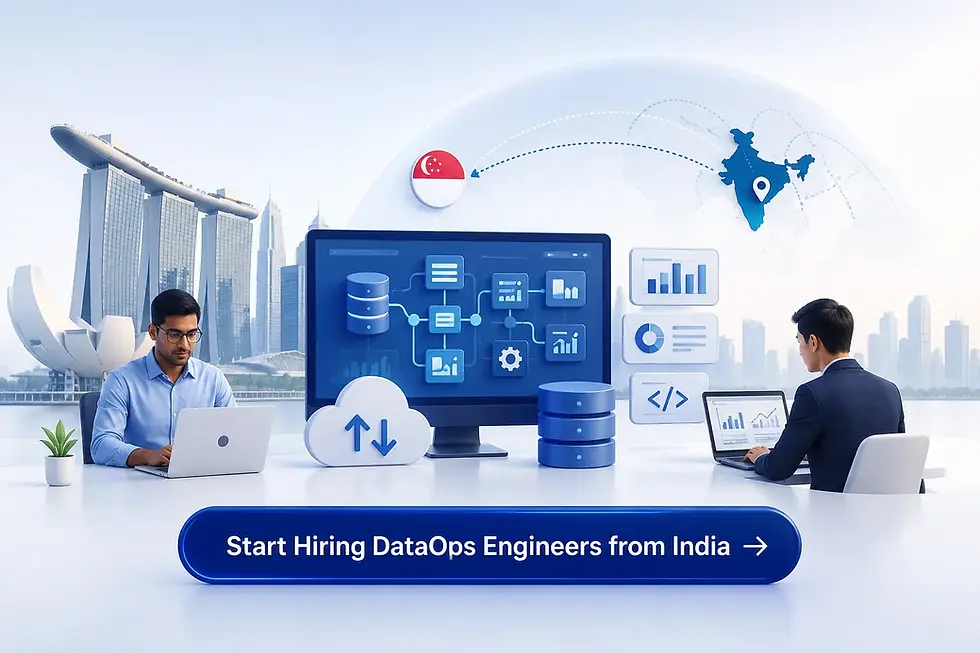
To hire DataOps engineers from India for Singapore firms, most companies use a contract or Employer of Record (EOR) model that keeps the engineer employed in India while working full time inside a Singapore team. This avoids Employment Pass and COMPASS salary thresholds entirely, cuts cost by 45 to 60 percent compared to a locally hired DataOps engineer, and can go live in three to four weeks once the mandate is scoped around dbt, Airflow, and pipeline observability skills.
Singapore's Ministry of Manpower raised the Employment Pass qualifying salary to S$5,600 a month for most sectors, with the COMPASS points framework layered on top before any foreign hire is approved for local employment. That threshold, and the paperwork behind it, is exactly what most Singapore firms hiring DataOps talent from India are trying to avoid, because the engineer doesn't need to sit in Singapore to keep a data platform healthy.
Why Singapore Firms Are Choosing to Hire DataOps Engineers from India
Singapore's data engineering market is tight exactly at the level DataOps sits. Demand for data engineers keeps outpacing supply as banks, fintech, and GovTech modernise their pipelines, and DBS alone runs one of the largest data platforms in Southeast Asia. That demand pulls experienced engineers toward pure build roles, modelling and warehousing, and away from the operational discipline of DataOps: pipeline SLAs, lineage tracking, incident response, and cost governance across Airflow, dbt, and Kafka.
We see this gap most in three sectors: Banks and financial institutions such as DBS, OCBC, UOB and Standard Chartered need DataOps engineers who understand MAS's data governance expectations well enough to make pipelines auditable, not just functional. E-commerce and logistics firms near Changi and the Tuas mega port need someone watching pipeline uptime through peak trading windows, because a broken data feed at 11pm SGT becomes a broken dashboard for a regional ops team by 9am. GovTech and Smart Nation linked GLCs run large multi agency data platforms but are largely restricted to citizens and PRs for headcount, which pushes DataOps overflow work to contractors by default.
One pattern from our mandates: a Singapore based logistics client had two data engineers doing DataOps work, pipeline monitoring, retries, alerting, on top of their actual modelling jobs. They were burning out, and pipeline incidents went undetected for hours at a time. That is the exact profile that triggers a DataOps hire, and it rarely shows up in a job description until the client tells us where the on call rotation actually breaks down.
The current market is also shifting fast. AI powered anomaly detection is becoming standard in pipeline monitoring, FinOps practices are spreading into data platform budgets as cloud costs come under scrutiny, and agentic monitoring tools are starting to replace manual dashboard checks. Companies hiring DataOps talent now increasingly ask for engineers comfortable pairing traditional orchestration tools with AI assisted observability, not just Airflow scripting.
Contract Hiring vs Full Time Hiring: What Singapore Firms Should Understand First
Before comparing legal structures, it helps to separate two different questions: do you want to hire DataOps engineers from India for Singapore firms as contractors, or as full time employees relocated onto a local payroll? These are not interchangeable decisions, and each suits a different kind of need.
Contract hiring means the engineer remains employed in India, either directly or through an EOR, and works remotely for the Singapore company on defined deliverables or an ongoing retainer. It is faster to set up, has no work pass requirement, and is easy to scale up or down as pipeline workload changes. Most DataOps mandates fall here because the work is operational and location independent.
Full time hiring means bringing the engineer onto the Singapore entity's own payroll, which usually requires an Employment Pass if the candidate is not a citizen or PR. This route suits roles that genuinely need a physical presence, tight coordination with an on site incident response team, or direct reporting lines into a Singapore based engineering leadership structure. It costs more, takes longer to process, and locks the hire to one employer, but it also integrates the engineer fully into local hiring frameworks like CPF contributions and standard employment benefits.
Most Singapore firms we work with choose contract hiring when they hire DataOps engineers from India for Singapore firms specifically, and reserve full time local hiring for platform architects or engineering managers who need to sit inside daily leadership meetings.
Which Indian Cities Offer the Deepest DataOps Talent Pool
Firms that want to hire DataOps engineers from India for Singapore firms often start with the wrong question, asking for a data engineer when they actually need someone who has operated pipelines under SLA, not just built them. India has this because its Global Capability Centre boom put exactly this kind of operational data work in house at scale.
Bengaluru carries the deepest bench. GCCs for Goldman Sachs, JPMorgan, and Walmart Global Tech all run round the clock data platform operations out of the city, giving engineers genuine incident response and SLA experience relevant to regulated environments. Hyderabad is close behind, anchored by Microsoft, Amazon, and a dense fintech and healthtech data engineering cluster; it is often our first stop for candidates strong in Azure Data Factory and Databricks. Pune has a smaller but sharper pool skewed toward BFSI data platforms, useful when a Singapore bank or insurer wants someone already comfortable working inside regulated data governance requirements.
What Indian DataOps candidates bring reliably: strong Airflow, dbt and Kafka fundamentals, comfort across multi cloud environments, and genuine on call discipline from operations heavy GCC backgrounds. What they typically lack, and what we screen for specifically, is direct exposure to a regulator like MAS or to Singapore specific data residency expectations under the PDPA.
We test this with a scenario round, not a resume line: we walk candidates through a mock data breach timeline and see whether they instinctively separate fixing the pipeline from who needs to be told and by when. Candidates from unregulated e commerce backgrounds usually miss the second half on the first pass, which is coachable, but has to be caught before placement.
Legal and Compliance Reality for Singapore Firms Hiring DataOps Talent
At AnjuSmriti Global, we structure every mandate to hire DataOps engineers from India for Singapore firms around one of three legal paths, and each carries a different compliance load. Getting this wrong is the most common mistake we see, treating an India based contractor as if Singapore employment law applies to them when it does not, unless the person is actually working inside Singapore.
Remote contract keeps the engineer employed or self employed in India, and the Employment Act 1968 does not apply because there is no local employment relationship. This is the fastest route, but the Singapore client still carries obligations under the Personal Data Protection Act 2012 the moment that contractor touches personal data belonging to Singapore data subjects, regardless of physical location. Section 26 of the PDPA specifically limits transferring personal data outside Singapore unless a comparable standard of protection travels with it, so contracts need data processing clauses, not just an NDA.
EOR arrangements have an Indian Employer of Record legally employ the engineer under Indian labour law while they work full time for the Singapore client. This adds a monthly EOR fee of roughly 8 to 15 percent of gross salary but gives statutory compliant payslips and an audit trail that procurement teams at banks and GLCs typically require.
Employment Pass routes apply when the role genuinely needs physical presence in Singapore. The qualifying salary is S$5,600 a month for most sectors and S$6,200 for financial services, and the candidate must also clear the COMPASS points framework, at least 40 points across salary, qualifications, workforce diversity and local employment criteria, unless they earn above S$22,500 a month and are exempted outright. Data engineering and DevOps adjacent roles currently sit on the Shortage Occupation List, which adds bonus points, but the process still adds four to eight weeks and ties the hire to one employer.
Contract vs EOR vs Employment Pass: Quick Comparison
Remote Contract | EOR | Employment Pass (onsite) | |
Governing law | Contract law (India based engineer) | Indian labour law via EOR | Singapore Employment Act |
Work pass needed | No | No | Yes, EP with COMPASS 40+ points |
Time to start | 2 to 3 weeks | 3 to 4 weeks | 6 to 10 weeks including relocation |
PDPA exposure | Yes, transfer clauses required | Yes, plus EOR data handling terms | Yes, but data stays in country |
Best fit | Cost sensitive, project scoped work | Ongoing, headcount like roles needing a compliance trail | Roles needing physical presence or on site response |
Most of our Singapore mandates for DataOps roles land in the EOR column, enough compliance cover for procurement, without the Employment Pass timeline.
Our Hiring Process and a Real Client Outcome
Our process runs in four stages: intake and stack mapping to understand what the client actually runs, whether Airflow, dbt, Kafka or Databricks; a technical screen built around incident scenarios rather than trivia questions; a paid take home exercise focused on diagnosing a broken pipeline from logs alone; and a final panel with the client's engineering lead. From first call to signed offer, this typically runs 18 to 24 working days for a mid to senior DataOps hire.
One recent mandate involved a Singapore based fintech, Series B stage with around 90 staff, that had a single data engineer covering both pipeline building and pipeline operations for a lending decision platform. A silent Airflow DAG failure went undetected for six hours during a batch credit scoring run, caught only because a downstream analyst flagged stale numbers, not because of any alerting. That near miss is what triggered the mandate.
Our team placed a Hyderabad based DataOps engineer on an EOR contract within 19 working days. Within the first month, they rebuilt the alerting layer so Airflow SLA misses now page on call staff within five minutes, and the client avoided a second incident during a subsequent quarter end batch run that would have hit the same blind spot.
What It Really Costs to Hire DataOps Engineers from India for Singapore Firms
Based on 40 plus India to Singapore data and DataOps mandates we've closed, contract and EOR rates for Indian DataOps engineers typically run $2,200 to $3,200 a month for mid level talent, $3,200 to $4,800 for senior level, and $4,800 to $6,500 for a lead or platform owner, all inclusive of the EOR fee where applicable.
Compare that with Singapore resident salaries: Morgan McKinley's salary guide puts local Data Engineers at S$120,000 to S$170,000 a year, roughly $7,400 to $10,500 a month, while separate market survey data puts the broader average nearer S$96,000 a year across all levels. Even at the senior end, an EOR based Indian DataOps hire runs at roughly 45 to 60 percent of the equivalent Singapore resident total cost once you add the local employer's CPF contribution on top of base salary.
Clients typically reinvest that gap in one of two places: a second DataOps hire to build proper follow the sun coverage across IST and SGT, a tight but workable 2.5 hour overlap window for handoffs, or a dedicated observability tooling budget for platforms like Datadog or Monte Carlo that most Singapore data teams say they wanted but couldn't justify at full local headcount cost.
Conclusion
We expect Singapore's DataOps demand to keep concentrating in banking and fintech as MAS's data governance expectations tighten further and firms move from simply building pipelines to proving those pipelines are trustworthy, which is DataOps work, not data engineering work, and most local teams aren't resourced for that distinction yet. AI assisted pipeline monitoring is also becoming a baseline expectation rather than a nice to have, and we're screening more candidates specifically for comfort with these tools.
In live mandates right now, we're seeing more Singapore clients ask for EOR from the first call rather than exploring a local hire first, which wasn't true even recently. If your team is weighing whether to hire DataOps engineers from India for Singapore firms versus a local search, the honest answer depends on how much of the role is genuinely operational versus how much needs a person physically in the building. For most pipeline reliability and observability work, it doesn't need to be the latter.
Interesting Reads:
FAQs
1.Does the Singapore Employment Act apply to an Indian DataOps engineer working remotely on contract?
No. The Employment Act 1968 only governs employment relationships physically based in Singapore. A remote India based contractor falls outside it entirely, though the Singapore client still carries PDPA obligations for any personal data the contractor touches during pipeline work.
2.Do we need an Employment Pass to hire a DataOps engineer from India?
Only if the engineer will physically work in Singapore. Remote contract or EOR arrangements need no work pass at all. Onsite roles require the qualifying salary of S$5,600 a month plus a COMPASS score of at least 40 points.
3.How does the PDPA affect an India based DataOps contractor accessing Singapore customer data?
The PDPA's transfer limitation obligation requires comparable data protection to travel with the data wherever the contractor sits. Contracts need explicit data processing clauses, and the Singapore firm remains the accountable data controller under the law.
4.What is the real cost difference between hiring locally and hiring DataOps engineers from India?
EOR based Indian DataOps hires typically run 45 to 60 percent of Singapore resident total cost. Local senior Data Engineer salaries reach S$120,000 to S$170,000 a year versus $3,200 to $4,800 a month all in for an equivalent Indian EOR hire.
5.Which Indian city has the strongest DataOps talent for Singapore banking clients?
Bangalore, due to round the clock GCC operations run by firms like Goldman Sachs and JPMorgan, which gives engineers genuine incident response and SLA experience relevant to regulated environments overseen by MAS in Singapore's banking sector.
6.Can an EOR hired DataOps engineer legally handle data governed by MAS regulations?
Yes, provided the contract includes PDPA compliant transfer clauses and the EOR's Indian employment terms don't conflict with the client's data residency commitments. Candidates are screened specifically for regulatory context awareness before placement on bank adjacent mandates.
7.How long does it take to hire a DataOps engineer from India for a Singapore firm?
On a contract or EOR model, 18 to 24 working days from intake to signed offer is typical for mid to senior DataOps roles. An Employment Pass route for onsite relocation adds four to eight weeks for COMPASS processing and paperwork.
8.Should a Singapore fintech choose contract hiring or full time hiring for ongoing DataOps support?
Contract or EOR hiring suits ongoing DataOps needs because it avoids Employment Pass timelines while still giving procurement a compliance trail. Full time local hiring suits roles needing daily physical presence or direct leadership reporting lines instead.
Comments