.png)


EOR India vs Captive GCC: Which Model Is Right for Your Company?

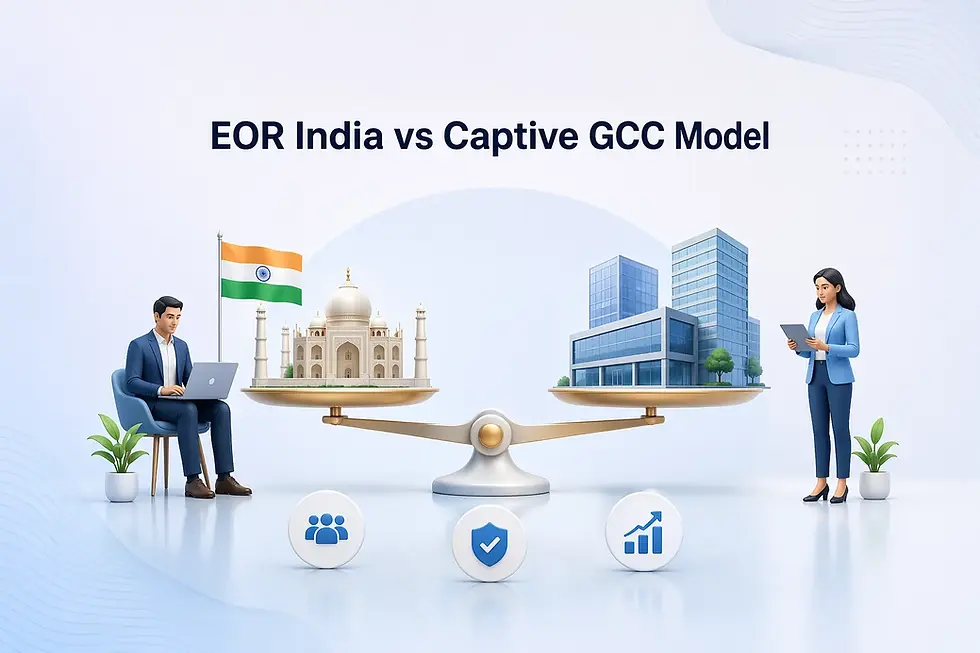
Entering the Indian market presents immense opportunities for global companies, but turning that opportunity into execution is rarely straightforward. Despite access to a vast and skilled talent pool, organizations often face delays due to entity setup requirements, compliance challenges, and operational inefficiencies. What begins as a growth initiative can quickly slow down because of administrative and legal bottlenecks. This is exactly where the debate around EOR India vs Captive GCC becomes highly relevant for decision-makers.
For startups, SMEs, and global enterprises, the real challenge is not talent acquisition it is building and managing that workforce efficiently without disrupting business momentum. Delayed hiring can directly impact product timelines, customer delivery, and revenue growth.
This is where the decision between an Employer of Record (EOR) and a Captive Global Capability Center (GCC) becomes critical. Both models enable companies to hire in India, but they differ significantly in structure, cost, speed, and long-term impact. Understanding these differences helps businesses make a more informed and strategic choice.
What is an Employer of Record (EOR) in India?
An Employer of Record (EOR) is a third-party organization that legally employs workers on behalf of a company while allowing the company to manage their daily work. This model removes the need to establish a legal entity in India, making it one of the fastest ways to enter the market.
Companies exploring this route often start by understanding how an Employer of Record (EOR) works in India, especially in terms of compliance, payroll, and employee benefits.
Instead of navigating complex registration processes, businesses can onboard employees quickly and begin operations without delay. This significantly reduces the time-to-hire and allows organizations to focus on execution rather than administrative hurdles.
For example, a US-based SaaS company looking to build a development team in India can hire engineers within weeks using an Employer of Record (EOR), whereas setting up a legal entity could delay hiring by months.
What is a Captive GCC and How Does It Work?
A Captive Global Capability Center is a fully owned offshore entity established by a company in India. Unlike an Employer of Record (EOR), this model requires setting up a legal entity and managing all aspects of employment internally. Businesses planning long-term expansion often evaluate how a Captive Global Capability Center (GCC) supports strategic functions such as product development, analytics, and operations.
A GCC operates as an extension of the company’s global operations, offering full control over workforce management, internal processes, and company culture. Over time, these centers evolve into innovation hubs that contribute significantly to business growth.
However, this model involves higher complexity, requiring investment in infrastructure, compliance management, and local leadership.
Employer of Record (EOR) India vs Captive GCC: Key Differences
Although both models allow companies to hire in India, their approach and impact differ significantly. The Employer of Record (EOR) model focuses on speed and operational simplicity, while the GCC model emphasizes control and long-term scalability.
Factor | Employer of Record (EOR) – India | Captive GCC |
Speed to hire | Fast (days to weeks) | Slow (months) |
Entity requirement | Not required | Required |
Cost structure | Operational expense | Capital + operational expense |
Compliance | Managed by EOR | Managed internally |
Control | Moderate | Full control |
Scalability | Flexible | Less flexible initially |
When Employer of Record (EOR) in India is the Right Choice
An Employer of Record (EOR) is ideal for companies that need to move quickly and avoid operational complexity. It allows businesses to enter the Indian market without heavy upfront investment or long setup timelines.
This model becomes especially useful when hiring remote or distributed teams, as it enables companies to scale talent across locations without building local infrastructure.
Startups and SMEs benefit significantly because they can test the market, validate hiring strategies, and build teams without committing to long-term investments. It also reduces compliance risks by transferring legal responsibilities to the EOR provider.
Looking to expand into India without delays or compliance risks?Talk to our EOR experts
When a Captive GCC Makes More Sense
A Captive GCC becomes the right choice when companies are ready to invest in a long-term presence in India. This model provides full control over operations and allows businesses to build strong internal capabilities.
Organizations planning strategic roles or specialized hiring often explore areas like investment hiring in India as part of building a strong GCC structure. Companies that plan to hire at scale or manage core business functions benefit the most from this model, as it allows deeper integration with global operations.
Cost Considerations and Long-Term ROI
Cost plays a crucial role in deciding between an Employer of Record (EOR) and a Captive GCC, but it must be evaluated in context. EOR offers predictable pricing with minimal upfront investment.
To better understand real-world pricing, companies often review insights such as the cost to hire in India via EOR, which highlights how expenses scale with team size. In contrast, a GCC involves significant initial costs, including entity setup, infrastructure, and HR teams. While it becomes more cost-efficient at scale, it requires time and commitment.
A Hybrid Approach: Combining Employer of Record (EOR) and GCC
Instead of choosing one model, many companies adopt a phased approach. They begin with an Employer of Record (EOR) to enter the market quickly and later transition to a GCC as operations mature.
Organizations working with Anjusmriti Global have successfully implemented this strategy, ensuring smooth transitions, compliance continuity, and operational efficiency throughout the process.
Making the Right Choice for Long-Term Business Growth
The decision between Employer of Record (EOR) India vs Captive GCC ultimately depends on your business goals, timeline, and growth strategy. An Employer of Record (EOR) offers speed, flexibility, and reduced risk, while a GCC provides control and scalability for long-term operations. The most effective approach is one that evolves with your business. By aligning your hiring model with your objectives, you can build a strong and sustainable presence in India while maintaining operational efficiency.
Need help choosing the right expansion strategy?Book a consultation
Interesting Reads:
FAQs
1.What is the key difference between Employer of Record (EOR) in India and a Captive Global Capability Center (GCC)?
Employer of Record (EOR) in India enables companies to hire talent quickly without setting up a legal entity, while a Captive GCC requires full entity establishment and operational control. EOR focuses on speed and compliance, whereas GCC emphasizes long-term strategic presence. Choosing between EOR India vs Captive GCC depends on whether agility or control is your priority.
2.When should a company choose EOR India over setting up a Captive GCC?
Global companies often prefer EOR in India when entering the market for the first time or testing new teams. It reduces upfront costs and legal complexity while ensuring compliance with local labor laws. If speed, flexibility, and lower risk matter, EOR becomes the more practical option compared to building a captive center.
3.Is a Captive GCC more cost-effective than Employer of Record services in India?
A Captive GCC can become cost-efficient at scale, especially for large teams and long-term operations. However, the initial setup, infrastructure, and compliance costs are significantly higher. In contrast, Employer of Record India offers predictable pricing and eliminates hidden administrative expenses, making it ideal for smaller or mid-sized expansions.
4.How does compliance differ in EOR India vs Captive GCC models?
Employer of Record providers handle payroll, taxes, and labor compliance, reducing legal exposure for global companies. In a Captive GCC, the company itself is responsible for navigating complex Indian regulations. For organizations unfamiliar with local laws, EOR ensures smoother compliance compared to managing a GCC independently.
5.Can companies transition from EOR India to a Captive GCC later?
Yes, many global companies start with Employer of Record in India to validate the market and then transition to a Captive GCC as they scale. This phased approach minimizes risk while allowing gradual investment. It also helps companies understand workforce dynamics before committing to a full entity setup.
6.Which model offers faster hiring: EOR India or Captive GCC?
Employer of Record India significantly accelerates hiring, often enabling onboarding in days instead of months. A Captive GCC requires entity registration, infrastructure setup, and compliance approvals, which delay hiring. For companies needing immediate access to talent, EOR provides a clear advantage.
7.How does control over employees differ in EOR India vs Captive GCC?
In a Captive GCC, companies have full operational and managerial control over employees and processes. With Employer of Record, the provider is the legal employer, but day-to-day work and performance remain under your direction. This hybrid structure balances control with administrative ease.
8.What are the scalability benefits of Employer of Record in India compared to a GCC?
Employer of Record India allows companies to scale teams up or down quickly without long-term commitments. This flexibility is especially valuable for project-based or evolving business needs. A Captive GCC, while stable, is less agile and requires significant effort to adjust workforce size.
9.How do global companies evaluate EOR India vs Captive GCC for expansion?
Many global organizations analyze factors like time-to-market, compliance risk, team size, and long-term goals. EOR India is often chosen for rapid entry and lean operations, while Captive GCC suits companies planning large-scale, permanent presence. The decision depends on strategic timelines and resource allocation.
10.Which model is better for long-term growth in India: EOR or Captive GCC?
For sustained, large-scale operations, a Captive GCC can provide deeper integration and brand presence. However, Employer of Record in India remains valuable for ongoing flexibility, especially in dynamic industries. Many companies combine both models to balance stability with agility in their India strategy.
Comments