.png)


How Portuguese Startups Use EOR to Access Mumbai Tech Talent?

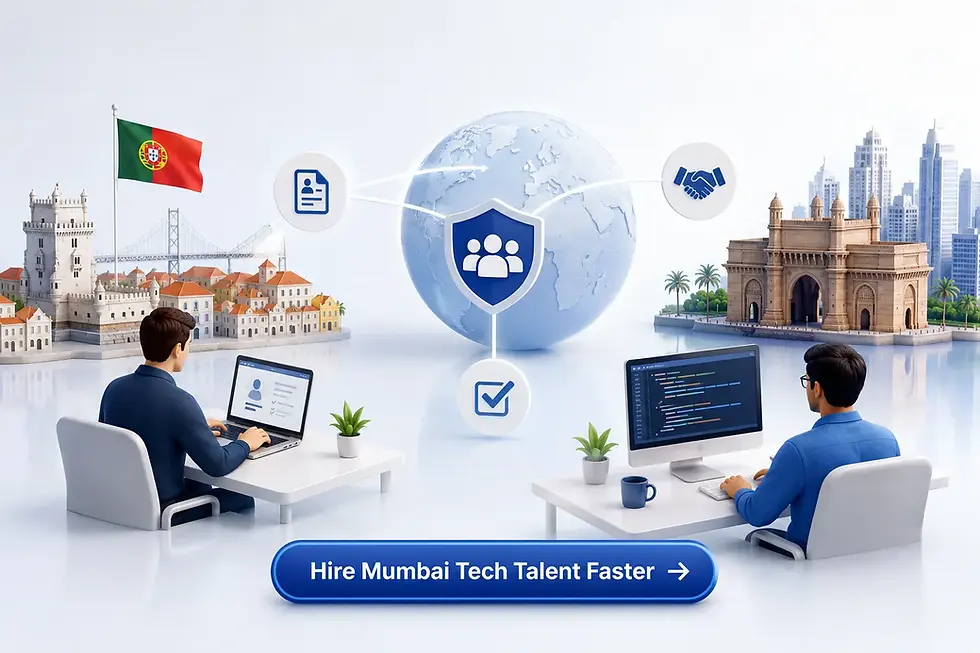
A mid level backend engineer in Lisbon costs a Portuguese startup roughly €38,000 to €48,000 a year, once you add Segurança Social employer contributions of 23.75%. The same engineer, hired in Mumbai through an Employer of Record, costs €14,000 to €18,500 a year fully loaded, and can typically be writing code within three to four weeks. We have run this playbook for Lisbon and Porto based startups more than a dozen times, and the pattern holds up consistently. When Portuguese startups use EOR to access Mumbai tech talent, the real advantage is not just the salary gap. It is that a compliant local employer of record handles Indian payroll and labour law while the startup keeps full control of the engineering work itself.
This piece is written for founders, so we will skip the jargon and focus on what you will actually spend, what can go wrong, and how the mechanics work once Portuguese startups use EOR to access Mumbai tech talent for the first time.
Why Are Lisbon Startups Running Out of Senior Engineers?
Portugal's startup scene has grown faster than its senior engineering talent pool. Lisbon and Porto now host companies like Talkdesk, OutSystems, and Feedzai, and all three compete for the same shallow bench of senior backend and cloud engineers. We have had three separate Lisbon based fintech founders tell us the same thing this year. Juniors are easy to hire, but a senior engineer with real production experience in distributed systems takes four to six months to close, and by the time an offer goes out, a bigger company has usually already poached the candidate with a counteroffer.
Portugal's own labour market numbers back this up. Unemployment in tech remains near zero in Lisbon, and salary inflation for mid to senior engineers has outpaced most other EU tech hubs as nearshoring firms serving French and German clients bid for the same talent pool.
This is exactly why Portuguese startups use EOR to access Mumbai tech talent instead of continuing to fight for the same few hundred senior engineers in Lisbon. Mumbai is not the cheapest city in India, Pune and Bengaluru often undercut it on cost, but its fintech and BFSI adjacent engineering talent maps unusually well onto what Portuguese fintech and insurtech startups actually need.
What Makes Mumbai Engineers a Strong Fit for Fintech and Insurtech Teams?
Mumbai's tech corridor, concentrated around BKC, Powai, and Andheri East, developed around the city's role as India's financial capital. Engineers based there have spent years building for banks, NBFCs, payment processors, and insurance platforms. If your Portuguese startup touches payments, claims, or compliance heavy data, Mumbai engineers already understand reconciliation logic and regulatory reporting in a way generalist engineers from other cities often do not. This is a core reason Portuguese startups use EOR to access Mumbai tech talent rather than a generic offshore location.
What Mumbai engineers typically bring: strong Java and Spring Boot backgrounds, solid experience with high transaction volume systems, and increasingly strong AWS and Azure cloud skills as global banks scale up their GCC based cloud migrations from Mumbai. Cloud fluency is now a baseline expectation, and most candidates we screen arrive with working exposure to Kubernetes and infrastructure as code, alongside growing comfort using AI coding assistants for scaffolding and review, which has quietly compressed delivery timelines across most mandates we run.
What they typically lack, and what we test for specifically, is exposure to smaller, fast moving product teams. So when a startup wants someone who can move fast without layers of sign off, we run a structured pairing exercise. We put the candidate through a 90 minute live coding session with deliberately ambiguous requirements mid task, because that is the real difference between startup ready and enterprise only candidates. Roughly one in three candidates who look strong on paper fails this specific test.
Contract Hiring or Full Time Hiring: Which Model Fits a Portuguese Startup Better?
This is a question we get on almost every first call, and it shapes how Portuguese startups use EOR to access Mumbai tech talent in the first place. Contract hiring works best when you have a defined project, a fixed budget, or need to validate a hire before committing long term. It gives you exit flexibility and a faster start date, and it is the model most seed stage founders choose for their first Mumbai engineer. A contractual hiring structure is typically the right starting point if you are not yet sure how long the role will exist in its current form.
Full time hiring through an EOR makes more sense once the role is clearly permanent and the engineer is becoming central to your roadmap. Most Portuguese founders we work with start with a contract engagement for three to six months, then convert the engineer to a full time EOR employee once the fit is proven. Conversion is straightforward on the Indian side, since PF and leave balances carry over cleanly when the EOR remains the employer of record throughout.
The Legal Reality Behind Portuguese Startups Using EOR to Access Mumbai Tech Talent
Here is the part founders skip past and then regret. If your Portuguese company pays a Mumbai based engineer directly, as a contractor on a simple invoice basis, without a registered Indian entity, you are very likely creating what Indian tax authorities treat as a permanent establishment, and exposing the engineer, and yourself, to misclassification risk under Indian labour law.
The relevant law is the Maharashtra Shops and Establishments Act, which governs working conditions, leave, and termination notice for anyone working in Mumbai, regardless of who pays them. Layered on top are the Employees' Provident Funds and Miscellaneous Provisions Act, 1952, and the Employees' State Insurance Act, 1948, mandating retirement and health contributions once thresholds are met. None of this disappears because the paying company sits in Lisbon. It attaches to where the work is physically performed.
An Employer of Record (EOR) solves this by becoming the legal employer of the Mumbai based engineer inside India, handling PF, ESI, and Shops and Establishments compliance, while your Portuguese company directs the work and pays a single monthly invoice. The mistake we see most often is founders assuming that a happy freelancer means no risk. Indian labour authorities look at the substance of the relationship, fixed hours, exclusivity, managerial control, not the label on the contract.
There is a second layer worth knowing on the Portuguese side too. Under Portugal's Código do Trabalho, how you structure the relationship with an overseas worker can affect whether Portuguese tax authorities view the arrangement as creating a taxable presence in India, a separate question that is often confused with Indian permanent establishment risk. Getting both sides right from day one is far cheaper than untangling it eighteen months later, and it is exactly why AnjuSmriti's compliance team reviews both sides of every contract before it goes to signature.
The Compliance Checklist Every Founder Should Screenshot
Before signing with any EOR provider for a Mumbai based hire, confirm each of these:
Item | What to Check | Why It Matters |
PF registration | UAN issued within 15 days of start | Most common compliance gap in audits |
ESI eligibility | Confirmed under the wage threshold | Missing cover means retroactive penalty |
Shops and Establishments registration | Active registration in Maharashtra | Pan India registration alone is not enough |
Leave policy alignment | Matches Maharashtra minimums, 21 days plus holidays | Under provisioning is common and avoidable |
Termination notice | Consistent with Shops and Establishments rules | Wrong terms turn an exit into a dispute |
IP assignment | Assigned to your Portuguese entity, not the EOR | Otherwise code ownership stays ambiguous |
Data residency | Clear terms on where access credentials sit | Matters for GDPR if you touch EU data |
Invoice breakdown | Salary, PF/ESI, and EOR margin shown separately | Bundled invoices block real cost benchmarking |
Most founders keep this table on hand for every new Mumbai hire.
Our Hiring Process and a Real Client Outcome
Our process runs on a tight timeline. Week one is role scoping and a technical assessment framework built around your stack. Weeks two and three are sourcing and first round screens. Week four is client interviews and offer. Onboarding through the EOR completes within five to seven working days after offer acceptance. Total time from kickoff to first day usually runs three to five weeks depending on seniority.
We avoid generic coding tests. For a Java and Spring Boot hire, we build a scenario around whatever domain problem is closest to your product, reconciliation logic for a payments client, claims processing for an insurtech client, because BFSI trained engineers perform very differently on domain relevant problems than on abstract puzzles.
Here is a real scenario, anonymised. A seed stage Lisbon fintech, under 15 employees, needed a senior backend engineer to rebuild their payment reconciliation pipeline before a Series A raise, after four months of failed hiring in Lisbon. We placed a Mumbai based senior engineer within 26 days of kickoff. The part that almost went wrong: the original contract named only the EOR as IP owner, leaving the pipeline's ownership ambiguous. We caught it during review and corrected it before the start date. Eighteen months later that engineer leads a three person backend pod, at roughly 55 percent lower cost than an equivalent Lisbon team, savings reinvested into a second hire and a compliance specialist ahead of a regulatory audit.
What It Actually Costs: Real Numbers in Euros
Here is the comparison between Lisbon direct hire costs and Mumbai EOR costs across three seniority levels, in euros per year.
Mid level engineer, three to five years: Lisbon fully loaded runs €38,000 to €48,000. Mumbai via EOR runs €14,000 to €18,500.
Senior engineer or tech lead, six to nine years: Lisbon fully loaded runs €58,000 to €72,000. Mumbai via EOR runs €22,000 to €29,000.
Lead engineer or architect, ten or more years: Lisbon fully loaded runs €78,000 to €95,000. Mumbai via EOR runs €32,000 to €41,000.
The EOR figure typically breaks down as roughly 70 to 75 percent base salary and statutory benefits, 15 to 18 percent mandatory PF and ESI contributions, and 8 to 12 percent EOR service fee. Compare this against a straight remote hiring model without EOR protection, and the savings look similar on paper until the compliance exposure outlined above erases any short term gain.
Most Portuguese founders reinvest 40 to 60 percent of the savings into a second or third Mumbai hire within the first year, which is how a single reconciliation engineer hire often turns into a small offshore pod within 12 to 18 months.
Conclusion
The next wave of change is already visible in the mandates we run. AI assisted development has shifted what founders ask for in a technical screen, with less emphasis on raw coding speed and more on architecture judgment and the ability to review AI generated code critically. Cloud spend optimisation is now a standing request in almost every scope call, and GCC style pooled hiring, where a startup builds a small dedicated Mumbai team rather than a single hire, is becoming the default path once a company crosses its Series A.
For any Portuguese founder still weighing whether Portuguese startups use EOR to access Mumbai tech talent as the right model, the honest answer from where we sit is that it works, provided the compliance groundwork is treated as a first step and not an afterthought.
If you are ready to explore what a Mumbai EOR hire would look like for your specific stack and budget, start here.
Interesting Reads:
Which Tier-2 Indian City Is Best for Building an Offshore Developers Team? How to Hire Verified AI Developers in India in Under 14 Days
FAQs
1.Does Portugal's Código do Trabalho apply to a Mumbai based engineer hired through an Indian EOR?
No. It governs employment inside Portugal. A Mumbai based engineer is governed by Indian labour law, including the Maharashtra Shops and Establishments Act, PF, and ESI rules. Portuguese tax law still matters separately for your own entity's permanent establishment exposure.
2.Which Mumbai tech corridors have the strongest fintech engineering talent?
BKC, Powai, and Andheri East host the highest concentration of BFSI and fintech adjacent engineering talent, largely due to major banks, NBFCs, and global capability centres based in those areas, especially around Powai's growing GCC presence.
3.How does IP ownership work when a Mumbai engineer works for an EOR on a Portuguese product?
IP must be explicitly assigned to your Portuguese entity in the contract. It does not transfer automatically just because the EOR is the legal employer. Always require a clause naming your company as the ultimate owner of all work product.
4.What happens if a Mumbai based engineer wants to leave before the notice period ends?
Notice periods under the Maharashtra Shops and Establishments Act typically range from 30 to 90 days depending on seniority and contract terms. We recommend building a documented handover process into every contract from day one to reduce operational risk.
5.Can a Portuguese startup convert a Mumbai EOR employee into a direct hire later?
Yes, once a startup opens its own Indian entity. The EOR relationship is formally ended and the engineer is re-onboarded directly, with PF account continuity typically preserved. Most founders wait until headcount crosses four or five engineers before converting.
6.Why do Mumbai engineers cost more than engineers in Pune or Bengaluru?
Mumbai's cost of living and concentration of BFSI and GCC employers push salaries 8 to 15 percent higher than Pune or Bengaluru for equivalent experience. Startups often accept the premium because domain relevant experience reduces onboarding time significantly.
7.How does GDPR compliance work when a Mumbai engineer has access to EU customer data?
GDPR obligations remain with your Portuguese entity as data controller regardless of where the engineer sits. Contractual data processing terms with the EOR and masked access to sensitive data are standard practice for compliance heavy startups.
7.What is the typical ramp up time for a Mumbai engineer joining a small Portuguese startup team?
Most Mumbai based senior engineers reach full productivity within four to six weeks, faster than the eight to ten week average for engineers moving from larger enterprise environments, since BFSI trained engineers already understand regulatory and audit heavy logic patterns.
Comments