.png)


How Canadian Firms Hire Android Engineers from India on Contract?

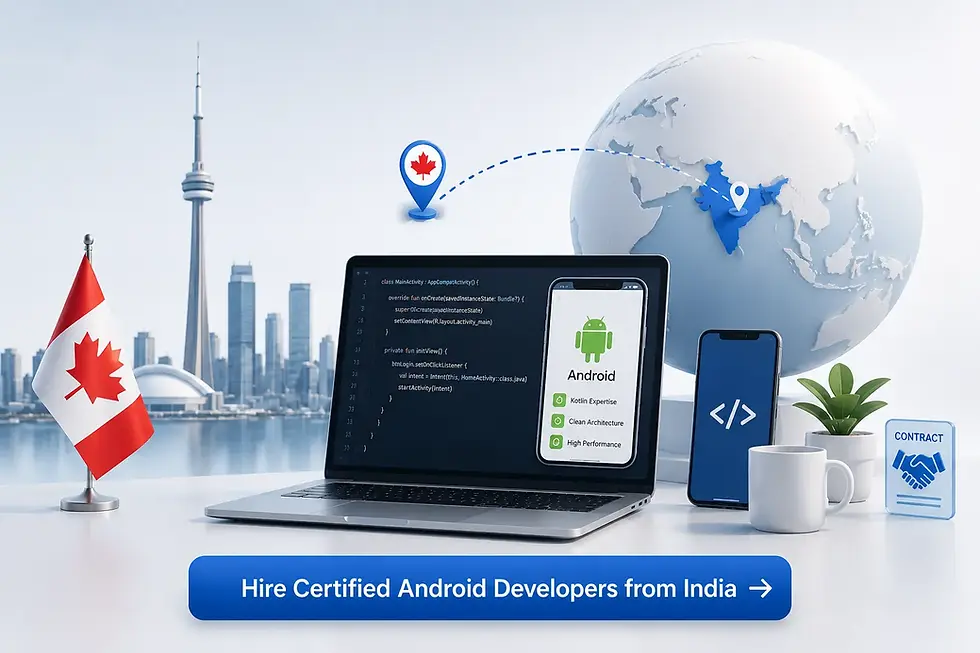
A senior Android engineer in Toronto now costs a company between CAD 118,000 and CAD 145,000 a year once you add CPP, EI, vacation pay, and benefits on top of base salary. That gap is exactly why Canadian firms hire Android Engineers from India on contract, and in our own mandates across Toronto, Vancouver, and Waterloo, we typically move from kickoff to a signed engineer inside four to six weeks.
This isn't a cost pitch dressed up as a trend piece. It's what we do every week: source, technically vet, and place Android engineers from India into Canadian product teams, on contracts that hold up under both Canadian and Indian compliance rules.
Why Are Canadian Companies Struggling to Fill Android Engineering Roles?
Toronto's fintech corridor, a growing healthtech and logistics app scene in Vancouver, and Waterloo's startup cluster all compete for the same narrow pool of Kotlin fluent engineers. Waterloo absorbs junior and mid level talent quickly through its university pipeline, which pushes senior Android hiring pressure back onto companies with no local bench to pull from.
We track open Android roles across Canadian job boards before every mandate, and the pattern holds steady: postings for senior Android engineers (five plus years, Kotlin, Jetpack Compose, CI/CD ownership) sit open far longer than equivalent backend roles. Companies that can't fill the seat locally either slow their release cadence or start looking offshore, and that's usually the point we get the first call.
There's also a currency dynamic at play. A softer Canadian dollar against the US dollar makes it harder for Canadian firms to compete with US based remote employers paying in USD for the same senior Android talent. Contract hiring from India sidesteps that wage inflation problem entirely, since Indian contract rates aren't tied to the CAD to USD exchange rate.
Where Does India's Android Engineering Talent Actually Come From?
Bengaluru remains the deepest pool for Android engineering specifically, not just mobile development broadly. Companies like Swiggy, PhonePe, Flipkart, and Meesho have trained a generation of engineers on production Android apps handling tens of millions of daily users. Pune runs close behind with a strong base of fintech and edtech Android engineers, and Hyderabad has built real depth in telecom and healthtech app backgrounds, useful if your Canadian product sits in either space.
This is exactly the talent base that Canadian firms hire Android Engineers from India on contract to tap into. Indian Android engineers from these ecosystems are almost always fluent in Kotlin, Jetpack Compose, MVVM or MVI architecture, and coroutine based concurrency, the stack most Canadian teams now standardize on. What we consistently see them lacking is exposure to accessibility compliance work. Ontario's AODA and the broader Accessible Canada Act push Canadian product teams toward WCAG compliant mobile UI in a way most domestic Indian apps simply never require.
We test for this directly. Every Android candidate we shortlist for a Canadian mandate goes through a live coding round retrofitting TalkBack support and content descriptions onto an existing screen, plus an architecture discussion on offline first sync patterns, since many Canadian requests, especially in logistics and field service apps, involve engineers working reliably across low connectivity zones.
What Does Contract Hiring Actually Mean for Canadian Firms Hiring Android Engineers from India?
Contract hiring is not a stopgap measure. It's a deliberate model that gives Canadian firms three things a full time local hire rarely can: speed, flexibility, and access to specialized skills that simply aren't available at scale in the local market. When Canadian firms hire Android Engineers from India on contract, they're not settling for less, they're buying faster access to a much wider talent pool.
Most of our Android mandates from Canadian clients fall within a $30 to $50 per hour budget, depending on seniority and specialization. That range comfortably covers mid level Android engineers through senior Kotlin and Jetpack Compose specialists, and it gives Canadian companies room to hire a broader mix of technology professionals (Android engineers, QA automation, backend, DevOps) without the fixed overhead of full time local salaries. Contracts can run project based, three to six months, or extend into ongoing engagements as the roadmap demands, and they scale up or down without the severance and notice obligations tied to permanent Canadian hires.
For engineering leaders, this flexibility matters as much as the cost. A Compose migration or an accessibility rebuild is often a defined, time bound piece of work. Contract hiring lets a Canadian team bring in exactly the specialized skill set that project needs, use it fully, and then reallocate budget once the work ships, rather than carrying a permanent headcount built around a temporary need.
What Legal and Compliance Rules Apply When Hiring Android Engineers from India on Contract?
The biggest compliance question Canadian HR and finance teams ask us is worker classification, and it depends on how the engagement is structured, not on one clean federal statute. If a Canadian company engages an Indian Android engineer directly, the risk isn't Canadian labour law, since the engineer isn't a Canadian resident, it's the Canada Revenue Agency's permanent establishment and withholding tests, alongside India's own classification standards under the Code on Wages.
The mistake we see most often: a founder signs an Indian engineer on a simple services agreement, pays month to month, and treats them functionally like an employee, fixed hours, exclusive engagement, performance reviews, without realizing this creates misclassification exposure on both sides.
The clean fix, and what AnjuSmriti sets up for nearly every Canadian mandate, is engaging the Android engineer through an Employer of Record (EOR), which formally employs the engineer in India, handles statutory compliance, and invoices the Canadian company as a single line item. This keeps the Canadian firm outside Indian employment law while giving the engineer full statutory protection.
Contractor vs EOR vs Staffing: Which Model Fits Your Android Hiring Needs?
Model | Who Employs the Engineer | Best Fit | Typical Start Time |
Direct contractor agreement | Self employed engineer | One engineer, short project under four months | Two to three weeks |
Indian EOR | Indian EOR entity | Ongoing role, six plus months, one engineer or small pod | Three to four weeks |
Staffing or contractual hiring through an agency | Agency employs, client directs work | Bulk Android hiring, two to ten engineers | Four to six weeks for the first hire |
Canadian entity with sponsorship | Canadian company | Rare for Android roles given the cost | Four to six months |
For a single senior Android engineer on a six to twelve month contract, most Canadian firms land on the EOR model. For teams building a full Android pod, often as part of a GCC setup, the staffing route tends to scale faster since the sourcing pipeline is already active.
How Does AnjuSmriti Structure the Hiring Process for Android Engineers?
When Canadian firms hire Android Engineers from India on contract through us, the process is built for speed without skipping vetting. Our standard timeline runs four to six weeks from kickoff to a signed engineer. Week one is role scoping with the hiring manager, since briefs that don't specify Compose versus View based UI, or CI/CD ownership expectations, produce weak shortlists.
Weeks two and three cover sourcing and our technical screen, including the accessibility and offline sync assessment described above, plus a mobile specific system design round covering state management at scale and background work scheduling. Week four is client interviews, followed by contract paperwork through the EOR structure, which typically closes within a week once terms are agreed.
A mid sized Toronto healthtech company needed two senior Android engineers to rebuild its patient facing app in Jetpack Compose while keeping AODA compliance intact, after its two in house engineers were fully allocated elsewhere. We shortlisted candidates from our Pune and Bengaluru networks for prior healthtech and accessibility adjacent experience.
One near miss stood out during reference checks: our first choice candidate tested strong technically but showed weak documentation habits, a real risk for a compliance sensitive rebuild with a small in house team. We swapped him for our second ranked candidate before client interviews. The team was fully staffed within five weeks, and the rebuilt app passed its next accessibility audit.
What Do Canadian Companies Actually Pay for Android Engineers from India on Contract?
Toronto and Vancouver salary bands for Android engineers, fully loaded with CPP, EI, vacation, and benefits, typically run from CAD 85,000 to CAD 100,000 for mid level engineers, CAD 118,000 to CAD 145,000 for senior engineers, and CAD 150,000 to CAD 175,000 for lead or staff level engineers.
Indian contract rates for equivalent experience generally fall within the $30 to $50 per hour range we mentioned earlier, inclusive of EOR statutory costs and agency fees. This covers mid level engineers at the lower end and senior Kotlin or Jetpack Compose specialists toward the top of that band. Most Canadian clients reinvest the savings into a second Android hire to build redundancy into a previously single threaded mobile team, or into a QA automation contractor to keep pace once the bottleneck engineer is no longer the constraint.
This cost gap is a core reason Canadian firms hire Android Engineers from India on contract rather than expanding local headcount alone. Workforce planning today also increasingly factors in AI assisted development tooling and cloud native release pipelines. Canadian firms hiring Android Engineers from India on contract are asking, more than before, whether candidates can work efficiently with AI pair programming tools and cloud based CI/CD systems, since that directly affects how much output a contract engineer delivers per hour billed.
Conclusion
Demand for contract Android engineers from India is climbing, driven by accessibility compliance deadlines under provincial legislation and by fintech and healthtech apps racing to complete Compose migrations before older View based codebases become a maintenance liability. In live mandates right now, we're seeing more Canadian clients ask for engineers with prior AODA or WCAG exposure specifically, rather than generic Android experience.
If your roadmap depends on Canadian firms hiring Android Engineers from India on contract to hit a release date, the fastest path isn't the cheapest headline rate, it's the shortest time to a properly vetted, compliant hire.
Interesting Reads:
FAQs
1.Does Ontario's AODA apply to apps built by contract engineers based in India?
Yes. AODA compliance applies to the product, not the location of the engineer. If your app serves Ontario users, it must meet accessibility standards regardless of where it's built, so a Canadian lead should still review pull requests for accessibility regressions.
2.Can a Canadian startup hire one Android contractor from India without an EOR?
Yes, for short, clearly scoped engagements under four months. Past that point, or if the relationship becomes exclusive and ongoing, an EOR structure is safer, since it reduces misclassification risk on both the Canadian and Indian sides.
3.How is IP ownership handled when the codebase is built by an Indian contract engineer?
IP assignment must be explicit in the contract, since default ownership rules differ between India and Canada. Every EOR and staffing contract we set up includes clauses assigning all code and assets to the Canadian client.
4.Which Canadian industries have the highest demand for contract Android engineers?
Fintech, healthtech, and logistics or field service apps generate most of our current mandates. Fintech and healthtech need AODA compliant UI, while logistics apps need offline first architecture built for low connectivity zones.
5.How much timezone overlap exists between India and Canadian teams?
IST is about ten and a half hours ahead of EST and twelve and a half hours ahead of PST. Toronto teams typically get two to three hours of daily overlap in the Indian evening, while Vancouver overlap is thinner, often just one hour.
6.What technical assessment is used before shortlisting an Android candidate?
Beyond a Kotlin and Compose coding round, candidates complete a live accessibility retrofit exercise and a system design discussion on offline first sync and background work scheduling, plus a portfolio review of documentation habits.
7.Do Indian Android engineers need a Canadian work permit for remote contract roles?
No. If the engineer stays physically in India and works remotely, no Canadian work permit is required, since they aren't entering the Canadian labour market. This is a key advantage over relocating talent.
8.What happens if a contract Android engineer underperforms mid mandate?
Our staffing and EOR contracts include a replacement guarantee, typically within the first 90 days, if a client isn't satisfied with technical output. Re-sourcing and re-screening happen at no additional placement fee within that window.
Comments