.png)


Hourly Hiring India vs Fixed Retainer Which Is Better for Your Business

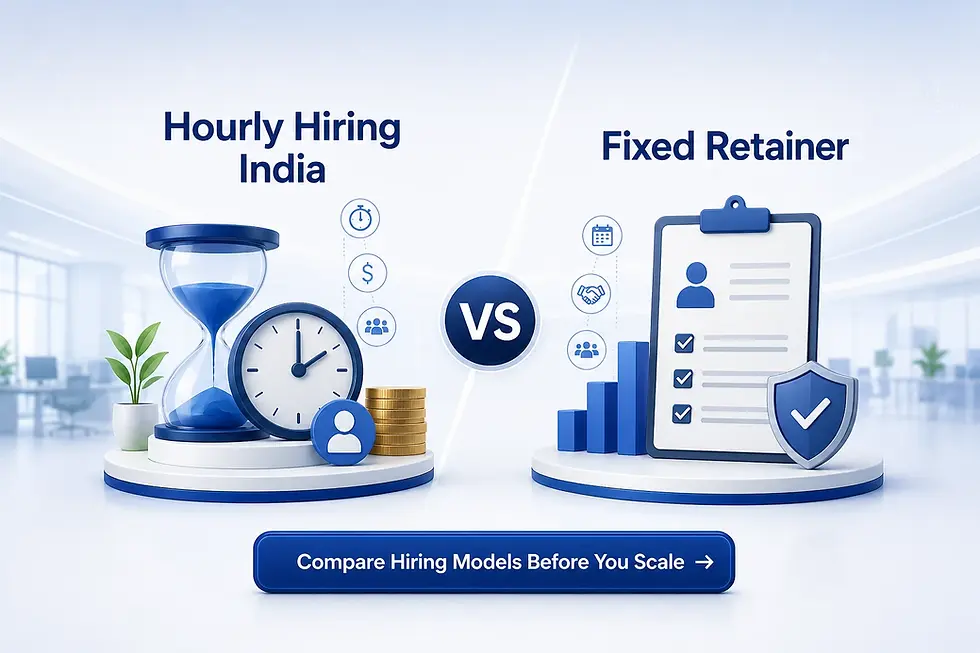
A mid-level Indian backend developer on an hourly contract typically bills between $18 and $28 an hour right now. The same engineer on a fixed monthly retainer, working exclusively for one client, usually costs between $1,800 and $2,600 a month, all-in. Run that math against a standard 160-hour work month and the retainer often wins on raw cost, but it loses on flexibility. That single trade-off decides hourly hiring India vs fixed retainer for most founders and hiring managers we talk to. It rarely comes down to which model looks cheaper on paper. It comes down to how predictable your workload actually is over the next two quarters.
Hourly Hiring India vs Fixed Retainer: What Is Actually Different?
Before comparing costs, it helps to separate the two hiring structures clearly, because many companies confuse pricing model with employment model.
Contract hiring means engaging a professional for a defined period or project, without adding them to your permanent headcount. The engineer can be billed hourly, weekly, or monthly, and the relationship ends when the contract term or scope ends. It gives companies speed and flexibility without long-term commitment.
Full-time hiring means bringing someone onto payroll as a permanent employee, with statutory benefits, notice periods, and an ongoing employment relationship that doesn't expire at the end of a project.
A fixed retainer sits between the two. The engineer isn't a permanent employee of your company, but they work exclusively for you every month under a predictable, recurring fee, usually through a contract hiring structure or an Employer of Record (EOR). Hourly billing, by contrast, is contract hiring priced by consumption rather than by time period. Both are forms of contract hiring; they simply price the same relationship differently.
Why Are Companies Rethinking Hiring Models Right Now?
Hiring patterns have shifted noticeably in the last couple of years. AI-assisted development tools have compressed how long routine coding tasks take, which means some clients now need fewer hours per sprint than they used to, making hourly billing more attractive for lighter workloads.
At the same time, cloud-native platform engineering, Kubernetes management, and data pipeline work have grown complex enough that companies want dedicated engineers who stay embedded in one codebase for months, which pushes them toward retainers instead.
Global Capability Centers (GCC) continue to expand out of Bengaluru, Hyderabad, and Pune, and most GCCs start with a retainer model for their core team before adding hourly-billed specialists for short bursts of work like security audits or platform migrations. We're also seeing more hybrid teams, where a company keeps two or three core engineers on retainer and brings in hourly contractors around product launches or seasonal spikes. This hybrid approach is becoming the default for teams that outgrow a single hiring model.
Which Indian Cities Suit Hourly Contracts vs Retainer Hires?
Bengaluru and Hyderabad produce the deepest pool of engineers comfortable with hourly billing. Both cities have a mature freelance and consulting culture around cloud, DevOps, and data roles, and engineers there are used to logging billable hours cleanly through tools like Harvest or Toggl.
Delhi NCR and Pune skew differently. Engineers there have typically spent their careers inside captive centers and product companies, and they tend to expect a fixed monthly relationship with a single reporting line. Many have never billed hourly before and need a short ramp-up period before they're comfortable tracking time with the discipline hourly billing requires.
What Indian engineers on hourly contracts often lack isn't technical skill. It's estimation discipline. Strong senior developers routinely under-quote a task by half simply because they've spent their careers in salaried roles where estimating time was never their responsibility. During vetting, we ask candidates to break a real client ticket into hour-level estimates, then compare that against how long the same ticket actually took to close in a past mandate. Candidates who under-estimate by more than 30 percent get routed toward retainer roles instead of hourly ones, because under-estimation on an hourly contract is what erodes client trust fastest.
What Does Indian Employment Law Say About Contract and Retainer Hiring?
The biggest compliance mistake we see foreign clients make is treating hourly-billed Indian contractors as casual freelancers with no legal exposure. Under the Contract Labour (Regulation and Abolition) Act, 1970, any arrangement where an Indian worker is supplied through an intermediary and works under the client's effective supervision can qualify as contract labour. That brings registration obligations for both the contractor and the principal employer, regardless of whether billing is hourly or monthly.
This is exactly why most engagements we run at AnjuSmriti Global go through an Employer of Record structure rather than direct invoicing. An EOR employs the engineer locally in India, manages Provident Fund and ESI contributions, applies the correct TDS deduction under Section 194J or 194C depending on classification, and issues GST-compliant invoices. Retainers sit cleanly inside this structure because the monthly cost is predictable and maps to a single invoice.
Hourly arrangements need slightly more diligence, since logged hours have to reconcile against each invoice every cycle. This is where clean payroll handling matters most, and sloppy hour reconciliation is the most common reason hourly clients dispute invoices a few months into an engagement.
Full-time hiring in India, by comparison, requires establishment registration under the relevant state's Shops and Establishments Act and comes with statutory notice periods and gratuity obligations once tenure crosses certain thresholds, none of which apply to short-term contract or hourly engagements.
Hourly vs Retainer Cost Comparison (Real Rates)
Here's the framework we walk every client through before choosing a model.
Seniority | Hourly Rate (USD) | Monthly Cost at 160 hrs | Fixed Retainer (Monthly, All In) | Best Fit |
Mid-level (3 to 5 yrs) | $18 to $28/hr | $2,880 to $4,480 | $2,200 to $2,900 | Retainer, if workload is steady |
Senior (6 to 9 yrs) | $32 to $45/hr | $5,120 to $7,200 | $3,600 to $4,800 | Retainer for core roles, hourly for audits |
Lead or Architect (10+ yrs) | $50 to $70/hr | $8,000 to $11,200 | $6,000 to $8,500 | Retainer, almost always |
The pattern holds at every level. Hourly billing only comes out cheaper than a retainer when actual utilization drops below roughly 100 to 110 hours a month. Above that, the retainer's built-in buffer stops mattering, and it becomes the cheaper option outright.
How Do You Decide Between Hourly Hiring and a Retainer?
Use this checklist before signing anything.
Do you have more than three months of confirmed, steady work for this role? Choose a retainer.
Is this a one-off project like an audit, migration, or proof of concept? Choose hourly.
Does the role require deep codebase context that takes weeks to rebuild? Choose a retainer.
Are you hiring more than five people for the same role at once? Choose a retainer and negotiate volume pricing.
Is this a trial before a permanent, full-time offer? Start hourly for four to six weeks, then convert.
For most teams weighing hourly hiring India vs fixed retainer for the first time, the honest starting point isn't the price sheet. It's mapping your next two quarters of workload before mapping your budget.
A Real Client Scenario: When Hourly Billing Stopped Making Sense
A Series B logistics SaaS company, roughly 80 employees, came to us wanting five backend engineers on hourly contracts to accelerate a platform rewrite they expected to finish in four months. We flagged early that a rewrite of that scope rarely stays contained to four months, and it didn't. By month three, billed hours had run well past projections, and the client's finance team assumed it meant the engineers were inefficient. It was a scoping problem, not a talent problem, and the client nearly walked away from the engagement over it.
We restructured three of the five roles onto a fixed retainer once it was clear the rewrite was becoming a permanent platform team, and kept two engineers on hourly billing for the remaining short-burst cleanup work. Monthly spend stabilized within 8 percent of forecast over the following two quarters, down from a swing of over 30 percent during the hourly-only phase.
Conclusion
Over the coming quarters, expect more companies to move toward hybrid structures: a core team on fixed retainers, with hourly-billed specialists brought in for defined sprints, rather than picking one model company-wide. In live mandates right now, roughly a third of new clients are requesting this hybrid setup from the start, up sharply from previous years, mainly because finance teams have been burned by pure hourly overruns and want predictability without losing flexibility. Comparing hourly hiring India vs fixed retainer isn't really a pricing exercise. It's a workload forecasting exercise wearing a pricing question's clothes.
If you want a cost breakdown specific to your roles, timeline, and target Indian city, start that conversation here.
Interesting Reads:
FAQs
1.Is hourly hiring cheaper than a fixed retainer for Indian developers?
Only when utilization stays below roughly 100 to 110 hours a month. Above that, the retainer's built-in buffer makes it cheaper overall. Hourly billing works best for light, unpredictable workloads. Retainers work best once a role is consistently busy more than half the month, which is the more common pattern for core engineering roles.
2.What is the average hourly rate for Indian software developers right now?
Mid-level developers typically bill $18 to $28 an hour, senior engineers $32 to $45, and lead or architect-level talent $50 to $70. Rates vary by city, stack, and specialization, with Bengaluru and Hyderabad generally commanding a premium for cloud and DevOps expertise compared to other tech hubs.
3.Can a foreign company hire Indian developers without registering a local entity?
Yes, through an Employer of Record. The EOR becomes the legal employer in India, handling payroll, statutory contributions, and compliant invoicing, while the engineer works exclusively for the client. This avoids the cost and delay of setting up a local entity for a small team.
4.Does Indian labour law apply to hourly-billed contractors?
Yes. The Contract Labour Act can apply based on supervision and integration into the client's team, not on how billing is structured. Companies that treat hourly contractors as casual freelancers without proper registration often discover the gap during a compliance audit, well after the engagement has started.
5.How long does it take to hire a contract developer from India?
Hourly-billed contract roles typically fill in 9 to 12 working days from mandate kickoff to start date. Retainer roles usually take 12 to 15 days, since screening is heavier and often includes a paid trial task before a final offer is made.
6.Can hourly contractors convert to full-time employees later?
Yes. Most contracts include a conversion clause from the start, often with a small fee if conversion happens within the first 90 days, waived after that. If the engineer is already employed through an EOR, only the billing and contract terms need to change, not the underlying employment structure.
7.What is included in a fixed retainer cost for Indian tech talent?
A retainer typically covers base compensation, employer Provident Fund and ESI contributions of roughly 13 percent, agency fees of 15 to 20 percent of CTC, and an EOR fee if applicable. For a mid-level engineer, total client cost usually lands between $2,200 and $2,900 a month.
8.Which hiring model is better for short-term projects?
Hourly billing suits short, defined projects like audits, migrations, or proof-of-concept work, since you only pay for hours actually used. Retainers make more sense once a project extends past three months or requires an engineer to hold deep, ongoing context across sprints.
Comments