


How Does the 50% Wage Rule Impact India Payroll for US Firms?

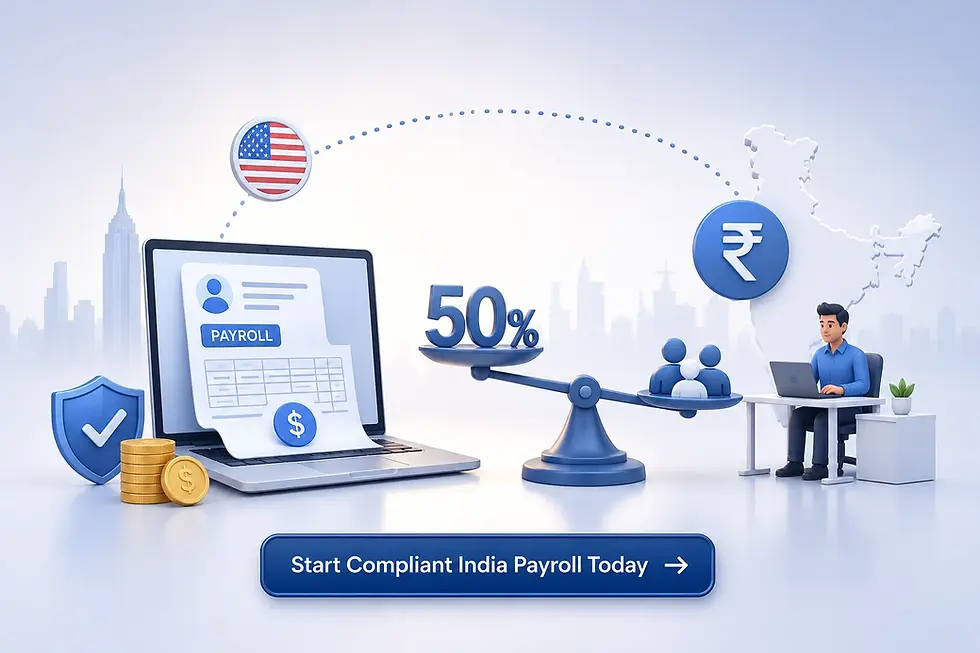
Since the notification date on which the labour codes took effect, every company running payroll in India has had to answer one question before it runs its next salary cycle: is basic pay plus dearness allowance at least 50% of total remuneration? That single line, written into Section 2(y) of the Code on Wages, is the reason the 50% wage rule impact India payroll for US firms now has to plan around is showing up in board decks, not just HR memos.
We have restructured CTC for a dozen US headquartered clients since the codes came into force. If your Indian entity, GCC, or EOR employed team is still running the old CTC structure, basic pay at 30 to 35%, the rest split across HRA, special allowance, and flexible benefits, you are already out of compliance, even if no inspector has flagged it yet.
Why Are US Companies Feeling the 50% Wage Rule Impact on India Payroll Right Now?
US clients with captive GCCs in Bengaluru and Pune, and founders who hire through an Indian employer of record specifically to avoid setting up an entity, both assumed the labour codes were "eventually" law, the kind of reform that gets announced and delayed for a decade. That held for six years. It stopped holding when the Ministry of Labour and Employment notified all four codes, the Code on Wages, the Industrial Relations Code, the Code on Social Security, and the Occupational Safety, Health and Working Conditions Code, as effective law, repealing the 29 statutes they replaced.
Central rules were still being finalized through the early part of this year, with the government targeting full operational enforcement by April 1, and several states publishing their own timelines separately. That staggered rollout is exactly why finance teams keep getting caught off guard: the codes are law, but "enforceable" and "fully clarified" are not the same thing, and a structure that passed muster last quarter may not survive a PF audit this year.
US SaaS companies with 40 to 150 person India teams are the most exposed, because they historically kept basic salary low, often 25 to 30% of CTC, specifically to cap employer PF contributions. That is the exact design the rule was written to close, and it is the clearest example of the 50% wage rule impact India payroll for US firms are budgeting around this quarter, which is why Bengaluru and Pune tech employers are running compressed restructuring timelines.
How Is the India Talent Pool Responding to This Change?
The wage rule does not change who is available to hire. Bengaluru, Hyderabad, and Pune still have the deepest bench for backend, cloud, and data engineering roles, and Delhi NCR and Chennai remain strong for enterprise and SAP adjacent talent. What it changes is the offer letter conversation candidates now expect.
Indian engineers who have worked at three or more employers are increasingly wage code literate. Candidates in Bengaluru and Hyderabad routinely ask recruiters to break down basic versus allowances before accepting an offer, because they have already seen take home pay shift at their current job. A senior engineer comparing two offers at the same gross CTC will pick the one with the more sustainable basic ratio if nobody explains why the low basic structure will not hold up.
What candidates typically do not bring, regardless of city, is payroll literacy specific to how their own compensation is computed, nor should they need to. Every offer package we build for a US client now includes a plain language basic versus allowance breakdown, because candidates who do not understand a lower in hand figure will walk.
What Does Section 2(y) of the Code on Wages Actually Change?
Section 2(y) defines "wages" as basic pay, dearness allowance, and retaining allowance where applicable, and separately excludes HRA, conveyance allowance, statutory bonus, overtime, commission, and gratuity. The operative rule: if excluded components exceed 50% of total remuneration, the excess gets added back into "wages" for statutory calculations. In practice, basic pay has to sit at or above 50% of CTC for most standard structures, which is the core of the 50% wage rule impact India payroll for US firms now has to design around from the first offer letter.
That reclassification hits two numbers every US finance team watches. Employer PF contributions, 12% of basic wages under the EPF framework now folded into Chapter III of the Code on Social Security, are calculated on a larger base, raising monthly statutory cost even when gross CTC stays flat. Gratuity under Section 53 of the same code uses the same expanded wage definition, raising accrued liability on the balance sheet, particularly for employees nearing gratuity eligible tenure.
The mistake we see most often is treating this as an HR only exercise. A mid size fintech client restructured its Bengaluru team using a template pulled from a vendor post online, without recalculating PF and gratuity provisioning, and its India controller flagged a six figure INR gap in accrued liability during the audit they thought they had prepared for. Whether payroll runs direct, through outsourcing, or via an EOR, the restructuring needs someone who can run PF and gratuity numbers alongside the HR changes, not after them.
What Does a Code on Wages Compliant CTC Structure Look Like?
Component | Older Typical Structure | Compliant Structure |
Basic + DA (share of CTC) | 25% to 35% | Minimum 50% |
HRA, conveyance, special allowance combined | 45% to 55% | Capped at or below 50% |
Employer PF contribution base | Low, basic only | Higher, since basic is larger |
Gratuity accrual base | Understated in legacy models | Recalculated on higher basic |
Employee take home (short term) | Higher, low PF deduction | Typically 3% to 7% lower |
Employer statutory cost (PF + gratuity) | Lower | Higher, even at flat CTC |
Three things this table does not capture: annual performance incentives are treated separately from "wages" for statutory calculation, retrospective PF recovery is not required under current clarifications, and multi state employers need a state by state tracker because rule finalization has not moved at the same pace everywhere.
How Do US Companies Roll This Out Without Getting It Wrong?
Our engagement runs on a fixed sequence: audit the current CTC breakdown for every India employee, model the compliant ratio against updated PF and gratuity liability, present the finance impact to the US side CFO before offer letters change, then roll out revised structures with a written explanation employees can actually read. A payslip that suddenly shows lower take home pay with no explanation generates support tickets and attrition risk in equal measure.
One case stays with us: a US enterprise software company with roughly 90 employees across its Pune GCC came to us already mid restructuring, having built its own compliant model in house. The 50% ratio was correct. What it missed was recalculating gratuity accrual for employees who had already crossed four years of tenure, since the higher basic wage meant their gratuity provision at exit would be materially higher than budgeted.
Our team at AnjuSmriti Global caught this during a compliance review two weeks before their board reporting cycle, rebuilt the provisioning model, and helped the client avoid a restated liability line. Their year one recompliance cost came in at roughly ₹38 lakh in additional statutory provisioning across the 90 person team, money better known early than discovered mid cycle. For clients hiring net new, we build the compliant structure into the offer template from day one, so there is no retroactive fix required.
Contract Hiring vs Full Time Hiring: How Does the Rule Apply Differently?
US companies scaling India teams typically choose between direct full time employment through an entity or EOR, and contract based engagement through staffing partners. The wage rule treats these differently in theory and more similarly in practice than most founders expect.
For full time employees, the 50% threshold is unambiguous: basic plus dearness allowance sits at or above half of total remuneration, and PF and gratuity flow directly from that figure.
Contract hiring is where the confusion lives. Genuine independent contractors, engaged outside an employer employee relationship, sit outside the wage definition entirely. But a large share of "contract" arrangements in Indian IT staffing function close enough to employment, fixed hours, exclusive engagement, day to day direction, that misclassification risk is real. When that line is crossed, labour authorities can look past the contract label to the substance of the relationship, and the same PF and gratuity exposure that applies to full time staff follows.
What Does This Actually Cost in Real Numbers?
For a Bengaluru based software engineer, assuming a CTC neutral restructuring where gross pay stays flat and the internal split gets rebuilt:
Mid level engineer, CTC ₹18,00,000 per year. Basic rises from about ₹5,40,000 to ₹9,00,000. Employer PF contribution rises from about ₹64,800 to ₹1,08,000 annually.
Senior engineer, CTC ₹32,00,000 per year. Basic rises from about ₹9,60,000 to ₹16,00,000. Employer PF contribution rises from about ₹1,15,200 to ₹1,92,000 annually.
Lead or architect, CTC ₹55,00,000 per year. Basic rises from about ₹16,50,000 to ₹27,50,000. Employer PF contribution rises from about ₹1,98,000 to ₹3,30,000 annually.
Layer on gratuity provisioning, any EOR management fee, and a placement or retained search fee, and added statutory cost typically lands between 2.5% and 4% of gross CTC per employee in year one, not the double digit swing some vendors quote to rush clients into restructuring.
Most of our clients reinvest the certainty this buys, a defensible, audit ready payroll structure, into faster hiring elsewhere, since restructuring once, correctly, means every later hire uses a template that is already compliant.
What Should US Companies Expect Over the Next 12 to 18 Months?
State rule notification is still catching up to the central framework, and we expect the coming months to bring tighter enforcement rather than further delay, since India's labour ministry has shown no appetite for another multi year postponement after six years of waiting. For US firms, offer letter transparency around basic versus allowance splits is becoming a candidate expectation, particularly among senior Bengaluru and Hyderabad engineers who have already seen their own pay restructured once.
More clients are now asking us to build the 50% wage rule impact India payroll for US firms directly into their standard offer template, rather than treating it as a one time fix, which tells us this has moved from a recent regulatory change to a permanent design constraint for anyone hiring in India, whether through a captive GCC, an EOR relationship, or a blended team of full time staff and contract specialists.
If your India payroll has not been rebuilt against the current wage definition, the honest next step is a structured audit before your next PF filing, not your next annual review. Book a payroll compliance review with our team.
Interesting Reads:
FAQs
1.Does the 50% wage rule apply to Indian employees hired through a US firm's EOR, or only to direct entities?
It applies either way. The Code on Wages defines "wages" for statutory purposes regardless of who is technically the employer of record. If your India team is engaged through an EOR, its payroll must still meet the 50% basic to CTC threshold, with PF and gratuity calculated on that same expanded base. Not every EOR provider had rebuilt its salary templates when the codes took effect, so confirm this in writing rather than assuming it is handled.
2.Will restructuring salaries to meet the 50% rule change an employee's gross CTC?
Not necessarily, and in most engagements it does not. A CTC neutral restructuring keeps total annual cost the same while shifting the internal split, raising basic pay and lowering the allowance components that used to make up most of the package. What changes is take home pay, since a larger basic wage means a larger PF deduction from the employee's side too, typically 3% to 7% lower monthly in hand pay.
3.How does the 50% wage rule affect gratuity liability for a US company's India entity?
Gratuity under Section 53 of the Code on Social Security is computed on the same wage definition the 50% rule sets, so a higher basic wage produces a higher gratuity accrual per employee, particularly for staff with several years of tenure. For US finance teams, this shows up as an increased accrued liability line on the India entity's books, not a cash outflow until an employee actually exits, which is why recalculating it early matters.
4.Do annual bonuses or sign on incentives count toward the 50% wage calculation?
Current Ministry of Labour clarifications treat annual performance based incentives as separate from "wages" for the statutory calculation, so they do not need to be folded into the basic versus allowance ratio. Sign on bonuses are usually treated the same way when structured as one time, non recurring payments. State level interpretation has varied here, so verify against the specific state's notified rules for multi state teams.
5.Which Indian cities are seeing the fastest wage rule driven restructuring among US GCCs?
Bengaluru and Pune are moving fastest, largely because they carry the highest concentration of mid size and enterprise US GCCs with headcounts above 50, making the statutory cost impact material enough to push early restructuring. Hyderabad follows closely, driven mostly by US fintech and SaaS captives. Delhi NCR and Chennai employers have moved slower, partly because they are still waiting on state specific rule finalization.
6.Is retrospective PF recovery required for salary structures that were not compliant before the codes took effect?
Based on current Ministry of Labour clarifications, retrospective recovery of PF contributions for the period before compliant restructuring is not required. What matters going forward is that your structure is compliant from the point of implementation onward. That is meaningful relief for US clients worried about backdated liability, though it is not a reason to delay, since the gap only grows the longer restructuring waits.
7.How should a US company handle basic wage restructuring for contract based Indian developers versus full time employees?
The underlying wage definition applies to how compensation is structured for statutory purposes regardless of contract framing, so contract engineers are not automatically exempt. Genuine independent contractors engaged outside an employer employee relationship sit outside this rule, but many "contract" arrangements in Indian IT staffing function close enough to employment that misclassification risk is real and worth reviewing before assuming exemption.
8.What happens if a US firm's India payroll vendor has not updated its salary templates for the new wage definition?
You inherit the compliance gap, not the vendor. Several payroll and EOR providers were still running pre code salary templates well after the codes took effect, while central and state rules were finalized. Responsibility for statutory compliance sits with the employer of record, not the software processing the payroll, so get written confirmation that current employee structures meet the 50% threshold.
Comments