.png)


How Much Take-Home Pay Will an Employee in India Receive From Their CTC?

Updated: Aug 9
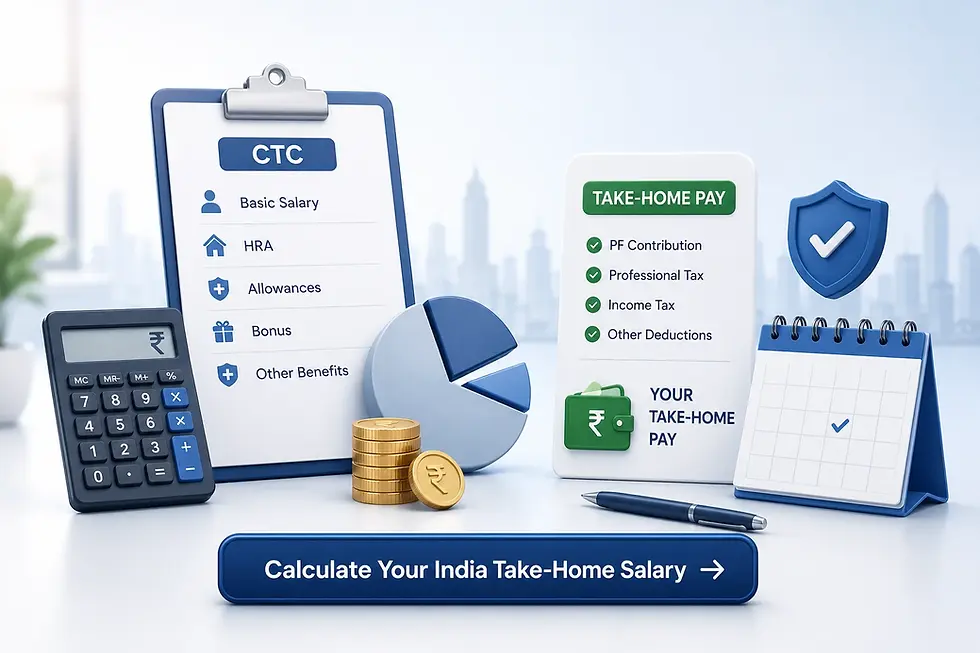
On a ₹12,00,000 CTC offer in Bengaluru or Delhi, an employee typically takes home close to ₹80,000 a month, near 80 percent of the annual figure on the offer letter. On a ₹35,00,000 CTC, that ratio falls to around 73 percent because India's income tax is progressive. This is the exact question every HR team asks before finalising an India based offer: how much take-home pay will an employee in India receive from their CTC? We answer this question in nearly every mandate we run for overseas companies, and the answer follows a predictable structure once you understand where the deductions actually come from.
Why Does CTC Confuse Global Employers Hiring in India?
CTC, or Cost to Company, is not a salary. It is the employer's full annual spend on an employee, and Indian pay structures bundle in items that Western payroll systems usually keep separate, such as retirement contributions and gratuity. A US or European employer used to a base salary plus benefits model often assumes CTC equals take-home pay, then discovers the actual bank credit is 20 to 30 percent lower.
We see this most with companies building their first India based team, especially now that AI, cloud infrastructure, and platform engineering roles are pulling more global companies into direct India hiring instead of routing everything through outsourcing vendors. As more Global Capability Centers (GCC) open in Bengaluru, Hyderabad, and Pune, and as companies mix full-time hires with contract talent to move faster, CTC transparency has become a bigger factor in whether a candidate accepts an offer at all. In metro cities where rent can absorb a quarter of take-home pay, candidates now check the CTC breakup carefully before responding.
What Components Make Up an Indian Employee's CTC?
An Indian CTC is typically built from five parts: basic salary, house rent allowance, employer provident fund contribution, gratuity accrual, and variable pay.
Basic salary usually sits between 35 and 50 percent of CTC and is the base used to calculate several other components. House Rent Allowance, commonly 40 to 50 percent of basic in metro cities, is paid monthly and counts fully toward take-home pay. Employer provident fund, fixed at 12 percent of basic under law, is part of CTC but never appears in the employee's bank credit.
Gratuity, close to 4.81 percent of basic, is set aside as a future payout that reaches the employee only after five years of continuous service. Variable pay, usually 8 to 15 percent of CTC for technical roles, is taxed in the year it is actually paid rather than spread evenly.
This structure changes depending on whether the person is hired full-time or brought on through contract hiring. A full-time employee's CTC includes provident fund and gratuity as ongoing statutory obligations, while a contractor engaged through a compliant contract hiring model is usually paid a flat monthly rate without these long-term accruals, which is why contract CTC figures and full-time CTC figures are rarely directly comparable.
How Much Take-Home Pay Will an Employee in India Receive From Their CTC Under Indian Law?
Three laws determine what actually reaches an employee's bank account each month.
The Employees Provident Fund and Miscellaneous Provisions Act, 1952 requires a 12 percent employee contribution on basic salary, deducted before the salary is paid out. This is usually the single largest gap between CTC and take-home pay.
The Payment of Gratuity Act, 1972 requires employers to set aside roughly 15 days of basic salary per year of service, payable only after five years, so it never reduces monthly take-home pay even though it sits inside CTC. The Payment of Wages Act, 1936 requires every offer letter to itemise these components clearly instead of quoting one lump figure.
Income tax, governed by the Income Tax Act, 1961, is the other major factor. Under the current new tax regime, salaried employees pay little to no tax on total income up to roughly ₹12.75 lakh after the standard deduction, which is why CTC bands in that range now retain a noticeably higher share of take-home pay than higher bands do. The most common compliance mistake we see foreign employers make is skipping a properly itemised offer letter, particularly for contract or remote hires, which creates real exposure under Indian labour law regardless of company size.
CTC to Take-Home Pay Table: Mid, Senior, and Lead Level Salaries
Figures below use Bengaluru based fixed to variable ratios under the current new tax regime.
CTC (Annual) | Level | Monthly Basic | Employer PF and Gratuity (inside CTC) | Approx. Monthly Tax | Approx. Monthly Take Home | Take Home as % of CTC |
₹12,00,000 | Mid level, 5 to 8 years | ₹40,000 | about ₹6,700 | close to ₹0 to 1,000 | about ₹79,000 to 80,000 | around 80% |
₹22,00,000 | Senior, 8 to 12 years | ₹73,333 | about ₹12,300 | close to ₹13,000 | about ₹1,32,000 | around 78 to 79% |
₹35,00,000 | Lead or Principal, 12+ years | ₹1,16,667 | about ₹19,700 | close to ₹33,000 | about ₹1,81,000 | around 73 to 74% |
The pattern is consistent across every mandate we run: as CTC rises, the take-home percentage falls, because India's tax slabs are progressive and the tax-free threshold mainly protects lower bands. This table is the clearest way to show a candidate or a client how much take-home pay an employee in India will receive from their CTC before an offer goes out.
How We Help Companies Set the Right CTC Structure
At AnjuSmriti Global, we run a short compensation check before any offer goes out. We benchmark the fixed monthly component against current city level data, confirm provident fund, gratuity, and tax treatment are itemised correctly, and walk the client through a take-home projection so nothing surprises the candidate on their first payslip.
One case stayed with us. A European SaaS company hiring its first India based engineer through an EOR structure built a CTC using a UK style template, with 35 percent of the package as an annual retention bonus. The candidate, six years into a Bengaluru product company career, worked out the fixed monthly component in minutes and questioned why the effective take-home was far lower than a competing offer with a similar headline CTC. The offer nearly fell through until the client rebalanced the structure toward fixed pay. The candidate accepted within a day.
The same care applies whether a company is hiring full-time or building a contract team. Full-time offers need a clean CTC breakup with provident fund and gratuity clearly shown, while contract hiring needs a transparent flat rate with no ambiguity about what is and is not included, so both sides know exactly how much take-home pay an employee in India will receive from their CTC or contract rate before signing.
What Does CTC Actually Cost the Employer?
For most Indian offers, CTC already includes employer provident fund and gratuity, so it sits close to the full cost of employment on the salary side. What sits outside CTC depends on the hiring model. An Employer of Record (EOR) typically charges 8 to 15 percent of CTC on top of salary for compliant payroll and statutory filing, while a one time agency placement fee, usually 8.33 to 16.67 percent of first year CTC, applies once at the point of hire.
Companies moving from a Western base plus bonus model to this fully loaded India model typically see 45 to 65 percent lower total cost at senior levels compared with a similar US or UK hire, and most reinvest that difference into growing the team.
Conclusion
Compensation structuring in India keeps shifting as tax rules evolve and companies lean harder into AI, cloud, and platform roles that command premium CTC bands. We are seeing more clients ask for a take-home projection built into every offer letter before it goes out, rather than after a candidate pushes back, and that shift is becoming standard practice as more global companies hire directly into India through EOR and contract models instead of opening a full entity.
If you are structuring your first India based offer and want a take-home projection built for your CTC band, start here.
Interesting Reads:
FAQs
1.Does Provident Fund reduce take-home pay every month, or only above a certain salary?
Yes, every month once an employee is enrolled. Employers deduct 12 percent of basic salary as the employee's PF contribution before paying the rest into the bank account. Most IT and tech employers apply this on the full basic salary as standard practice, which makes it the largest recurring gap between CTC and take-home pay for most salaried professionals in India.
2.Why does take-home pay change year to year even when CTC stays the same?
Two reasons usually explain this. Variable pay tied to performance ratings is not always paid out in full, so actual take-home can fall short of the CTC assumption. Income tax slabs and rebate thresholds also change with each budget cycle, so take-home pay can shift even with zero change to CTC, role, or performance.
3.What is the real difference between CTC and gross salary on an offer letter?
Gross salary is every cash component actually paid before deductions, including basic, HRA, and any disbursed bonus. CTC adds non-cash employer costs like provident fund and gratuity, which never reach the employee as a monthly credit. A clear offer letter should show both figures separately, not just one combined CTC number.
4.How does the new tax regime affect take-home pay for salaried employees in India?
It generally raises take-home pay for employees with fewer eligible deductions, since the new regime uses lower slab rates and a higher rebate threshold. Employees who rent in metro cities or invest heavily under old regime exemptions may still come out ahead on the old regime, so it is worth comparing both before assuming one is universally better.
5.Do performance bonuses count toward CTC even if the company misses its targets?
Bonuses are included in CTC as a target figure, not a guarantee. If a company pays out only part of the target bonus, actual take-home pay will fall short of the quoted CTC for that year, even though the contract terms have not changed. This is why we recommend keeping variable pay modest for technical roles.
6.Does ESI apply to mid-level or senior IT professionals in India?
Generally no. The Employees State Insurance Act applies to employees earning up to ₹21,000 gross per month, well below typical mid-level or senior tech salaries. ESI is more relevant for support staff or entry-level roles below that threshold, so it rarely factors into take-home pay calculations for engineering or product roles.
7.Does professional tax reduce take-home pay differently across Indian states?
Yes, slightly. States like Karnataka, Maharashtra, and West Bengal levy a small monthly professional tax, often around ₹200, capped near ₹2,500 a year. Other states, including Delhi, do not levy it at all. It is a minor deduction compared with provident fund or income tax, but it does create small city-to-city differences in take-home pay.
8.What happens to gratuity if an employee leaves before completing five years?
Gratuity accrues throughout employment as part of CTC, but under Indian law it is only payable after five years of continuous service, with limited exceptions. Employees who leave earlier forfeit the accrued amount entirely. It has no effect on monthly take-home pay while employed, since it is never deducted from or added to the regular payslip.
Comments