.png)


India Employer of Record (EOR) for EU Companies: How to Stay GDPR & Labor Law Compliant

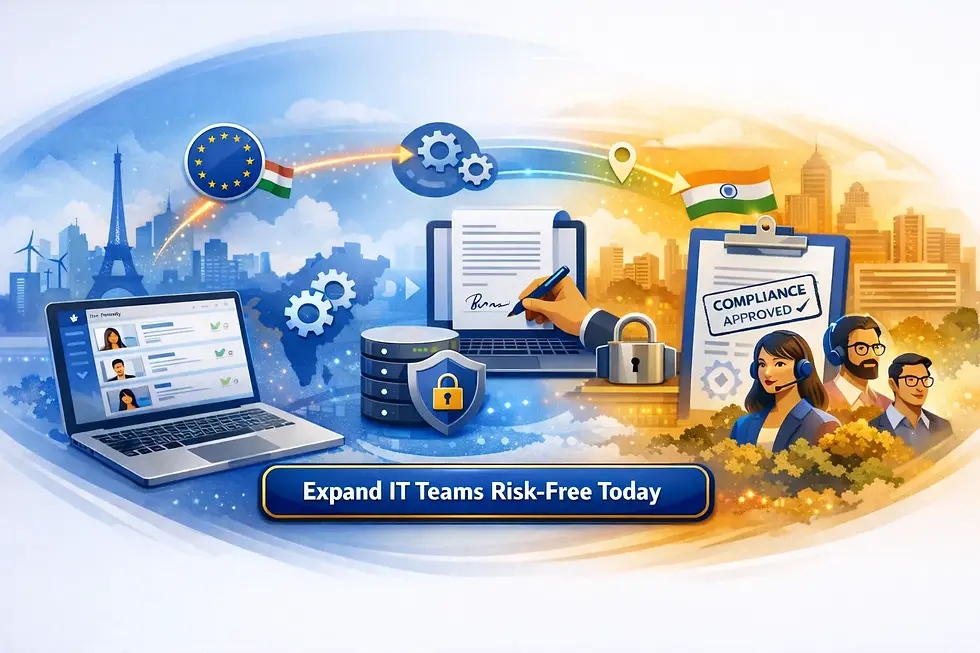
Expanding into India looks straightforward when viewed from a boardroom in Berlin, Paris, Amsterdam, or Stockholm. Access to highly skilled developers in Bengaluru, data engineers in Hyderabad, artificial intelligence specialists in Pune, and cybersecurity professionals across NCR makes India a natural extension of your growth strategy. Cost efficiency, time zone advantages, and technical depth further strengthen the case.
Yet once hiring discussions begin, complexity surfaces quickly.
You start asking practical questions.
Can we legally employ people in India without setting up a subsidiary?
How do we remain compliant with General Data Protection Regulation obligations while processing employee data outside the European Union?
Which Indian labor laws apply to our remote team?
What risks do we face if payroll or statutory filings are incorrect?
For many European Union companies, especially information technology businesses, Global capability center (GCC) leaders, and hiring managers expanding remote engineering teams, cross border employment feels less like a growth opportunity and more like a compliance maze.
You are not simply recruiting software developers skilled in Java, Python, React, Angular, SAP, Salesforce, cloud platforms like Amazon Web Services and Microsoft Azure, or cybersecurity frameworks. You are entering a dual regulatory environment that requires adherence to European data protection standards and Indian employment legislation. A single oversight can create exposure in both jurisdictions.
This is where an India Employer of Record (EOR) for EU companies becomes a structured, risk managed, and scalable solution rather than just an administrative convenience.
At AnjuSmriti Global, we support organizations that are scaling remote teams, establishing Global capability center (GCC) operations, hiring in bulk, expanding new offices, and building leadership pipelines in India. We manage the complete human resources function so you can concentrate on innovation, engineering delivery, and market expansion.
If you are evaluating your India expansion strategy and want clarity on compliance, workforce structure, and cost implications, you can share your requirements with us here.
Let us explore what staying compliant truly involves when hiring in India through an Employer of Record (EOR).
How does an India Employer of Record (EOR) for EU companies ensure General Data Protection Regulation and Indian labor law compliance simultaneously?
When your headquarters is in the European Union, compliance with the General Data Protection Regulation is mandatory. Responsibility does not disappear simply because your employees are located in India. Data related to contracts, payroll, identification numbers, attendance, performance reviews, and benefits still falls under regulatory scrutiny.
Many companies struggle with concerns such as:
• Where is employee data stored and processed?
• Are data processing agreements structured correctly?
• Is there a lawful basis for cross border data transfers?
• Who has access to sensitive information?
Without proper safeguards, even routine human resources processes can create exposure.
An India Employer of Record (EOR) for EU companies addresses these risks through structured compliance mechanisms. As the legal employer in India, we handle employment contracts aligned with Indian labor law while ensuring documentation and data handling processes reflect General Data Protection Regulation standards.
Our approach includes:
• Secure payroll coordination and structured human resources information systems
• Clearly defined data access controls
• Lawful employment documentation and audit trails
• Transparent statutory reporting and record maintenance
• Proper classification of employment relationships
This framework allows you to maintain operational control over your Indian team while we ensure local compliance and structured data governance.
What Indian labor laws must EU companies understand before hiring in Bengaluru or other Indian cities?
India’s labor ecosystem is comprehensive and state sensitive. Regulations differ across regions, and compliance requirements vary depending on employee count, compensation structure, and business activity.
When hiring in Bengaluru or setting up a Global capability center (GCC), you need to consider:
• Registration under the Shops and Establishments Act
• Provident Fund contributions
• Employee State Insurance obligations
• Professional Tax compliance
• Gratuity eligibility and calculation
• Statutory bonus requirements
• Leave entitlements including earned leave and maternity benefits
• Notice periods and lawful termination procedures
Termination compliance in particular is frequently underestimated. Improper exit management can lead to disputes, reputational risk, and operational disruptions.
Through an India Employer of Record (EOR) for EU companies, we manage:
• Drafting compliant employment agreements
• End to end employee lifecycle management from onboarding to exit
• Payroll processing with accurate statutory deductions
• Attendance and leave tracking systems
• Labor law filings and documentation
• Structured exit processes including full and final settlements
We have assisted companies that initially hired independent contractors in India without understanding classification risks. After identifying potential compliance exposure, we transitioned those teams into legally compliant employment structures while protecting business continuity.
Why do European technology companies and Global capability center (GCC) leaders choose an India Employer of Record (EOR) for remote and bulk hiring?
Speed to hire often determines competitive advantage. If your product roadmap depends on scaling engineering teams quickly, administrative delays can become costly.
Consider a scenario where your organization needs:
• Frontend engineers proficient in React or Angular
• Data engineers working with Python and Snowflake
• DevOps professionals managing Kubernetes and cloud infrastructure
• Cybersecurity analysts for risk mitigation
• Local leadership for operations management
Setting up a legal subsidiary in India involves incorporation processes, regulatory registrations, bank account setup, compliance audits, and ongoing governance obligations. These steps require time and capital before your first employee even begins working.
An India Employer of Record (EOR) for EU companies provides a compliant alternative. You can hire legally without establishing a local entity while maintaining agility and cost predictability.
This model allows you to:
• Onboard employees quickly
• Scale workforce numbers based on business demand
• Ensure statutory contributions are handled accurately
• Reduce administrative overhead
• Test the Indian market before long term structural commitments
For companies building a Global capability center (GCC), this approach often serves as a bridge between pilot hiring and full entity establishment.
How can companies building teams from scratch in India reduce risk and improve retention?
Entering a new talent market without local insight can create avoidable friction. Compensation structures, benefits expectations, and workplace culture differ significantly across geographies.
Common questions we hear include:
What is the appropriate cost to company structure in India?
How should salary components be split between fixed and variable pay?
Which benefits are competitive in Bengaluru’s technology ecosystem?
How should performance appraisals be structured for local teams?
Through our end to end human resources consulting model, we support:
• Compensation benchmarking aligned with Indian market standards
• Policy drafting and standard operating procedures
• Structured performance review systems
• Employee engagement and retention strategies
• Dedicated human resources support for employees
Organizations hiring in bulk, opening new offices, or expanding remote teams benefit from having consistent human resources governance from day one. That structure not only protects compliance but also strengthens employer branding in a competitive talent market.
How does an India Employer of Record (EOR) for EU companies reduce expansion risk while maintaining flexibility?
Decision makers often evaluate three options: hiring contractors, establishing a subsidiary, or partnering with an Employer of Record (EOR). Each model carries different risk profiles.
Contractor engagement may appear simple, yet misclassification can create legal exposure. Entity setup offers control but demands time and administrative commitment.
An India Employer of Record (EOR) for EU companies provides a balanced solution by combining legal compliance with operational flexibility.
With this model, you gain:
• Immediate legal employment capability
• Structured payroll and statutory compliance
• Reduced exposure to misclassification risks
• Flexibility to scale up or down
• A pathway to future entity transition if required
We have supported European Union organizations facing talent shortages in their domestic markets. By building engineering and product teams in India under a compliant framework, they sustained delivery timelines without compromising regulatory obligations.
What makes AnjuSmriti Global a trusted India Employer of Record (EOR) for EU companies expanding into India?
Selecting an Employer of Record (EOR) partner involves trust. You are entrusting regulatory compliance, payroll accuracy, statutory reporting, and employee experience to an external specialist.
At AnjuSmriti Global, our model is built around:
• Deep expertise in Indian labor law and statutory compliance
• Experience working with information technology businesses, startups, and multinational corporations
• Complete human resources management from onboarding to exit
• Transparent documentation and audit readiness
• Workforce planning and recruitment support
• A dedicated human resources point of contact for employees
We understand the intent behind searches such as:
India payroll compliance for European Union companies
Global capability center human resources partner in India
GDPR compliant hiring solutions in India
Our role is not merely administrative. We align compliance, people strategy, and operational scalability so your India expansion becomes structured and sustainable.
Is an India Employer of Record (EOR) for EU companies the right choice for your growth strategy?
If you are expanding into India for the first time, hiring remote engineers, building a Global capability center (GCC), scaling from a small pilot team to a large workforce, or addressing talent shortages in your home country, this model can provide clarity and control.
By combining compliance expertise with structured human resources governance, an India Employer of Record (EOR) for EU companies enables you to focus on innovation, digital transformation, cloud migration, artificial intelligence initiatives, and cybersecurity resilience.
If you would like to assess whether this approach aligns with your hiring plans, share your expansion goals with us here.
When compliance frameworks, workforce strategy, and leadership alignment come together, India evolves from a talent sourcing destination into a long term strategic advantage for your organization.
Interesting Reads:
FAQs
1. How does an India-based Employer of Record (EOR) help EU companies stay compliant with GDPR and Indian labor laws?
An India Employer of Record (EOR) for EU companies acts as the legal employer in India while you retain operational control. This ensures alignment with Indian labor statutes such as wages, statutory benefits, employment contracts, and termination rules, while also maintaining GDPR-level data protection standards for EU entities. Sensitive employee data is processed under structured agreements that reflect EU privacy principles. For global companies expanding into India, this model reduces compliance exposure without compromising governance.
2. Why should EU businesses choose an India Employer of Record (EOR) instead of setting up a legal entity?
Establishing a subsidiary in India involves regulatory registrations, tax structuring, banking compliance, and ongoing filings. By partnering with an India Employer of Record (EOR) for European organizations, you can hire talent immediately without incorporating a local entity. This approach significantly lowers administrative burden and accelerates market entry. Many global companies prefer this route when testing new markets or building remote teams before committing to long-term infrastructure.
3. How does an Employer of Record (EOR) in India manage cross-border payroll and tax compliance?
An India Employer of Record (EOR) handles salary processing, tax deductions, provident fund contributions, professional tax, and other statutory obligations under Indian law. EU companies benefit from transparent payroll reporting aligned with international accounting standards. Structured invoicing ensures clarity for cross-border transactions. This reduces financial risk and protects global employers from penalties due to non-compliance with Indian payroll regulations.
4. Can EU companies protect employee data in India while remaining GDPR compliant?
Yes, when working with a compliant India Employer of Record (EOR) partner, EU organizations can implement GDPR-equivalent safeguards. This includes secure data storage, limited access controls, lawful data processing, and cross-border data transfer mechanisms. Data Processing Agreements are typically aligned with EU standards to ensure transparency and accountability. For global employers handling sensitive HR data, this is essential to maintaining regulatory integrity.
5. How does an India Employer of Record (EOR) support hiring for a Global capability center (GCC) in Bengaluru?
Bengaluru has become a preferred destination for building a Global capability center (GCC) due to its skilled workforce and tech ecosystem. An India Employer of Record enables EU companies to onboard engineers, analysts, and operational staff quickly without entity formation. The Employer of Record (EOR) manages employment contracts, statutory benefits, and compliance frameworks. This helps global companies scale efficiently while maintaining labor law adherence in India.
6. What labor law risks do EU employers avoid by using an India Employer of Record?
Indian labor regulations cover wages, working hours, social security contributions, employee benefits, gratuity, and termination procedures. Non-compliance can result in penalties and reputational risks. An India Employer of Record (EOR) ensures contracts are locally compliant and structured to reflect Indian statutory requirements. For EU businesses unfamiliar with India’s employment landscape, this significantly reduces operational and legal uncertainty.
7. How flexible is workforce scaling under an India EOR model?
An India Employer of Record (EOR) allows EU companies to scale teams up or down based on project needs while adhering to lawful termination processes. This flexibility is particularly valuable for technology, fintech, consulting, and product-based global companies. Instead of navigating complex employment laws independently, the Employer of Record (EOR) manages compliant transitions. This creates agility without exposing the business to labor disputes.
8. How does an India Employer of Record (EOR) improve speed-to-market for EU companies?
Hiring through an India Employer of Record (EOR) eliminates months of entity setup, regulatory approvals, and administrative groundwork. EU companies can issue compliant employment contracts and onboard professionals within weeks. This speed is crucial for competitive industries expanding into Indian markets. Global employers often choose this model to capture talent opportunities in Bengaluru and other innovation hubs quickly.
9. What type of EU companies benefit most from India EOR services?
Technology firms, SaaS providers, fintech enterprises, life sciences organizations, and consulting groups frequently use an India Employer of Record (EOR) for European companies expansion strategies. Businesses establishing research units or a Global capability center (GCC) in Bengaluru gain structured compliance support. This model is particularly effective for companies hiring specialized talent without committing to a permanent legal structure initially.
10. How does an India Employer of Record (EOR) ensure long-term compliance for EU companies operating in India?
A structured India Employer of Record (EOR) for EU companies continuously monitors regulatory updates in both Indian labor law and evolving global data protection standards. Ongoing compliance audits, statutory filings, and employment documentation updates help maintain legal alignment. For global companies hiring across borders, this proactive approach ensures stability, reduces liability, and supports sustainable workforce growth in India.
Comments