.png)


How Do Japanese Companies Hire Engineers in India via an EOR?

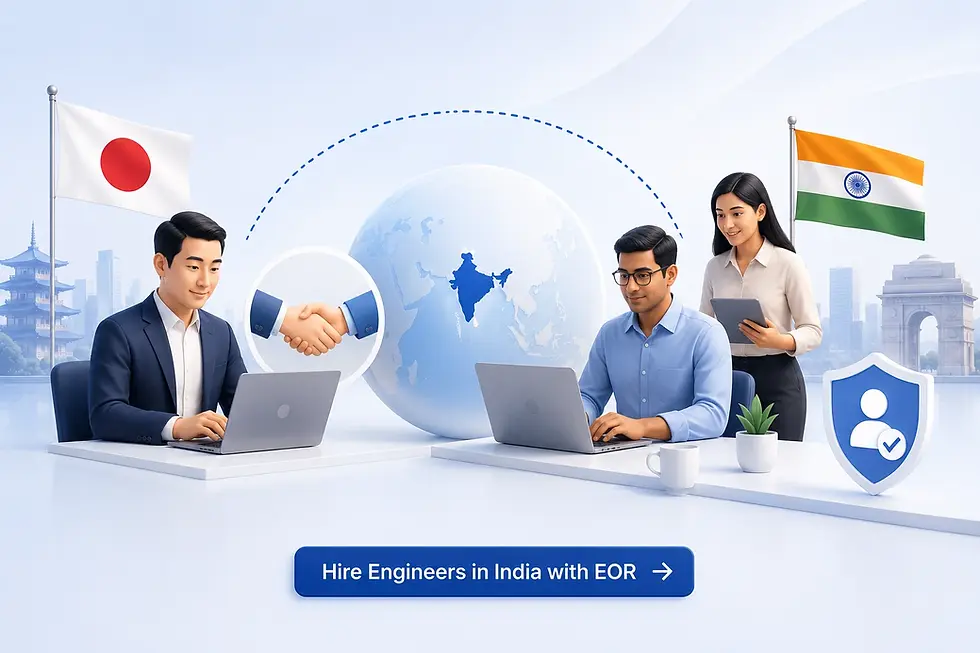
Japanese companies hire Engineers in India via an EOR when they want a compliant local employer without opening a Japanese subsidiary or an Indian branch office. An Employer of Record becomes the legal employer on paper, runs payroll, and lets an engineer start work in as little as four to six weeks. We handle this exact setup for Japanese manufacturing, automotive, and software clients regularly, and the pattern is always the same. The technical hiring is rarely the hard part. Payroll, provident fund contributions, and unfamiliar Indian labor rules are what slow Japanese HR teams down, and that is exactly what an EOR removes.
What Is an EOR and Why Do Japanese Companies Use One to Hire in India
An Employer of Record (EOR) is a third party registered in India that legally employs an engineer on behalf of a client company abroad. It issues the employment contract, runs payroll, deducts taxes, and manages statutory contributions such as provident fund, while the client keeps full control over the engineer's daily work and output. For a Japanese company, this removes two major blockers at once: entity registration, which can take three to four months, and ongoing compliance management, which requires local legal expertise most Japanese teams do not have in house.
Why Are Japanese Companies Hiring Engineers in India?
Japan's own engineering labor market is the main driver. Domestic demand for backend, embedded, and cloud engineers regularly outpaces supply, and Tokyo based product teams increasingly cannot fill mid to senior roles at a price the business can sustain.
The industrial relationship between Japan and India is already dense. Pune's manufacturing belt has one of the largest concentrations of Japanese affiliated companies in India, including Toyota Kirloskar and Honda. Bengaluru carries the software side, with Rakuten, NTT Data, and Hitachi all running engineering teams from the city.
What has shifted is scale. Japanese companies hire Engineers in India via an EOR even when they only need two or three people, not two hundred. Mid sized SaaS teams and robotics startups are now common clients, and AI adoption is pulling this forward, since Japanese firms building AI products often find it faster to source machine learning engineers in India than to compete for the same skills at home.
Which Indian Cities Have the Right Engineers for Japanese Companies
Pune is almost always our first recommendation for automotive and manufacturing clients. It has the deepest bench of embedded systems and automotive software engineers in the country, built over two decades of serving Japanese and other global OEMs. For software and cloud native roles, Bengaluru has the stronger DevOps bench, while Pune offers strong backend talent at a slightly lower cost. Chennai suits automotive adjacent software roles given its own manufacturing presence.
Indian engineers bring strong fundamentals in distributed systems and cloud infrastructure. What they often lack for Japan focused roles is comfort with low context written communication and the habit of flagging blockers early. We run a short communication assessment alongside every technical interview for roles reporting into Japan, since this gap, not code quality, most often causes early attrition.
What Indian Labor Laws Apply When Japanese Companies Hire Engineers in India via an EOR
The relevant law is Indian, not Japanese, since the employment relationship sits with the EOR. The Employees' Provident Fund and Miscellaneous Provisions Act, 1952 requires a 12 percent employer contribution on top of gross salary. The state level Shops and Establishments Act governs working hours, leave, and termination notice, and terms differ between Karnataka, Maharashtra, and Tamil Nadu.
Termination notice typically runs 30 to 90 days depending on tenure and state, longer than most Japanese teams assume. Gratuity becomes payable once an engineer crosses five years of continuous service, regardless of which client is billed. The most common mistake we see is a missing intellectual property assignment clause, since India's default law does not automatically transfer employee created work to the employer the way Japanese law does.
Contract Hiring vs Full Time Hiring: Which Model Fits Better
Most Japanese companies default to full time hiring because it is the model they know, but contract hiring often fits a first engagement better. Contractual hiring in India lets a company bring on an engineer for a defined project, with lower commitment and faster ramp down if priorities change. It suits short term builds, proof of concept work, or a specific skill gap such as a six month cloud migration.
Full time hiring through an EOR fits better once a role is clearly permanent, such as a backend engineer who will own a system long term. It carries full statutory entitlements, including eventual gratuity eligibility, and generally results in stronger retention. A simple rule: if the role has a deliverable with an end date, hire on contract. If the function is needed indefinitely, hire full time from day one rather than converting later.
Ready to figure out which model fits your hiring plan? Talk to our team about your engineering roles in India.
EOR Compliance Checklist for Japanese Companies Hiring in India
This is the checklist we walk every Japanese client through before an engineer's start date. It reflects exactly how Japanese companies hire Engineers in India via an EOR without missing a compliance step, and it is built to be usable on its own.
Item | What to Verify | Why It Matters |
EPF registration | Active EPFO registration number on file | Missing registration creates penalty risk |
PF employer contribution | 12 percent of basic salary, itemized separately | A common place low cost providers hide real cost |
IP assignment clause | Explicit transfer of work product to the client | Default Indian law does not favor the employer |
State specific leave policy | Matches the Shops and Establishments Act for that state | Karnataka, Maharashtra, Tamil Nadu terms differ |
Termination notice | 30 to 90 days depending on state and tenure | Often longer than Japanese teams expect |
Gratuity provision | Applies automatically after five years of service | Applies regardless of which client is billed |
Data handling terms | Aligned to Japan's APPI where relevant | Requested increasingly by fintech and healthtech clients |
Invoicing entity and currency | Confirm INR or JPY billing and invoicing entity | Affects FX exposure and tax treatment in Japan |
Our Process, Timelines, and a Real Client Scenario
At AnjuSmriti Global, our standard timeline runs four to six weeks from signed agreement to the engineer's first day: week one for role scoping and EOR setup, weeks two and three for sourcing and screening, and week four for interviews and offer, with statutory registration running in parallel. Technical assessment depends on the role. For embedded and automotive software, we use a practical assignment involving real time constraints rather than a whiteboard exercise. For cloud and backend roles, we use a take home architecture review followed by a live system design interview.
A recent example: a Tokyo based robotics company with about 80 employees needed three embedded engineers in Pune within two months. Their legal team initially wanted an Indian subsidiary, a path that would have taken three to four months on its own.
We moved them to an EOR structure instead and had two offers out within five weeks. Their first draft contract carried no IP assignment clause, since their standard Japanese template assumed Japanese default law. We flagged it before signing. All three roles were filled within six weeks, at roughly 38 percent of the fully loaded cost of hiring the same seniority in Tokyo, with no compliance issues in the first year.
What Does It Cost to Hire Engineers in India via an EOR
Cost is usually the first question we get, and it is a large part of why Japanese companies hire Engineers in India via an EOR in the first place. These figures reflect what we currently quote Japanese clients, including the 12 percent EPF contribution and our EOR management fee.
Level | Tokyo Salary (JPY/year) | India EOR Total Cost (INR/year) | Approx. JPY Equivalent | Typical Savings |
Mid (3 to 5 years) | 6,500,000 | 19,00,000 | 3,400,000 | About 48 percent |
Senior (6 to 9 years) | 9,800,000 | 34,00,000 | 6,100,000 | About 38 percent |
Lead or Architect (10+ years) | 14,500,000 | 58,00,000 | 10,400,000 | About 28 percent |
The gap narrows at the lead level since senior engineering talent in Pune and Bengaluru is not the bargain it was a few years ago. Most clients reinvest the savings from mid and senior tiers into an additional engineer rather than pocketing them.
Conclusion
Embedded and automotive software will likely keep growing fastest in this corridor, driven by Japanese suppliers accelerating EV and driver assistance software and finding it faster to build that capability in Pune than to compete for the same engineers at home. Interest from Japanese robotics and industrial automation companies is also rising. In live mandates right now, the clearest shift is Japanese clients asking for data residency and APPI alignment language as a default requirement, not a special request, which signals this corridor is maturing past its early stage.
Ready to hire your first engineer in India, or scope out a larger team? Get in touch with our hiring specialists.
Interesting Reads:
What Do Australian Companies Need to Know About EOR in India? Which Skills Are in Highest Demand in India's Workforce?
FAQs
1.Does India's EPF Act apply to engineers hired through an EOR for a Japanese company?
Yes, always. The Employees' Provident Fund and Miscellaneous Provisions Act, 1952 requires a 12 percent employer contribution on top of gross salary, regardless of where the client company is based. This applies to every engineer employed through an EOR in India and cannot be waived or bundled in to offer a lower rate. Any provider quoting a cost without this line item shown separately is quoting incorrectly, and it is worth confirming before signing anything.
2.How long does it take for a Japanese company to hire its first engineer in India?
Most engagements take four to six weeks from signed agreement to the engineer's first working day. This includes role scoping, sourcing, technical screening, offer negotiation, and statutory registration with the EPFO and relevant state authority. Most of these steps run in parallel rather than one after another, which keeps the overall timeline shorter than setting up an entity from scratch would take.
3.Is an Indian subsidiary required before a Japanese company can hire engineers in India?
No. An Employer of Record lets a Japanese company legally employ engineers in India without registering a subsidiary or branch office. Entity setup typically takes three to four months and involves ongoing local compliance overhead. An EOR arrangement removes both requirements and can have someone working within a few weeks of a signed agreement.
4.Who owns the intellectual property created by an engineer hired through an Indian EOR?
Ownership must be assigned explicitly in the employment contract rather than assumed. India's default law does not automatically transfer work product to the employer the way Japanese law does, so the contract needs a clear IP assignment clause naming the client company as owner of all code and deliverables the engineer produces during the engagement.
5.What is the notice period for terminating an engineer hired through an EOR in India?
Notice periods typically run 30 to 90 days depending on the employee's tenure and the specific state's Shops and Establishments Act. Karnataka, Maharashtra, and Tamil Nadu each apply slightly different terms, so this should be confirmed per engineer rather than assumed to match Japanese termination timelines, which tend to be shorter overall.
6.Can a Japanese company hire just one or two engineers in India through an EOR?
Yes, there is no minimum headcount required. This is one of the main reasons companies choose the EOR model over entity setup, since it works just as well for a single hire as it does for a larger team. Many Japanese clients start with one or two roles and expand once the arrangement proves out.
7.Which Indian city has the best engineers for Japanese automotive and manufacturing clients?
Pune has the deepest talent pool for embedded systems and automotive software, built over two decades of working with Japanese and other global OEMs including Toyota Kirloskar and Honda. Chennai offers a smaller but capable pool with manufacturing adjacent experience, given its own automotive manufacturing presence in the region.
8.How much cheaper is it to hire an engineer in India compared to Tokyo?
Savings typically range from about 28 percent at the lead level to about 48 percent at the mid level, once India side costs including EOR fees and the 12 percent provident fund contribution are fully included. The gap narrows as seniority increases, since senior Indian engineering talent commands a stronger market rate than it did a few years ago.
Comments