.png)


How Payroll Compliance Works in India for Foreign Companies

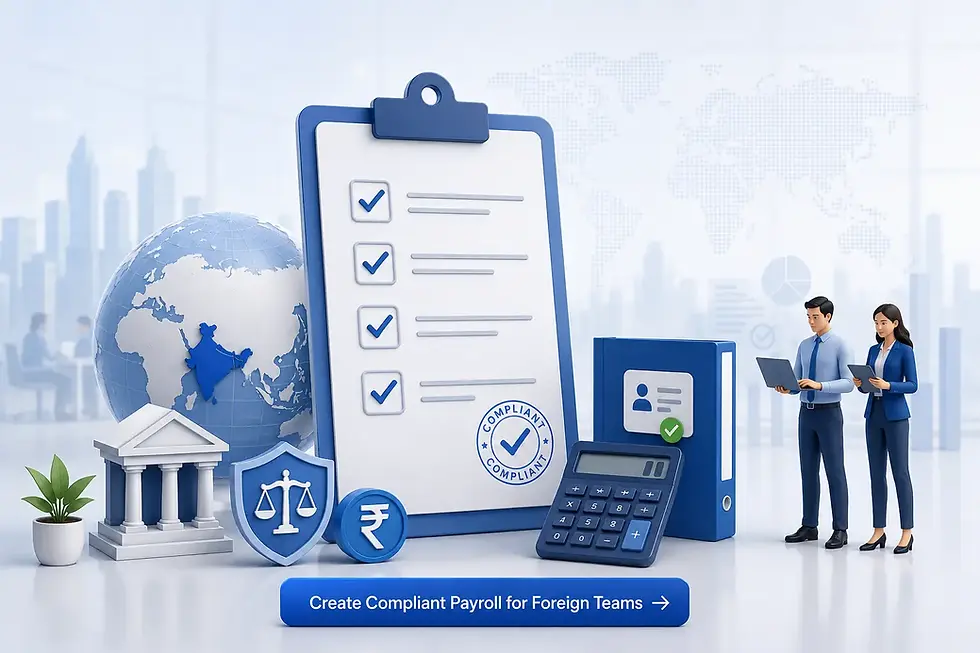
In our experience managing over 500 cross-border hiring mandates, foreign companies face their first major payroll compliance shock when the EPFO demands registration and monthly contributions within 30 days of onboarding even one eligible employee in India. One US SaaS client we supported almost received a notice because their global payroll provider missed the state specific Professional Tax slab differences between Karnataka and Maharashtra. Payroll compliance in India for foreign companies involves precise handling of Provident Fund (12 percent employer plus 12 percent employee), ESI (for wages up to 21000 rupees per month), TDS under the Income Tax Act, gratuity accrual, and the consolidated rules under the new Labour Codes.
We have guided dozens of US, European, and APAC clients through this process without them setting up a local entity. Our team has seen how small mistakes in salary structuring or missed ECR filings create penalties, delays, and employee dissatisfaction. We combine deep IT recruitment expertise with practical payroll navigation, helping foreign companies build compliant teams in Bengaluru, Hyderabad, Delhi NCR, Pune, and Chennai.
Why Foreign Companies Struggle with Payroll Compliance in India
Many of our clients initially underestimate the complexity of multi layered Indian compliance. Without a local entity, direct hiring can create permanent establishment risk under Indian tax rules. Even contractor arrangements carry misclassification risks that can lead to backdated contributions and penalties.
From our mandates, tech and product companies scaling operations in India commonly face challenges around multiple registrations including EPFO, ESIC, Professional Tax (state wise), Shops and Establishments, and TAN. Monthly filing deadlines are strict with TDS due by the 7th and PF ECR and ESI by the 15th of the following month. Accurate salary structuring is critical because post Labour Codes basic pay must constitute at least 50 percent of CTC for correct PF and gratuity calculations. State variations in leave policies, Professional Tax slabs, and Labour Welfare Fund rules add further complexity across Karnataka, Telangana, Maharashtra, Tamil Nadu, and Delhi.
We once worked with a mid sized Dutch fintech company whose finance team designed high HRA heavy packages. This led to underpaid PF contributions. Correcting it retroactively consumed time and affected employee trust. Such issues arise because global payroll systems often fail to account for India specific rules like varying state labour welfare requirements or exact wage definitions that impact multiple statutes at once.
Payroll compliance in India for foreign companies becomes even more critical when teams are distributed across multiple states with different local rules. Our on ground presence in Delhi NCR and strong partner network allow us to catch these nuances early. Many foreign companies come to us after facing issues with generic global PEO providers who treat India like any other market. The reality is that India has unique layered requirements involving central and state laws that demand local expertise.
We frequently support clients through employer of record and global payroll outsourcing solutions that eliminate these headaches while maintaining full compliance and giving employees proper local payslips they can use for bank loans, visas, and tax filings.
Which Indian Cities Offer the Best Tech Talent for Foreign Companies
Success in India depends on choosing the right talent hubs while managing compliant payroll.
Bengaluru remains the top choice for mature full stack, cloud, DevOps, and product engineering talent. Engineers here are familiar with international agile processes, CI CD pipelines, and global collaboration tools. They often have prior experience working with clients in the US and Europe, making transition smoother.
Hyderabad offers excellent cost to quality ratio for data engineering, AI ML, Java, and enterprise software roles, with a large pool of skilled professionals who deliver strong value.
Delhi NCR excels in fintech, cybersecurity, and full stack development, while Pune is strong for automotive, manufacturing tech, and cloud infrastructure projects.
Indian engineers typically bring strong technical depth in modern stacks including React, Node.js, Python, Java, AWS, Azure, Kubernetes, and microservices. They are well versed in scalable system design and cloud native development. However, they sometimes need targeted evaluation on client facing communication, detailed documentation standards, and security compliance aware development practices expected by Western teams.
In our vetting process, we use scenario based interviews, live coding exercises, system design rounds, and short paid trial projects to bridge any gaps effectively. This thorough approach ensures candidates not only have strong technical skills but also fit well into distributed global teams.
We help clients tap these cities effectively through our offshore recruitment agency in India and it recruitment agency capabilities, always backed by compliant payroll structures. Our team maintains active networks across these locations so we can match not just technical skills but also cultural fit for distributed teams working across time zones. This integrated approach ensures payroll compliance in India for foreign companies runs smoothly from day one without operational disruptions.
Payroll Compliance in India for Foreign Companies: Legal Requirements Explained
Key legislations include the Employees Provident Funds and Miscellaneous Provisions Act 1952 (EPF Act), Employees State Insurance Act 1948 (ESI Act), Payment of Gratuity Act 1972, Payment of Bonus Act, and the Income Tax Act 1961 for TDS. The four new Labour Codes have consolidated and strengthened these requirements, especially around wage definition and social security coverage.
Foreign companies generally have three primary routes. First, incorporating a subsidiary offers maximum control but involves three to six months for setup, capital requirements, and heavy ongoing compliance including annual audits and local director appointments.
Second, the pure contractor model is faster but carries higher risk of misclassification and limited benefits for talent, which can impact retention of top engineers.
Third, Employer of Record (EOR) is the fastest and safest for most foreign companies. The EOR acts as the legal employer, handles all registrations, payroll processing, statutory deductions, filings, and employee benefits while ensuring full adherence to local regulations.
A frequent mistake we observe is assuming that paying salaries directly from abroad via USD wire meets requirements. This often leads to non compliance with PF ESI TDS rules, creates tax notices, and results in employees receiving no proper payslips or social security credits. One client nearly faced attrition until we transitioned the team to a compliant EOR model with clear Indian payslips showing PF, ESI, and TDS breakdowns.
AnjuSmriti Global supports clients through structured contractual hiring India and hr outsourcing India models tailored for long term success. We ensure every hire receives full statutory benefits while giving our foreign clients complete visibility and control. Proper payroll compliance in India for foreign companies protects both the company and the employees from future disputes and builds trust with the Indian team.
Step-by-Step Payroll Compliance Checklist for Foreign Companies Hiring in India
Here is the practical, screenshot ready checklist we share with every new client. You can use this to audit your current or planned India setup.
Phase 1: Pre Onboarding Registrations
Obtain PAN and TAN (via EOR or subsidiary). Register with EPFO (mandatory if 20 plus employees or voluntary for fewer). Register with ESIC where applicable based on wage thresholds. Complete state Shops and Establishments registration. Register for Professional Tax in relevant states. Sign compliant employment contracts under Indian law that clearly define roles, notice periods, intellectual property ownership, and confidentiality clauses.
Phase 2: Monthly Payroll Process
Structure CTC with minimum 50 percent basic pay as per Labour Code guidelines. Deduct employee PF (12 percent), ESI (0.75 percent), Professional Tax, and TDS. Add employer contributions: PF (12 percent), ESI (3.25 percent), gratuity provision (around 4.81 percent). Generate payslips showing all breakdowns clearly. Meet deadlines: TDS by 7th, PF and ESI by 15th of next month. File ECR returns accurately with correct UAN mappings for every employee.
Phase 3: Quarterly and Annual Compliances
File TDS returns (Form 24Q) and issue Form 16. Handle annual PT returns (state wise). Track and provision gratuity liability accurately. Maintain records for minimum 7 years for potential audits. Conduct internal audits periodically to stay ahead of any regulatory changes or updates in Labour Codes.
Key Risk Areas
International worker PF rules for expatriates if any. State specific leave, bonus, and maternity rules. Proper Full and Final settlement on exit, including gratuity (eligible after 5 years or pro rata under new codes). Failure in any of these areas can lead to penalties, interest charges, and reputational damage with both employees and authorities.
This checklist has helped our clients achieve near zero compliance issues. Pair it with reliable recruitment process outsourcing rpo India or EOR partners for best results. Many clients tell us this framework alone saves them significant time and legal consultation costs when implementing payroll compliance in India for foreign companies.
How We Manage End-to-End Payroll and Hiring for International Clients
Our proven process typically follows this flow: Discovery call on your hiring needs and compliance requirements, talent sourcing from our pan India network, multi stage technical and cultural vetting, offer rollout with compliant contracts, EOR onboarding and payroll activation within 7 to 14 days, and ongoing HR and payroll support including attendance tracking, leave management, and exit formalities.
In one anonymised case, a mid sized US fintech company (approximately 200 global employees) needed to hire 15 backend and cloud engineers quickly in Hyderabad and Bengaluru to meet a critical product launch deadline. They had no India entity and were cautious after a previous poor experience with a generic provider.
We sourced strong candidates with relevant AWS, Java, and Python expertise. Our technical assessments included system design rounds focused on scalability and security best practices. We restructured offer letters to comply with basic pay norms and activated payroll through our EOR partner.
What almost went wrong: The client initially wanted a high variable pay component that would have violated the 50 percent basic pay rule. We flagged this early, adjusted the CTC structure, and prevented future under contribution issues. All 15 engineers were onboarded within 6 weeks with zero compliance flags in the first year. The team delivered their product milestones ahead of schedule. The client has since scaled to over 40 roles and continues to partner with us for both hiring and payroll support.
We are currently seeing strong demand in live mandates for compliant scaling of engineering teams. Our combination of international recruitment firm india expertise and payroll support delivers predictable results and allows founders and CTOs to focus on business growth rather than compliance worries. Getting payroll compliance in India for foreign companies right from the beginning has been a game changer for most of our partners and has helped them scale confidently.
Salary Breakdown and Total Cost of Employment in India for Foreign Companies
Here are realistic annual CTC figures for software engineering and related tech roles in India (in INR Lakhs):
Mid level (4 to 7 years experience): 12 to 18 Lakhs
Senior (8 to 12 years experience): 20 to 32 Lakhs
Lead Architect (12 plus years experience): 35 to 55 Lakhs plus
Additional employer costs through EOR typically add 15 to 20 percent on top of CTC. This includes PF and ESI contributions, gratuity provision, insurance, and admin fees. EOR service fees usually range between 5 to 10 percent depending on volume and scope.
Compared to hiring locally in the US or Europe, the total cost of employment in India through a compliant EOR model is significantly lower while delivering high quality output. Many clients reinvest 40 to 60 percent of the savings into competitive variable pay, learning and development budgets, or additional headcount. This creates a virtuous cycle of better retention and stronger team performance over time.
We support both individual hires and bulk hiring India requirements with full transparency on total cost of ownership. Our clients appreciate the predictability this brings to their budgeting process while ensuring complete payroll compliance in India for foreign companies.
Conclusion
We continue to see foreign companies successfully combining strong tech talent from India with robust payroll compliance frameworks. In the coming 12 to 18 months, enforcement of the new Labour Codes and digital filing systems is expected to tighten further, making early compliance planning even more important. Live mandates right now show that companies prioritizing both speed and compliance are scaling 20 to 50 person teams smoothly within six months.
If you are planning to expand your team in India, our team is ready to handle both talent acquisition and payroll compliance in India for foreign companies end to end.Get in touch with our team
Interesting Reads:
FAQs
1.How does an EOR handle PF and ESI contributions for foreign companies in India?
The EOR acts as the legal employer, completes all registrations, deducts employee shares, pays employer contributions, and files monthly ECR returns by the 15th. They ensure payslips clearly show all deductions and credits. This gives employees proper social security benefits while removing the administrative burden from your global finance team. We coordinate closely so you retain full visibility through dedicated portals and regular reports.
2.What are the main differences in payroll rules across Indian cities like Bengaluru and Hyderabad?
Bengaluru (Karnataka) and Hyderabad (Telangana) have different Professional Tax slabs, Labour Welfare Fund rules, and minor variations in Shops and Establishments Act requirements. Leave entitlements and filing portals also differ. A good EOR or HR partner tracks these per employee location to avoid penalties and ensures accurate reporting every month.
3.Can foreign companies handle payroll directly from abroad without local support?
It is risky and often non compliant. Direct USD transfers usually fail to meet PF, ESI, and TDS obligations and leave employees without proper Indian payslips needed for loans, visas, or tax filings. Structured EOR models are strongly recommended for compliance and talent satisfaction.
4.How do the new Labour Codes affect salary structuring for foreign companies?
The Codes mandate that basic pay should be at least 50 percent of CTC for accurate PF and gratuity calculations. Allowances exceeding this limit get reclassified. This impacts gratuity liability and bonus calculations. Proper structuring at the offer stage prevents issues later and avoids disputes during exits.
5.What TDS obligations exist when paying Indian developers?
TDS under Section 192 must be deducted on salary as per the employee’s tax regime and income slabs. The EOR or employer deposits it monthly and issues Form 16 annually. We help employees submit investment declarations to optimise tax where possible while staying fully compliant.
6.How quickly can compliant payroll be set up for new hires in India?
With an experienced EOR partner, payroll can usually be activated within 7 to 14 working days from offer acceptance. This includes contract finalization, background checks, and first month processing. Timelines are faster for repeat clients with existing setups.
7.Do social security agreements with other countries affect PF contributions?
Yes. Citizens from countries with bilateral social security agreements can use detachment certificates to coordinate or avoid double contributions. Proper documentation is essential and we assist with this process for affected employees.
8.What should foreign companies prepare for employee exit processes?
Full and Final settlement must be completed within statutory timelines, including gratuity payment (where eligible), PF withdrawal support, experience letters, and clearance of any recoveries. Smooth exits help protect employer branding in a competitive talent market.
9.How does compliance differ between contract and full time hires?
Full time hires through EOR require complete statutory benefits. Contractor engagements need careful vendor compliance checks to avoid liability. Clear scope definitions and proper classification are critical in both cases to prevent future disputes.
10.What records must be maintained for potential audits?
Payslips, bank proofs, contribution challans, TDS returns, contracts, attendance records, and gratuity calculations. Records should be kept for at least 7 years. Reputable EORs provide secure portals for easy access and audit readiness.
Comments