.png)


Poland IT Talent Crunch: Hire Indian Python & Django Developers

Updated: Feb 27
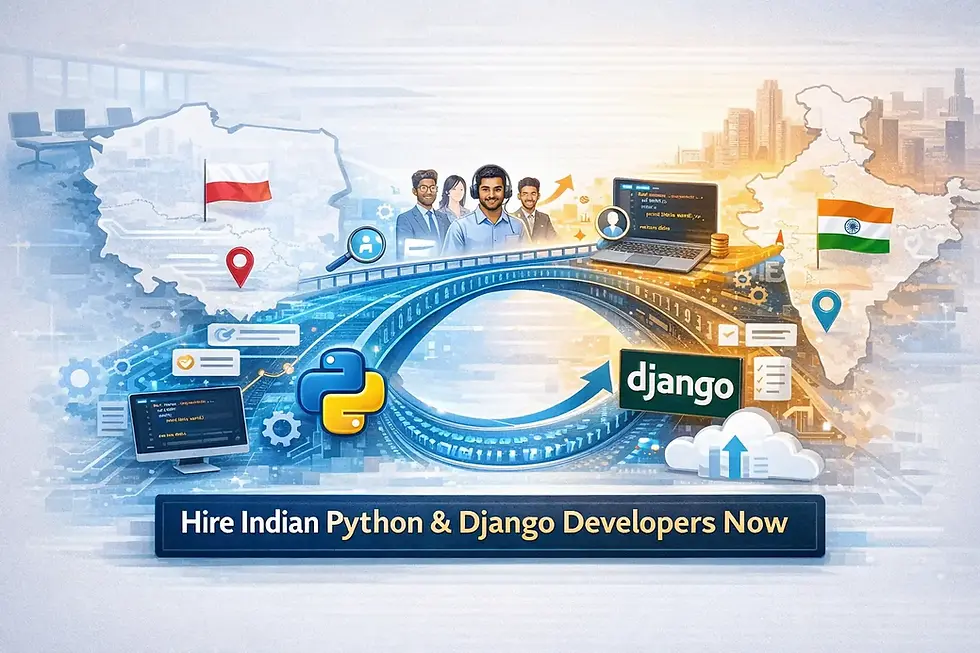
Poland has become one of Europe’s most ambitious digital economies. From fintech platforms in Warsaw to SaaS startups in Kraków and product engineering hubs in Wrocław, innovation is accelerating. Yet behind this growth story, there is a serious Poland tech talent shortage.
If you are trying to hire Django engineers in Poland, you already know the reality. Roles remain open for months. Compensation expectations are rising faster than budgets. Competing offers from EU and US companies are pulling away top Python talent.
You might have secured funding to expand your product team. Your Global capability center (GCC) may be scaling aggressively. Your leadership team may have approved a new office in Poland. But without reliable backend developers, product roadmaps stall and customer commitments suffer.
This is where we step in with a practical, people first solution. We help you hire Indian Python and Django developers while we manage the complete HR function across borders. You focus on building products. We take care of recruitment, compliance, payroll, onboarding, performance, and long term engagement.
If you are planning to scale quickly, you can directly connect with us here to explore your hiring roadmap.
Are you struggling with Poland tech talent shortage when trying to hire Django engineers?
You post a role for Senior Python Developer with Django experience. You expect strong applications within weeks. Instead, you receive limited profiles or candidates with multiple competing offers.
You may ask yourself:
• Why is it so difficult to hire Django engineers in Poland despite a strong tech ecosystem?
• How do we maintain product velocity while facing this Poland tech talent shortage?
The demand for Python developers in Poland has grown across industries:
• Fintech platforms building secure APIs
• E commerce companies scaling backend microservices
• SaaS providers optimizing cloud native applications
• AI driven startups integrating Python with machine learning frameworks like TensorFlow and PyTorch
Django engineers are especially in demand for building secure, scalable web applications and REST APIs. When the same talent pool is targeted by startups, MNCs, and remote global employers, the shortage becomes structural rather than temporary.
We have worked with IT businesses and hiring managers who experienced the following challenges:
• Offer rejection due to counteroffers
• Salary inflation beyond planned budgets
• Project delays due to unfilled backend positions
• Increased pressure on existing teams leading to attrition
Instead of competing in an overheated local market, many of our clients chose to expand their hiring strategy to India. That is where the opportunity becomes strategic rather than reactive.
How can hiring Indian Python and Django developers solve the Poland tech talent shortage?
When you expand your hiring geography, you unlock scale, cost optimization, and long term stability. India has one of the largest Python developer communities globally. Cities like Bengaluru, Hyderabad, and Pune produce thousands of skilled engineers with hands on experience in Django, Flask, FastAPI, PostgreSQL, Docker, Kubernetes, AWS, and Azure.
But hiring internationally is not just about sourcing resumes. It is about building a compliant, engaged, and high performing team.
We have supported:
• Global capability center (GCC) setups looking to complement their Poland teams with offshore backend developers
• Companies hiring in bulk for product releases
• Global companies opening new offices in Europe and needing parallel remote teams
• Leadership hiring companies building core architecture teams from scratch
• Organizations expanding remote engineering teams across time zones
For one SaaS client expanding in Poland, backend hiring was stuck for over four months.
We helped them:
• Define a clear hiring plan for Senior Python and Django engineers
• Source and screen developers with strong API design and database optimization skills
• Set up compliant employment structures through Employer of Record (EOR)
• Manage onboarding, payroll coordination, and HR policies
Within a quarter, they had a hybrid model. A lean onsite team in Poland focused on stakeholder collaboration. A larger backend team in India delivered feature releases without delay.
What should you look for when you hire Django engineers for scalable architecture?
When facing a Poland tech talent shortage, speed is important. However, quality cannot be compromised.
We always advise you to assess Django engineers beyond syntax knowledge. You should evaluate:
• Experience with building RESTful APIs using Django REST Framework
• Strong understanding of ORM optimization and database indexing
• Hands on work with PostgreSQL or MySQL
• Exposure to cloud infrastructure such as AWS, Azure, or Google Cloud
• Familiarity with CI CD pipelines, Git workflows, and containerization tools like Docker
• Knowledge of frontend integration with React or Angular
Many companies make the mistake of hiring purely on availability. Later, they face performance bottlenecks and refactoring costs.
Our recruitment and staffing support ensures that technical screening aligns with your architecture vision. We collaborate with your CTO or engineering manager to understand:
• Current tech stack
• Microservices or monolith approach
• Security and compliance requirements
This alignment reduces rework and ensures your Indian Python developers become long term contributors rather than temporary fixes.
How do you manage compliance, payroll, and HR when hiring outside Poland?
This is where most leadership teams hesitate. You may think:
If we hire Django engineers in India, how do we manage contracts, labor law compliance, and payroll?
The fear of misclassification, statutory reporting errors, and cultural misalignment often stops expansion.
We manage the complete HR function for onsite and remote teams across multiple countries, including:
• End to End HR consulting
• Employer of Record (EOR)
• IT Recruitment, staffing support and workforce planning
• Employee lifecycle management from onboarding to exit
• Payroll coordination, HRIS, attendance, and leave
• Labor law compliance and statutory reporting
• HR policies, SOPs, audits, and records
• Performance reviews, appraisals, and engagement
• A dedicated HR point of contact for employees
For companies building their teams from scratch or expanding a newly opened office, this structure creates confidence.
You do not need to establish a local entity immediately. Through our Employer of Record (EOR) model, you can legally employ Indian Python and Django developers while we handle contracts, compliance, and statutory obligations.
This approach is especially valuable for:
• Countries with talent shortage seeking alternative talent markets
• Companies hiring in bulk for aggressive growth
• Global capability center (GCC) planning phased expansion
• Organizations hiring remote teams across multiple geographies
How do you maintain engagement and performance in distributed Django teams?
Hiring is only the first step. Retention and performance management determine ROI.
We often see companies invest heavily in recruitment but overlook structured engagement. This leads to attrition, especially in high demand roles like Python developers.
Our employee lifecycle management ensures:
• Structured onboarding with clear role expectations
• Defined KPIs aligned with your sprint cycles
• Regular performance reviews and appraisals
• Transparent communication channels
• Continuous feedback mechanisms
For a fintech client serving EU customers, backend stability was critical. They hired a remote Django team through us. We implemented:
• Quarterly performance reviews
• Engagement surveys
• Clear SOPs and documentation standards
• Dedicated HR point of contact
Attrition reduced significantly compared to their previous offshore attempts.
When you think about Poland tech talent shortage Django engineers, the real solution is not just hiring more people. It is building a sustainable, compliant, and engaged global team.
Why are global companies shifting to hybrid Poland and India engineering models?
If you are expanding into Poland, you may still want local presence for business development, compliance with EU regulations, or customer proximity. That makes sense.
However, building a fully local backend team in a tight labor market increases cost and risk.
A hybrid model allows you to:
• Keep product managers and client facing roles in Poland
• Build scalable Python and Django backend teams in India
• Optimize cost without compromising quality
• Access a broader talent pool with diverse experience
We have seen startups, MNCs, and leadership driven organizations adopt this model to balance agility and stability.
This strategy also integrates well with technologies such as:
• Python for backend and data engineering
• Django for rapid web application development
• FastAPI for high performance APIs
• Kubernetes for container orchestration
• AWS and Azure for cloud scalability
By aligning hiring with architecture goals, you move from reactive recruitment to strategic workforce planning.
Is outsourcing HR and recruitment the right move for your expansion?
If you are a hiring manager, HR head, or founder, you already have enough complexity.
You are managing budgets, stakeholder expectations, product deadlines, and regulatory requirements. Adding cross border HR operations can dilute focus.
By partnering with AnjuSmriti Global, you gain:
• Structured workforce planning aligned with your growth roadmap
• Access to pre screened Python and Django engineers
• Full compliance coverage through Employer of Record (EOR)
• Transparent payroll and statutory reporting
• Ongoing HR audits and policy support
We work with IT businesses of all sizes, Global capability center (GCC), companies hiring in bulk, global companies opening new offices, and leadership hiring organizations building technology teams from zero.
We understand the pressure you face when a key Django role remains unfilled and your sprint backlog keeps growing.
Instead of asking how to survive the Poland tech talent shortage, you can start asking how to design a global hiring strategy that protects your roadmap.
The next step is simple. Share your hiring goals, expansion plan, or current bottlenecks with us, and we will map out a practical solution tailored to your organization.
Interesting Reads:
FAQs
1.Why is Poland experiencing a growing shortage of skilled Django engineers?
Poland’s digital economy is expanding rapidly, but the supply of experienced Django engineers hasn’t kept pace with demand. Startups, Global capability center (GCC) expansions, and enterprise modernization projects are competing for the same limited Python talent pool.As product innovation accelerates, companies face longer hiring cycles, rising salaries, and project delays. This widening Poland tech talent shortage is pushing businesses to explore global hiring models to stay competitive.
2.How does the Poland tech talent shortage impact software delivery timelines?
When skilled Django engineers are scarce, recruitment timelines stretch from weeks to months. Projects stall, product launches are delayed, and engineering teams experience burnout.Global companies hiring in Poland often struggle to scale backend development quickly due to limited availability of senior Python professionals. Accessing Indian Python developers can significantly reduce time-to-hire and speed up execution.
3.Why are global companies hiring Indian Python and Django developers to solve talent gaps?
India, especially Bengaluru, has one of the largest and most mature Python ecosystems globally. The developer community is highly experienced in Django, REST APIs, SaaS platforms, AI integrations, and enterprise-grade systems.For companies facing Poland tech talent shortages, hiring from India ensures access to scalable teams, cost efficiency, and strong technical expertise without compromising quality.
4.How can Indian Django engineers support Polish startups and enterprises?
Indian Django engineers bring strong expertise in rapid MVP development, cloud-native architecture, and scalable backend systems. They are experienced in supporting global product launches and distributed team collaboration.Startups and enterprises in Poland can extend their engineering capacity, maintain agility, and accelerate growth without being restricted by local hiring limitations.
5.Is remote hiring of Python developers from India reliable for long-term projects?
Yes, many global companies hiring across borders have successfully built long-term distributed teams with Indian developers. Strong communication skills, agile methodologies, and time-zone overlap make collaboration efficient.With structured onboarding and project management practices, remote Django engineers become seamless extensions of in-house teams, ensuring stability and continuity.
6.How does hiring Indian talent compare financially to recruiting locally in Poland?
Due to the Poland tech talent shortage, local salaries for experienced Django engineers have surged significantly. Recruitment costs, retention bonuses, and counteroffers add further pressure on budgets.Hiring Indian Python developers offers optimized cost structures while maintaining high-quality output, allowing companies to reinvest savings into innovation, marketing, and product expansion.
7.Can businesses scale quickly by hiring Django engineers from Bengaluru?
Absolutely. Bengaluru is home to thousands of skilled Python professionals working across fintech, healthcare, eCommerce, and SaaS industries.Companies can scale from one developer to a full agile squad in a short timeframe, enabling rapid backend development and seamless feature rollouts even during Poland’s tech talent shortages.
8.What compliance models support international hiring for Polish companies?
Companies expanding beyond Poland can leverage structured models like Employer of Record (EOR) to hire Indian developers compliantly without setting up a local entity.This approach simplifies payroll, taxation, and legal compliance while allowing businesses to focus on product innovation and growth rather than administrative complexity.
9.How do Indian Django developers ensure enterprise-level quality and security?
Indian engineers are well-versed in secure coding practices, DevOps integration, CI/CD pipelines, and scalable architecture design. Many have experience working with global enterprises and regulated industries.For organizations facing Poland tech talent shortages, this ensures that backend systems remain robust, secure, and performance-optimized at scale.
10.What is the strategic advantage of hiring globally during a tech talent shortage in Poland?
Relying solely on local hiring in a competitive market limits growth potential. Expanding globally unlocks access to a vast pool of experienced Django engineers ready to contribute immediately.Global companies hiring beyond borders gain faster development cycles, improved ROI, and a sustainable talent strategy that reduces dependency on a constrained local market.
Comments