.png)


Pune vs Chennai: Top Cities for Remote Developer Hiring in India

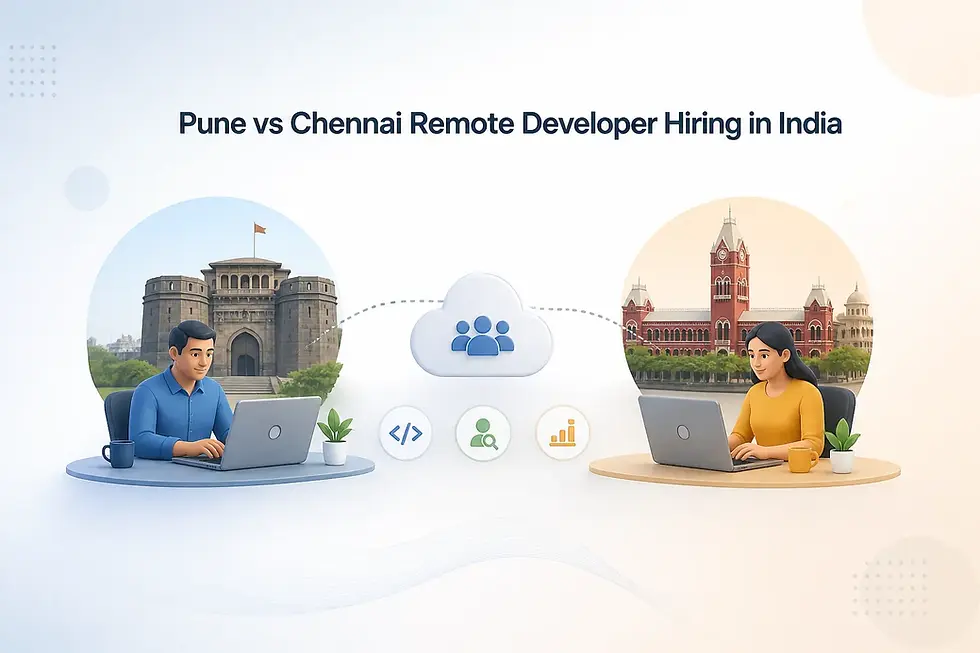
For many startups, SMEs, and global companies, evaluating Pune vs Chennai for remote developer hiring in India often begins as a straightforward expansion decision. The expectation is simpleaccess a large talent pool, reduce hiring costs, and scale quickly. However, the reality tends to be far more complex.
Hiring cycles stretch beyond expected timelines, critical developer roles remain open, and internal engineering teams start operating under pressure. Product releases get delayed, customer expectations are harder to meet, and leadership teams are forced to rethink growth strategies. What initially looked like an operational decision slowly becomes a business risk.
A key reason behind this challenge is the assumption that developer talent across India is uniform. In reality, cities like Pune and Chennai have fundamentally different hiring ecosystems. These differences influence everything from developer skill sets and salary benchmarks to work culture and retention patterns.
What Does Remote Developer Hiring in India Mean for Businesses?
Remote developer hiring in India is no longer just about outsourcing tasks to reduce costs. It has evolved into a strategic model for building global engineering capabilities. Companies today are setting up distributed teams that work as core contributors to product development, innovation, and long-term digital transformation.
For example, a SaaS startup may build its entire backend team in India to accelerate product releases, while a global enterprise might create a dedicated offshore development center to support ongoing operations. In both cases, the goal is integration, not delegation.
This shift has also increased the importance of choosing the right hiring location. Businesses are now evaluating factors such as developer productivity, collaboration efficiency, time zone compatibility, and long-term scalability. These considerations directly impact ROI and overall business performance.
Understanding the differences between Pune and Chennai helps organizations align their hiring strategy with these evolving expectations.
Pune vs Chennai for Remote Developer Hiring in India: Detailed Comparison
Criteria | Pune | Chennai |
Talent Ecosystem | Startup-driven, product-focused | Enterprise-driven, service-oriented |
Developer Mindset | Agile, innovative, fast-paced | Structured, disciplined, process-oriented |
Cost of Hiring | Higher due to competitive demand | Lower and more predictable |
Attrition Rate | Moderate to high | Low to moderate |
Skill Focus | Full-stack, AI/ML, cloud, SaaS | Backend, ERP, enterprise systems |
Work Culture | Flexible, growth-driven | Stable, long-term focused |
Scalability | Fast scaling possible | Sustainable scaling |
Retention | Requires strong engagement strategies | Naturally higher retention |
Best Fit For | Startups, SaaS, product innovation | Enterprises, long-term projects |
This comparison clearly highlights that Pune and Chennai serve different business purposes. Pune is designed for speed, experimentation, and innovation, while Chennai is optimized for stability, consistency, and long-term execution.
For decision-makers, this distinction is critical. Choosing the wrong city can lead to hiring inefficiencies, cultural mismatches, and increased operational costs. Choosing the right one can accelerate growth and improve overall team performance.
Why Pune Attracts High Growth and Innovation Driven Teams
Pune’s tech ecosystem has rapidly evolved into one of India’s most dynamic innovation hubs. The presence of startups, product companies, and global tech firms has created an environment where developers are constantly exposed to new technologies and modern development practices.
Developers in Pune are typically skilled in high-demand areas such as cloud computing, microservices architecture, DevOps, artificial intelligence, and full-stack development. They are comfortable working in agile environments where priorities shift quickly and rapid iteration is the norm.
From a business standpoint, this translates into faster execution and higher adaptability. Companies building SaaS platforms, fintech solutions, or digital products benefit significantly from this ecosystem. Teams can experiment, iterate, and scale without being constrained by rigid processes.
However, this fast-paced environment also creates a competitive job market. Developers frequently receive new opportunities, which can increase attrition. Businesses hiring in Pune must invest in strong engagement strategies, career growth plans, and competitive compensation to retain top talent.
Why Chennai Offers Stability for Long Term Scaling
Chennai’s IT landscape represents a more structured and stable approach to software development. The city has a long-standing presence of enterprise IT companies, which has shaped a workforce that prioritizes consistency, discipline, and long-term career growth.
Developers in Chennai often bring deep expertise in backend systems, enterprise software, ERP platforms, and large-scale infrastructure projects. They are experienced in working within defined frameworks and delivering consistent results over extended periods.
For businesses, this creates a reliable environment for long-term projects. Whether it is maintaining legacy systems, managing enterprise applications, or scaling support teams, Chennai provides the stability required for sustained operations.
Additionally, lower attrition rates contribute to better knowledge retention and smoother workflows. Teams remain intact for longer durations, reducing the need for frequent rehiring and retraining.
How Cost ROI and Hiring Efficiency Compare
When evaluating offshore hiring in India, cost should always be analyzed in relation to value delivered. Pune typically has higher salary benchmarks due to strong demand and competition for skilled developers. However, this higher investment often results in faster hiring cycles, quicker onboarding, and improved productivity. For businesses where speed is critical, this can lead to higher overall ROI.
Chennai, on the other hand, offers a more cost-efficient hiring model. Lower salaries and stable compensation trends make it easier for companies to scale teams without significant financial strain. This is particularly beneficial for enterprises managing large teams or long-term projects.
In essence, Pune optimizes for speed and innovation, while Chennai optimizes for cost control and stability.
Business Impact: Retention Productivity and Operational Continuity
One of the biggest challenges in remote hiring is maintaining team continuity. High attrition can disrupt workflows, delay projects, and increase hiring costs.
Pune’s competitive environment leads to higher employee mobility. While this encourages skill growth and innovation, it also requires companies to actively manage retention through engagement initiatives and career development opportunities.
Chennai offers a more stable workforce, where employees are more likely to stay with organizations for extended periods. This stability improves productivity, ensures smoother collaboration, and reduces operational risks.
Operational Complexity: Compliance Payroll and Risk Management
Hiring remote developers in India involves navigating multiple layers of compliance, including labor laws, taxation, and payroll management. For global companies, these requirements can become complex and time-consuming.
Many organizations overcome this challenge by partnering with Anjusmriti Global, which provides expertise in managing compliance, payroll, and employment frameworks. This allows businesses to hire talent in cities like Pune and Chennai without setting up a legal entity.
By simplifying operational processes, companies can focus on building high-performing teams rather than managing administrative complexities.
Building a Scalable and Future Ready Hiring Strategy
A successful remote hiring strategy goes beyond location selection. It requires a structured approach to recruitment, onboarding, and team management.
Implementing streamlined recruitment workflows helps reduce hiring timelines and improve candidate quality. Clear communication channels, defined performance metrics, and strong onboarding processes are equally important.
When these elements are combined with the right location strategy, businesses can build scalable remote teams that deliver consistent results and drive long-term growth.
Conclusion: Aligning Hiring Decisions with Business Outcomes
Choosing between Pune and Chennai is not about selecting the better city. It is about selecting the right city for your specific business needs.
Pune offers speed, innovation, and access to modern tech talent, making it ideal for startups and high-growth companies. Chennai provides stability, cost efficiency, and long-term reliability, making it suitable for enterprise-level operations.
By understanding these differences and aligning them with your hiring strategy, you can build a remote development team that supports sustainable growth and operational excellence.
Interesting Reads
FAQs
1.Which city offers a stronger talent pool for remote developer hiring: Pune or Chennai?
Both Pune and Chennai have deep and diverse developer ecosystems, but their strengths differ. Pune is often favored for its startup-driven, product-focused talent, while Chennai is known for highly skilled engineers with strong expertise in enterprise and backend systems. For remote developer hiring in India, the choice depends on whether companies prioritize innovation speed or structured technical depth.
2.How do salary expectations compare between Pune and Chennai for remote developers?
Salary benchmarks in Pune tend to be slightly higher due to its competitive startup environment and demand for niche tech stacks. Chennai, on the other hand, offers a more cost-effective talent pool without compromising on quality. Global companies hiring remote developers often balance budget and expertise by exploring both cities strategically.
3.Which city is better for hiring remote developers with niche or emerging tech skills?
Pune has an edge in emerging technologies like AI, SaaS, and blockchain due to its strong startup culture. Chennai excels in established domains such as cloud infrastructure, enterprise systems, and full-stack development. When evaluating Pune vs Chennai for remote developer hiring in India, companies should align hiring goals with project requirements.
4.Is communication and remote collaboration better in Pune or Chennai-based developers?
Developers from both cities are well-versed in remote work culture, but Pune professionals often have more exposure to global startups and agile environments. Chennai developers are known for disciplined workflows and strong documentation practices. For international companies hiring remotely, both cities offer reliable communication and collaboration capabilities.
5.Which city provides better scalability for building remote development teams?
Chennai offers strong scalability due to its large pool of engineering graduates and established IT ecosystem. Pune, while slightly smaller, provides quicker access to highly adaptable developers suited for fast-growing teams. Businesses comparing Pune vs Chennai remote developer hiring in India often consider Chennai for volume hiring and Pune for specialized roles.
6.How does infrastructure and remote work readiness compare between Pune and Chennai?
Both cities have robust digital infrastructure, reliable internet connectivity, and a growing remote-first workforce. Pune benefits from a modern work culture with flexible setups, while Chennai offers stability and consistency in long-term remote engagement. This makes both cities equally viable for remote developer hiring in India.
7.Which city is preferred by global companies for remote developer hiring in India?
Global companies often adopt a hybrid approach, sourcing talent from both Pune and Chennai. Pune is attractive for product innovation and startup agility, while Chennai is preferred for long-term, scalable engineering operations. Hiring data shows that companies frequently diversify across both cities to optimize cost and expertise.
8.Are developers in Pune or Chennai more experienced with international clients?
Pune developers often have more exposure to international startups and cross-border projects, especially in SaaS and tech-driven industries. Chennai developers, however, bring extensive experience working with global enterprises and large-scale systems. Both cities provide professionals comfortable with global standards and remote collaboration.
9.Which city offers better retention rates for remote developers?
Chennai generally has higher retention rates due to its stable work culture and long-term employment mindset. Pune, being more dynamic, may see higher movement due to competitive opportunities in startups. Companies hiring remote developers in India should factor in retention strategies when choosing between Pune and Chennai.
10.How should businesses decide between Pune and Chennai for remote developer hiring in India?
The decision should be based on project needs, budget, and hiring scale. Pune is ideal for innovation-driven, fast-paced projects, while Chennai suits structured, enterprise-level development. A balanced hiring strategy leveraging both cities can help businesses access top-tier talent while optimizing costs and performance.
Comments