.png)


How to Recruit AI Developers in India for Remote Global Teams

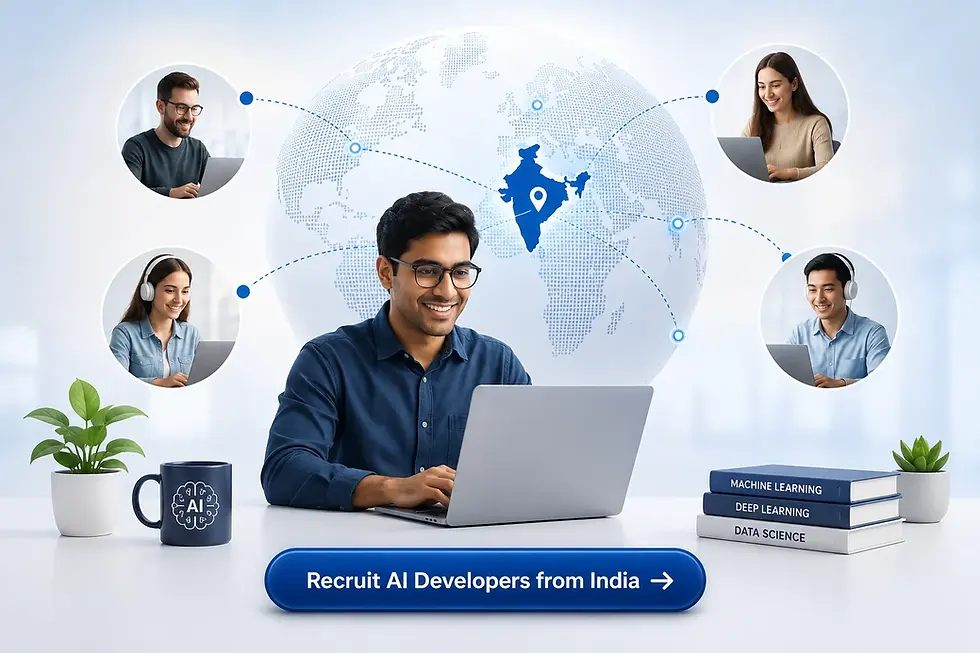
If you want to recruit AI developers in India for remote global teams, the number that matters most isn't annual salary. It's cost per hour of production ready engineering work, and right now that gap between India and markets like the US, UK, or Netherlands is wider than most founders expect. A senior AI engineer who costs a company in Frankfurt or Amsterdam over 100,000 euros a year can be hired in Bengaluru or Hyderabad at roughly a third of that cost, with the same depth in PyTorch, retrieval pipelines, and model evaluation. That's the real story behind why AI hiring from India has moved from a cost saving experiment to a default strategy for companies building agentic systems, copilots, and internal automation tools.
Why Global Companies Now Recruit AI Developers in India for Remote Global Teams
The AI hiring market has flipped in the last two years. Companies aren't just building simple chatbots anymore. They're building agent orchestration layers, retrieval augmented generation pipelines over proprietary data, and internal copilots that touch real customer information. That kind of work needs engineers who understand both model behavior and production systems, and that combination is in short supply almost everywhere except India, where it grew alongside a decade of global capability center investment from Google, Microsoft, and Amazon.
We're seeing this shift directly in the mandates coming through our desk. Roles that used to say "machine learning engineer" now say "AI engineer with agent orchestration experience" or "LLM evaluation lead." Companies that once wanted one generalist AI hire now want a small team: one engineer to own the model layer, one to own the data pipeline, and one to own evaluation and monitoring. This is exactly why so many founders and CTOs come to us wanting to recruit AI developers in India for remote global teams as a structured hiring plan rather than a single search.
Which Indian Cities Have the Right Talent for Your Remote AI Team
Bengaluru remains the deepest talent pool for applied AI work, largely because of the volume of global capability centers running serious AI research and applied science teams there. Hyderabad is close behind and has become our strongest source for engineers who combine AI skills with data engineering and MLOps, thanks to heavy investment from Microsoft and Amazon in the city.
Pune has a smaller but strong pool coming out of product companies. Delhi NCR and Chennai have good data science talent, but fewer engineers with real production experience shipping generative AI features at scale.
What Indian AI engineers bring reliably is strong fundamentals in PyTorch and TensorFlow, solid experience building retrieval pipelines with vector databases, and comfort working async with teams across US and European time zones. What they often lack is cost discipline around model API usage and a structured approach to evaluating model outputs rather than trusting a demo that looked convincing once. We test for both directly in technical screening before any candidate reaches a client.
Contract Hiring vs Full Time Hiring When You Recruit AI Developers in India
This is where many companies get stuck early. Contract hiring means engaging an AI developer for a fixed term or project scope, usually through an agency or an Employer of Record, without the long term commitment of a permanent role. It works well when you're validating a new AI feature or need extra capacity for a defined build cycle. Full time hiring means bringing someone onto your core team indefinitely, with statutory benefits, notice periods, and long term retention incentives built in.
Most companies starting out choose contract hiring first because it lets them test whether an engineer fits their stack and working style before committing further. Once the AI feature moves from experiment to core product, converting that contractor into a full time hire is usually simple through the same Employer of Record structure, and it avoids the friction of restarting a search from scratch.
Legal and Compliance Reality Behind Hiring AI Developers in India
Any company planning to recruit AI developers in India for remote global teams needs to get three things right early.
First, you cannot legally employ someone full time in India without either your own entity or an Employer of Record (EOR) acting as the legal employer on your behalf.
Second, the underlying employment relationship falls under state specific Shops and Establishments Acts, such as the Karnataka Shops and Commercial Establishments Act for Bengaluru based hires, along with the Payment of Gratuity Act for tenure based benefits.
Third, and increasingly overlooked, is data handling. If your AI developer processes personal data to train or evaluate models, India's Digital Personal Data Protection Act governs how that data can be stored, transferred, and consented to, and this needs to sit clearly in the contract alongside any GDPR obligations if you're serving European customers.
We've also seen IP disputes where a contractor's agreement never explicitly named model checkpoints and training pipelines as client owned work product. That single clause, written properly at the offer stage, prevents almost every dispute we've seen in three years of AI mandates.
The AI Developer Vetting Checklist Every Remote Team Should Use
This is the exact screening sequence we run before any AI candidate reaches a client interview.
Stage | What We Check | Why It Matters |
Portfolio review | Has the candidate shipped a model to production, not just a notebook demo | Reveals real monitoring and failure handling habits |
Framework depth | Hands on experience with PyTorch, TensorFlow, or JAX beyond calling a training function | Separates engineers who understand models from those who only call an API |
LLM specific round | Debugging a RAG pipeline and reasoning about cost versus latency tradeoffs | Filters out a large share of otherwise strong looking resumes |
MLOps and deployment | Model versioning, CI/CD for machine learning, and drift monitoring in production | Confirms the person can own a live system, not just build one |
Data governance | Understanding of DPDPA and GDPR obligations where relevant | Non negotiable for teams processing real customer data |
Communication fit | Live technical discussion directly with the hiring manager | Confirms comfort with async collaboration across time zones |
Save this table and use it to evaluate any recruiter, freelance platform, or internal referral you're considering alongside a dedicated AI hiring partner like AnjuSmriti Global.
Real Hiring Timeline and a Client Example
Our standard timeline runs in three phases. Week one is role scoping with the client's engineering lead to confirm exact stack and seniority bar. Weeks two and three cover sourcing and our internal technical screen, after which clients typically see their first shortlisted candidates. Client interviews and offer usually close by week five, and onboarding through an Employer of Record (EOR) takes another week.
A recent example, details kept anonymous by industry and size: a mid size European fintech needed a senior generative AI engineer to build document summarization over regulated financial data, requiring both AI depth and strict data handling awareness. We shortlisted four candidates within eighteen days.
Our first choice candidate's employer had a long notice period that only surfaced during final interviews, which would have delayed the client's launch. We caught it during standard verification and moved to our second ranked candidate, who started within two weeks. The feature has now been live in production for several months.
What It Costs to Recruit AI Developers in India for Remote Global Teams
Current market rates in Bengaluru and Hyderabad look roughly like this.
Mid level AI engineers with three to five years of experience earn between 24 and 34 lakh rupees annually.
Senior AI engineers with production LLM experience earn between 40 and 58 lakh rupees.
Lead or principal AI engineers earn between 68 and 95 lakh rupees. For comparison, equivalent senior talent costs well above 150,000 dollars in the US and above 90,000 pounds in the UK, before employer contributions that add another 20 to 35 percent depending on the country.
Budget for statutory employer contributions of roughly 12 to 13 percent, an Employer of Record management fee if you don't have your own entity, and a one time recruitment fee. Most clients reinvest the savings into a second AI hire or a dedicated evaluation engineer rather than treating the gap purely as margin.
Conclusion
The next wave of demand is shifting from generalist AI engineers toward specialists in agent orchestration and model evaluation, and toward hybrid hires who combine AI skills with strong data engineering. In our live mandates right now, most briefs specifically ask for retrieval and agent experience rather than classical model training alone. Companies that move early to recruit AI developers in India for remote global teams, while the market is still founder friendly on cost, will have a real structural advantage over competitors still trying to hire the same profile locally at double the price.
Ready to scope a role? Our team can usually turn around a shortlist within three weeks. Start your AI hiring mandate.
Interesting Reads:
FAQs
1.Can we hire AI developers in India without opening a local entity?
Yes. Most companies use an Employer of Record, which becomes the legal employer in India while the developer works exclusively on your team. This gets someone working for you within three to four weeks, compared to two to three months for setting up your own entity.
2.What is the difference between contract hiring and full time hiring for AI developers?
Contract hiring engages a developer for a defined term or project, often through an agency, with lower long term commitment. Full time hiring brings them onto your core team indefinitely with statutory benefits and notice periods. Most companies start with contract hiring, then convert once the role proves essential.
3.How much does it cost to hire an AI engineer in India compared to the US or UK?
A senior AI engineer in Bengaluru or Hyderabad typically costs a third to half of an equivalent hire in the US or UK, once salary, employer contributions, and management fees are included. Skill depth in frameworks like PyTorch and retrieval pipelines is comparable at the senior level.
4.How long does it take to recruit AI developers in India for a remote team?
A typical mandate takes about five weeks from role scoping to signed offer, with onboarding through an Employer of Record adding another week. Sourcing and technical screening usually produce a shortlist within the first three weeks.
5.Which Indian cities have the strongest AI and machine learning talent?
Bengaluru has the deepest pool, driven by global capability centers running applied AI research. Hyderabad follows closely with strength in MLOps and data engineering. Pune has solid mid level talent, while Delhi NCR and Chennai are stronger in data science than production grade generative AI work.
6.How do you confirm an Indian AI developer has real production experience?
Our technical screen includes a live scenario where candidates debug a retrieval pipeline with a real hallucination issue and reason through cost and latency tradeoffs. This filters out candidates whose experience is limited to demos or unlimited budget research environments.
7.Who owns the AI models built by contract developers in India?
Ownership depends entirely on what the contract states. Under the Indian Contract Act, work product ownership defaults to whoever the agreement names, which is why every AI contract should explicitly assign model weights, checkpoints, and training pipelines as client owned property from day one.
8.What compliance rules apply when Indian AI developers handle customer data for global teams?
India's Digital Personal Data Protection Act governs how personal data is stored, processed, and transferred by developers based in India. If you serve European customers, GDPR obligations apply alongside it, and both should be addressed explicitly in the employment or contractor agreement before data access begins.
Comments