.png)


What Changes When Scaling an India Team From 50 to 200 Employees?

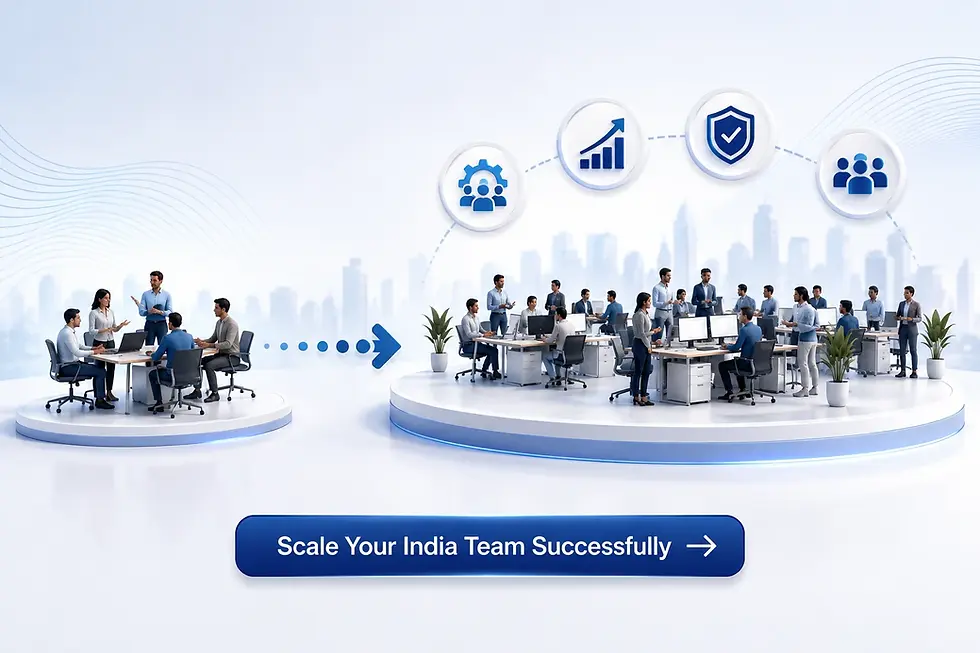
The moment an India team crosses roughly 50 people, the Employees' Provident Funds Act obligations that a founder was tracking manually start needing dedicated payroll infrastructure, and a Shops and Establishments registration filed for one office stops covering a second location the day a new city desk opens. We have walked more than a dozen clients through scaling an India team from 50 to 200 employees, and the pattern is always the same. The problems that surface are rarely about finding candidates. They are about compliance thresholds, missing management layers, and payroll systems built for 50 people being asked to run 200.
Why Does an India Team Change So Much Between 50 and 200 Employees?
At 50 employees, most India teams still run on a single HR generalist, informal reporting lines, and a founder or single India lead who knows every employee by name. At 200, none of that survives. GCC growth across Bengaluru and Hyderabad has made this transition common. Karnataka alone now hosts more than 1,400 GCCs employing over 600,000 people, and much of that growth comes from companies converting a 40 to 60 person pilot team into a full delivery centre within 18 to 24 months.
The shift is also being shaped by newer hiring patterns. Teams scaling right now are not just adding backend and QA headcount. They are building dedicated platform engineering, cloud cost optimisation, and applied AI teams inside their India centre, because global companies increasingly want AI and automation work handled close to the core engineering team rather than outsourced separately. A scale up that used to mean "more developers" now usually means a mix of engineering, data, AI tooling, and site reliability roles growing together.
Attrition adds another layer most founders underestimate. Bengaluru's engineering attrition still runs 15 to 20 percent a year, and Hyderabad's sits close behind at 14 to 18 percent. A company planning to add 150 net new employees needs to hire closer to 180 people once replacement hiring is factored in, or the scale up quietly falls behind schedule.
Which Indian Cities Have the Right Talent for This Kind of Scale?
Bengaluru holds the deepest bench for senior engineering, platform architecture, and product leadership, and it is usually where the first 15 to 20 leadership hires should go before volume hiring starts anywhere else. It also carries a 15 to 20 percent cost premium over Hyderabad or Pune for equivalent roles, since GCCs run by Walmart, Goldman Sachs, and Target compete hard for the same senior talent.
Hyderabad has become the volume engine for mid level engineering, data, and cloud roles thanks to its concentration of GCCs in HITEC City, and it typically absorbs 35 to 40 percent of total headcount once a scale up moves past its leadership phase. Pune and Chennai fill narrower gaps, Pune for fintech and auto tech adjacent skills, Chennai for SaaS product engineering with strong client facing communication.
A large part of scaling well comes down to choosing between contract hiring and full time hiring correctly for each role. Contract hiring works best for short term capacity, project based AI or data initiatives, and roles where a company wants to test fit before committing, and it is often arranged an onboarding and payroll are handled without setting up a separate structure. Full time hiring is the right call for core engineering, management, and any role tied to long term product ownership, because retention and institutional knowledge matter far more once the team crosses 100 people.
What Indian engineers consistently bring at this stage is strong individual technical depth. What most lack, specifically between 50 and 200 employees, is first time people management experience, since a senior engineer who thrived as an individual contributor at 50 people is often asked to manage six to eight people once the team hits 150. We test for this by asking candidates to walk through a real underperformance conversation they have actually led, not a hypothetical one.
What Legal Rules Kick In When Scaling an India Team From 50 to 200 Employees?
The Industrial Employment Standing Orders Act, 1946 applies nationally once an establishment reaches 100 workmen, but Karnataka, Maharashtra, and Gujarat have all reduced this threshold to 50 workmen through state amendments. That means a company scaling past 50 people in Bengaluru or Pune may already need certified Standing Orders covering classification, conduct rules, and termination procedure, and most founders only discover this during an inspection.
Two other laws are usually already active by 50 employees but need re verification as headcount grows. The Employees' Provident Funds and Miscellaneous Provisions Act, 1952 becomes mandatory at 20 employees and requires a 12 percent employer contribution on basic wages. The Sexual Harassment of Women at Workplace Act, 2013 requires a constituted Internal Committee once headcount passes 10. What changes at 200 employees is not whether these laws apply, it is whether the existing process can handle the volume without errors.
The common mistake is treating India compliance as a one time filing rather than a scaling checkpoint. Companies scaling through an Employer of Record (EOR) avoid most of this exposure because the EOR entity absorbs threshold tracking, while companies running their own India entity need a compliance calendar mapped to headcount milestones rather than the fiscal year alone.
The Headcount Checklist You Can Screenshot
This is the framework we hand every client before they scale past 50 people in India.
Headcount | What Typically Activates |
10+ employees | POSH Internal Committee mandatory, Maternity Benefit Act applies |
20+ employees | EPF registration mandatory, Payment of Bonus Act applies for eligible wage bands |
20+ contract workers | Contract Labour Regulation Act registration required |
50 to 100 employees | Standing Orders certification required in Karnataka, Maharashtra, and Gujarat |
100+ employees | Central Standing Orders Act applies nationally if not already triggered |
120 to 150 employees | Second management layer usually needed |
150 to 200 employees | Dedicated payroll compliance resource becomes cost justified |
200 employees | Formal grievance redressal system usually required |
This single table is what clients tell us they reuse most, because it turns "scale carefully" into a concrete check against a real headcount number.
How We Scale a Team From 50 to 200 Employees Without Losing Quality
Our process runs in three phases instead of one continuous sprint, because hiring 150 people at once produces worse outcomes than hiring in structured waves. Phase one fills the leadership and management layer, usually 15 to 20 hires across engineering managers, senior HR, and functional leads. Phase two runs parallel volume hiring across Bengaluru, Hyderabad, and Pune, typically delivering 8 to 15 qualified joiners a week once the pipeline is warm. Phase three shifts to steady state replacement hiring to offset attrition, usually starting around month five.
At AnjuSmriti Global, we also build a blended contract and full time hiring plan for most scale ups, since bringing in contract engineers for a defined AI tooling or migration project lets a client absorb a short term surge without inflating permanent headcount, while core roles are filled full time from day one for continuity.
One scenario shows how this plays out. A US headquartered fintech company, mid size and Series C funded, asked us to scale their Bengaluru team from 45 to 180 people over 14 months to build a full engineering and risk analytics centre. Around employee 92, a routine compliance check flagged that their entity had never registered under Karnataka's Standing Orders amendment, since their legal team was tracking only the national 100 workmen threshold.
Filing took six weeks and finished two weeks ahead of a labour department audit that would otherwise have created real hiring risk. The client reached 185 employees a month ahead of plan, with voluntary attrition held at 11 percent against a market average of 17 to 19 percent.
What Does It Actually Cost to Scale an India Team This Big?
Compensation mix shifts as much as headcount does.
Mid level engineers with three to five years of experience run ₹18 to 28 lakh per annum in Bengaluru and Hyderabad.
Senior engineers and tech leads run ₹32 to 48 lakh. Engineering managers and directors run ₹55 to 90 lakh, with VP Engineering or India site head roles reaching ₹1 to 1.6 crore.
On the HR side, a mid level business partner runs ₹14 to 20 lakh, and a senior people leader runs ₹35 to 55 lakh.
Compared with an equivalent build out through direct UK or US hiring, where fully loaded engineering cost typically runs three to four times the India cost for the same seniority, most clients reinvest the savings into building the management layer earlier or into a dedicated payroll outsourcing partner.
This is also where the contract versus full time decision matters financially, since contract roles carry no gratuity or long term severance liability, making them useful for testing new AI or automation functions before converting the strongest performers into full time roles as the team stabilises.
Conclusion
Standing Orders exposure is becoming a more visible risk as labour departments increase inspection frequency around India's biggest GCC hubs, particularly in Karnataka. AI adoption inside India delivery centres is also changing the shape of a scale up itself, with companies now building dedicated platform and applied AI functions into their India headcount rather than treating AI work as a separate offshore project.
In live mandates right now, more clients are asking us to run a compliance audit before volume hiring starts rather than after, which is the right order but a real shift from how most scale ups approached this even a couple of years ago. Companies serious about scaling an India team from 50 to 200 employees are treating compliance as part of the hiring plan itself, not a parallel legal workstream.
If you are planning this kind of scale up and want a hiring and compliance roadmap built around your real headcount targets, reach our team here.
Interesting Reads:
FAQs
1.At what headcount does the Industrial Employment Standing Orders Act apply to an India team?
Nationally the threshold is 100 workmen, but Karnataka, Maharashtra, and Gujarat have amended it down to 50. A company scaling past 50 employees in these states may already need certified Standing Orders covering conduct rules and termination procedure. Waiting until 100 employees to check this is a common and costly mistake we see repeatedly during audits.
2.Do we need separate PF and ESI registrations across multiple India cities during a scale up?
PF is registered at the company level under a single Universal Account Number system, so one registration generally covers employees across cities. ESI is different since it is state administered, so scaling into Hyderabad or Pune alongside Bengaluru requires separate ESI registration in each state, typically taking three to four weeks per location to complete.
3.How many managers do we need once our India team reaches 200 people?
A healthy span of control for engineering teams in India sits around six to eight direct reports per manager. For 200 employees that generally means 22 to 28 first line managers plus four to six second line leads reporting into a site head. Teams that skip this structure see attrition rise sharply between 120 and 160 employees.
4.What is the biggest reason India hiring timelines slip during a scale up?
Underestimating attrition driven backfill is the most common cause. With engineering attrition running 14 to 20 percent across Bengaluru and Hyderabad, a company targeting 150 net new hires actually needs closer to 180 total hires. Planning against net headcount alone consistently leads to an 8 to 12 percent shortfall by year end.
5.Should we move from an EOR model to our own India entity once we cross 100 employees?
There is no fixed headcount that forces this switch. Most companies evaluate it between 80 and 150 employees, once ongoing EOR fees exceed the amortised cost of entity setup and in house compliance staff. The right call depends on whether the team plans to keep growing past 200 or stabilise there.
6.What do Indian engineers moving into management roles usually struggle with?
The most common gap is delivering direct, uncomfortable feedback in one on one settings, since many senior engineers come from individual contributor heavy cultures where performance issues were escalated to HR instead. We test for this using real underperformance scenarios candidates have personally handled rather than hypothetical management questions.
7.Does the Payment of Bonus Act apply once our team crosses 100 employees?
The Act applies to employees earning up to ₹21,000 a month in gross wages, regardless of total headcount, once the establishment crosses 20 employees. As teams scale and add support and junior operations roles, more employees often fall into this wage band than founders initially expect, so it needs periodic reassessment rather than a one time check.
8.How long does a responsible 50 to 200 employee scale up in India usually take?
Twelve to eighteen months is realistic for a scale up that builds its management layer before volume hiring. Companies that try to compress this into six to eight months by hiring volume first consistently see quality and retention issues emerge once the team passes 100 employees, because there is no one available to onboard and coach new joiners properly.
Comments