.png)


Top Staff Augmentation vs Dedicated Team for India IT Projects

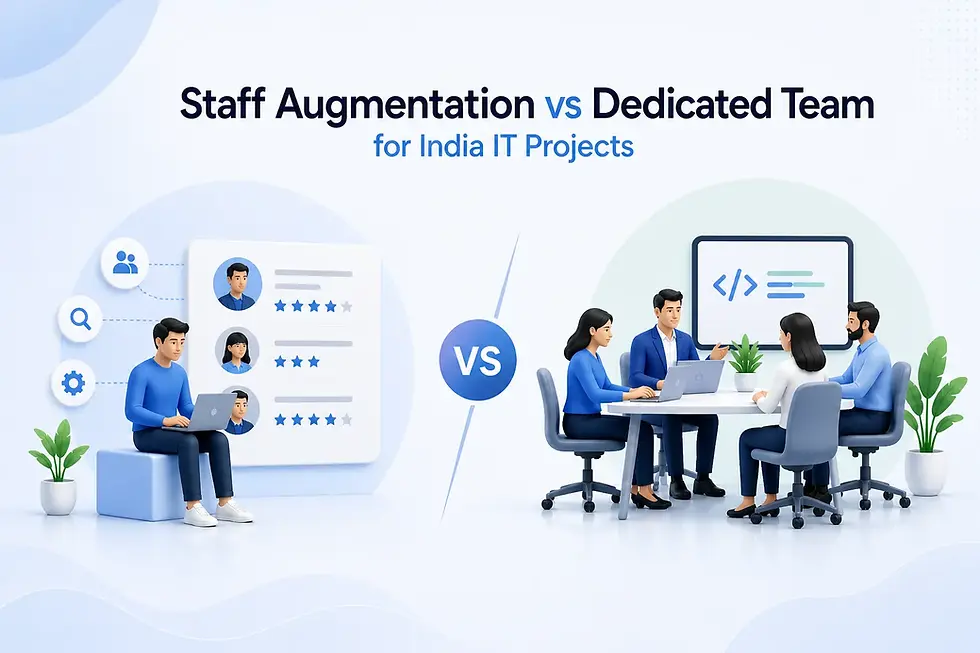
Scaling an IT team in India is often seen as a straightforward move, access to skilled talent, reduced costs, and faster development. However, in reality, the biggest challenge is not hiring talent, it is choosing the right hiring model. This is where the decision around staff augmentation vs dedicated team for India IT projects becomes critical for aligning your execution strategy with business goals.
Startups working toward product market fit often need speed but lack structured hiring processes. SMEs must balance budget efficiency with consistent delivery, while global companies entering India deal with compliance challenges, operational complexity, and team alignment issues. Despite different contexts, they all face one common problem, building the right team structure at the right time.
Choosing the wrong model can lead to delays, increased costs, and inefficiencies. The right choice, however, improves delivery speed, enhances team productivity, and creates a scalable foundation for growth. This blog helps you make that decision with clarity and confidence.
Understanding Staff Augmentation in India’s IT Ecosystem
Staff augmentation is a flexible hiring model that allows businesses to extend their internal teams with external professionals. These individuals work under your direct management and follow your internal workflows, tools, and processes. This makes it an ideal solution for companies that want to maintain control while scaling quickly.
In India, this model is especially effective due to the availability of a large and diverse talent pool. Businesses can onboard skilled developers, engineers, and specialists rapidly without long recruitment cycles. This speed becomes critical when projects have tight deadlines or require niche expertise for a limited duration.
For example, a company preparing for a product launch may need additional developers for a short period. Instead of hiring full-time employees, they can use staff augmentation to bring in experienced professionals who contribute during critical phases and exit once the work is completed.
However, this approach requires strong internal leadership. Since your team is responsible for managing resources, success depends on effective coordination, communication, and performance tracking.
The Dedicated Team Model: A Long-Term Growth Strategy
The dedicated team model is built for long-term collaboration and business alignment. Instead of hiring individual contributors, companies engage a complete team that works exclusively on their project. This team typically includes developers, QA engineers, designers, and project managers who function as an extension of your organization.
Over time, a dedicated team develops a deep understanding of your product, workflows, and long-term objectives. This continuity leads to better efficiency, fewer errors, and stronger accountability. The team is not just executing tasks, it is contributing to the overall product vision.
For example, a SaaS company expanding its platform may establish a dedicated team in India to manage continuous development and innovation. Rather than repeatedly onboarding new resources, they build a stable team that evolves alongside the product.
While the initial setup may take slightly longer, the long-term advantages such as scalability, consistency, and improved output quality make it a strategic choice for growing businesses.
Staff Augmentation vs Dedicated Team for India IT Projects: A Strategic Comparison
Choosing between these models requires a clear understanding of how they impact business performance, cost control, and scalability.
Criteria | Staff Augmentation | Dedicated Team |
Engagement Model | Short to mid-term engagement based on project needs | Long-term collaboration aligned with business goals |
Flexibility | Highly flexible with easy scaling up or down | Moderately flexible with structured scaling |
Control & Oversight | Full control managed by the client’s internal team | Shared control with vendor-supported management |
Speed of Hiring | Rapid onboarding, often within days | Slightly longer setup due to team formation |
Cost Structure | Variable costs based on resources and duration | Fixed monthly pricing for predictable budgeting |
Best Use Cases | Filling skill gaps, short-term projects, urgent requirements | End-to-end product development and long-term scaling |
Team Stability | Lower stability due to resource rotation | High stability with consistent team members |
Management Effort | Requires active involvement from the client’s team | Reduced effort with built-in project management |
Security & Compliance | Moderate, depends on multiple external resources | Higher control with structured and stable environment |
This comparison highlights a clear distinction, staff augmentation focuses on flexibility and speed, while dedicated teams provide stability and long-term alignment.
Why India Is the Preferred Destination for IT Hiring
India has established itself as a global IT hub due to its highly skilled workforce, cost efficiency, and a mature outsourcing ecosystem. Businesses across the world rely on India not just to reduce costs, but to access specialized talent across technologies such as cloud, AI, and full stack development. The availability of experienced professionals, combined with strong communication capabilities and global delivery experience, makes it easier for companies to build and scale high-performing engineering teams.
However, the real advantage lies in choosing the right hiring structure. Companies that align their hiring model with their long-term business goals are able to maximize productivity, improve collaboration, and ensure consistent delivery. Instead of treating India only as a cost-saving destination, businesses that take a strategic approach to team building are better positioned to drive innovation and achieve sustainable growth.
Compliance, Risk, and Operational Efficiency
Hiring in India involves navigating labor laws, taxation, and payroll compliance, which can be complex for companies without local expertise. Staff augmentation simplifies this process by shifting compliance responsibilities to the service provider. Dedicated teams, while offering deeper integration, require structured governance and oversight.
Working with experienced partners such as Anjusmriti Global helps businesses manage these complexities effectively, ensuring compliance, reducing risk, and enabling smooth operations while scaling in India.
5 Essential Criteria for Choosing the Right Hiring Model
Choosing the right hiring model requires evaluating practical business factors rather than relying on assumptions.
1.Project Timeline and Continuity Requirements
The first key consideration is your project timeline. Long-term projects demand continuity, making dedicated teams more effective as they build deep familiarity with your systems over time. Short-term requirements, however, benefit from the flexibility of staff augmentation, allowing you to quickly onboard talent and scale down once the work is completed.
2.Internal Management Capacity and Leadership Bandwidth
Another important factor is your internal management capacity. If your leadership team has the bandwidth to manage additional resources, staff augmentation can work efficiently. However, if your team is already stretched, a dedicated team with built-in management support ensures smoother coordination and reduces operational burden.
3.Clarity and Evolution of Project Requirements
The clarity of your requirements also plays a crucial role. Stable and well-defined tasks align well with staff augmentation, where specialists can execute specific responsibilities. On the other hand, evolving product development benefits from a dedicated team’s adaptability, as they can adjust to changing priorities and contribute strategically.
4.Security, Compliance, and Codebase Sensitivity
Security and compliance are critical, especially for businesses handling sensitive data or operating in regulated industries. Dedicated teams provide better control and lower risk due to their stable structure, while frequent changes in augmented staff may increase exposure to your codebase.
5.Budget Structure and Financial Predictability
Finally, budget structure is a key consideration. Staff augmentation offers flexible, variable costs that work well for short-term needs. Dedicated teams, however, provide predictable pricing through fixed monthly models, making long-term financial planning more stable and manageable.
Real-World Strategy: The Hybrid Approach
Many businesses today adopt a hybrid approach by combining staff augmentation and dedicated teams to balance flexibility and stability. This allows organizations to address immediate hiring needs while also building a long-term development foundation. For example, startups often begin with staff augmentation to accelerate product development and quickly enter the market.
As the product evolves and the need for continuity increases, businesses transition toward dedicated teams to ensure stability, deeper product understanding, and consistent delivery. This approach enables companies to scale efficiently while maintaining control, reducing operational risks, and adapting to changing business requirements without disrupting ongoing progress.
Closing Perspective: Strategic Takeaways for Smarter IT Hiring
Choosing between staff augmentation vs dedicated team for India IT projects is less about picking a model and more about building the right operational foundation for your business. The most effective organizations align their hiring decisions with their product lifecycle, internal capabilities, and long-term growth strategy.
Early-stage initiatives often benefit from the flexibility of staff augmentation, while scaling businesses gain more value from the stability and continuity of dedicated teams. Understanding when and how to use each model ensures better efficiency, faster delivery, and improved resource utilization.
Another key insight is that success depends not just on hiring talent, but on how well that talent is structured and managed. Even highly skilled professionals require the right level of direction, collaboration, and ownership to deliver consistent results. Businesses that prioritize alignment, continuity, and clear execution frameworks are better positioned to achieve sustainable growth. Ultimately, the goal is to create a system that supports innovation, reduces operational friction, and drives long-term performance.
Interesting Reads:
FAQs
1.Which model delivers faster onboarding for India-based IT projects—staff augmentation or a dedicated team?
Staff augmentation typically enables faster onboarding because companies can plug in pre-vetted Indian developers into existing workflows with minimal ramp-up time. This model suits urgent project gaps where speed matters more than long-term alignment. Dedicated teams, while slightly slower to start, offer better cohesion and stability once fully onboarded.
2.How do global companies decide between staff augmentation and hiring a dedicated team in India?
Global companies often evaluate project scope, duration, and control requirements before choosing between these models in India. Staff augmentation works well for short-term scaling, while dedicated teams are preferred for strategic, long-term development initiatives. Cost predictability and management involvement also influence the decision.
3.Is staff augmentation more cost-effective than a dedicated team for IT outsourcing in India?
Staff augmentation can be more cost-efficient for short-term needs since businesses only pay for specific skills and durations. However, for long-term projects, a dedicated team in India often provides better value due to consistent productivity and reduced turnover. Companies should compare total cost of ownership rather than just hourly rates.
4.Which model offers better control over project management in India IT outsourcing?
Staff augmentation gives companies full control, as augmented developers work under the client’s direct supervision and processes. In contrast, a dedicated team often operates with shared or vendor-led management, reducing internal workload but also slightly limiting direct oversight. The choice depends on how hands-on the organization wants to be.
5.What are the scalability benefits of staff augmentation vs dedicated teams in India?
Staff augmentation allows rapid scaling up or down based on project demands, making it highly flexible for dynamic workloads. Dedicated teams provide scalability as well, but adjustments may take more time due to team structure and long-term commitments. Businesses prioritizing agility often lean toward augmentation.
6.How does quality compare between staff augmentation and dedicated teams in India?
Quality depends largely on talent selection and management practices rather than the model itself. Staff augmentation can deliver high-quality outcomes when integrated effectively into internal teams. Dedicated teams, however, often build stronger collaboration and domain expertise over time, which can enhance consistency and innovation.
7.Which model is better for long-term digital transformation projects in India?
For long-term initiatives, a dedicated team is usually the better choice because it ensures continuity, domain understanding, and aligned goals. Staff augmentation may struggle with consistency if team members rotate frequently. Many global enterprises prefer dedicated teams in India for sustained innovation and product development.
8.Are there any risks associated with staff augmentation compared to dedicated teams in India?
Staff augmentation may pose risks like integration challenges or dependency on individual contributors if not managed properly. Dedicated teams reduce these risks by offering a structured setup, but they require trust in the external partner. Proper onboarding and communication strategies can mitigate risks in both models.
9.How do communication and collaboration differ between these two models in India IT projects?
With staff augmentation, communication aligns directly with internal teams, making collaboration seamless if processes are well-defined. Dedicated teams often establish their own workflows, which may require structured coordination but can improve efficiency over time. Time zone alignment and cultural compatibility in India support both models effectively.
10.Can businesses combine staff augmentation and dedicated team models for India IT projects?
Yes, many companies adopt a hybrid approach to balance flexibility and long-term stability. For example, they may use staff augmentation to handle peak workloads while maintaining a dedicated team for core development. This blended strategy is increasingly popular among global firms looking to optimize performance and costs.
Comments