.png)


How Sweden Gaming Studios Hire Indian Unity Developers on Contract?

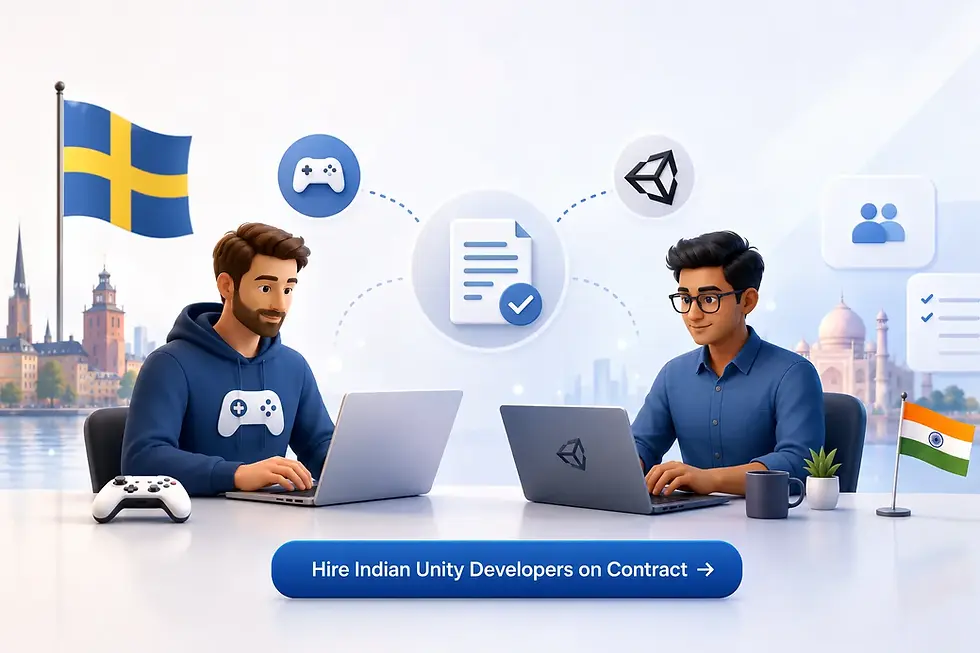
A mid-level Unity developer in Stockholm costs a Swedish studio approximately SEK 734,000 per year once you account for gross salary, the mandatory 31.42% employer social fees under Socialavgiftslagen (2000:980), and ITP1 pension contributions. The equivalent role filled by an Indian Unity contractor via an Employer of Record comes in at roughly SEK 195,000 all-in for year one. That gap is the reason Sweden gaming studios hire Indian Unity developers on contract at a pace we have not seen slow down since we started placing engineers into Scandinavian studios.
When Sweden gaming studios hire Indian Unity developers on contract, they are not cutting corners. They are extending engineering bandwidth in a market where local Unity talent has been functionally exhausted for several years. We have placed Unity engineers into Swedish studios ranging from eight-person indie teams in Malmo to 120-person mobile gaming companies headquartered in Stockholm. The mechanics of doing this compliantly and well are specific enough that a general guide will not serve you. This article is about Sweden, Unity, and the contract model.
Why Swedish Gaming Studios Cannot Hire Fast Enough Locally
Sweden punches well above its weight in gaming. The country that gave the world Minecraft, Battlefield, Candy Crush, and Valheim has a disproportionate concentration of studios relative to its population of ten million. Stockholm alone hosts King, DICE, Paradox Interactive, Mojang, and Avalanche Studios. Gothenburg has Massive Entertainment. Malmo has Sharkmob.
Every one of these studios competes for the same pool of Swedish Unity developers. Based on mandates we have managed, the active Unity talent pool in Sweden with three or more years of commercial experience does not exceed 2,800 professionals nationwide. That includes people already employed. When a studio needs to staff up a mobile game project or an XR prototype on a six-month timeline, local hiring is slow and expensive.
Average time-to-hire for a senior Unity developer in Sweden through local channels runs 14 to 18 weeks. Studios we work with have reported receiving fewer than four qualified applications per open Unity role on LinkedIn or Arbetsformedlingen before giving up and contacting us.
The Swedish gaming industry has responded by embracing remote contract hiring from India faster than almost any other European market we serve. Swedish studios already operate with distributed teams. The culture accommodates async collaboration, detailed documentation, and outcome-based management. When we present an Indian Unity engineer to a Swedish hiring manager, the conversation is rarely about whether remote work is viable. It is almost always about technical depth and timezone fit.
IST is 3.5 hours ahead of CET. A Bengaluru-based Unity engineer who starts at 9:00 AM IST has a 5.5-hour overlap window with a Stockholm team that starts at 9:00 AM CET. Our placed engineers typically shift to a 10:00 AM to 7:00 PM IST schedule, which gives four solid hours of live collaboration before the Stockholm team logs off.
Where India's Unity Talent Lives and What Contract Hiring Actually Delivers
The deepest Unity talent pools in India sit in three cities, and they are not interchangeable.
Bengaluru produces the highest volume of Unity engineers with cross-platform commercial experience across PC, console, and mobile. Engineers here have strong C# fundamentals, experience with Unity's DOTS and ECS architecture, and solid shader knowledge covering HLSL, ShaderLab, and URP/HDRP pipelines. This is the city we draw from for senior and lead roles.
Hyderabad has a strong pipeline of mid-level Unity engineers with mobile-first experience on Android and iOS, Unity Ads integrations, and analytics tooling. If a Swedish studio needs multiple engineers at mid-level for a mobile casual title, Hyderabad is the most cost-efficient source.
Pune has a growing concentration of Unity engineers with strengths in UI systems, Unity UI Toolkit, and VR/AR prototyping, which is relevant for Swedish studios doing XR work.
What contract hiring actually means for a Swedish studio:
Contract hiring gives studios access to pre-vetted, project-ready engineers without the overhead of permanent headcount. There are no long-term employment obligations, no Swedish social fee accumulation on permanent staff, and no redundancy exposure if a project concludes. Studios can scale a team up for a production sprint and right-size it after launch.
In the $30 to $50 per hour range, companies can hire almost any type of technology candidate through the contract model, including software developers, cloud engineers, DevOps professionals, AI engineers, data scientists, cybersecurity specialists, SAP consultants, and other niche technology experts. For gaming studios specifically, this budget covers mid-level to senior Unity engineers from India with commercial shipping experience. The contract model means the studio pays only for active engagement hours, with no benefits overhead, no notice periods under Swedish LAS, and no pension contribution obligations.
The flexibility extends to skills access. A studio building a multiplayer PC title needs different Unity expertise than one building a mobile AR product. Contract hiring lets studios bring in the exact specialisation they need for a defined period, rather than hiring a generalist permanently and hoping their skills stretch far enough.
AnjuSmriti Global has structured contract engagements for Swedish clients ranging from single-engineer placements on three-month feature builds to five-engineer contract teams running 18-month project cycles. The model works at both ends of that range.
The Legal and Compliance Reality for Contract Hiring Between Sweden and India
Sweden's employment framework is structured. The primary legislation governing employment relationships is Lag (1982:80) om anstallningsskydd, known as LAS. For contract arrangements, the relevant frame shifts to the Lag (1993:440) om privat arbetsformedling, which governs private labour market intermediaries, and to tax classification rules under Inkomstskattelagen.
The most common mistake Swedish studios make is treating an Indian Unity contractor as a simple B2B service provider without understanding Swedish tax residency and permanent establishment implications. If a Swedish company enters into a direct services contract with an Indian individual and that individual works exclusively for the Swedish client for more than six months, Swedish authorities may reclassify the engagement as an employment relationship. The studio then faces retroactive employer tax obligations and penalties.
The right structure for most studios is the Employer of Record (EOR) model, where the Indian engineer is employed by an Indian EOR entity that handles PF under the Employees' Provident Funds and Miscellaneous Provisions Act 1952, ESI, TDS, and all Indian statutory obligations. The Swedish studio contracts with the EOR, not with the engineer directly. This eliminates PE risk and keeps the engagement clean under Swedish law.
One nuance worth knowing: Sweden's Uthyrningslagen (Lag 2012:854 om uthyrning av arbetstagare) entitles temporary workers placed at a Swedish user company to equal pay and conditions after 12 weeks. However, this applies to workers physically placed in Sweden. Remote Indian engineers on an EOR contract in India fall outside this scope because both the employment relationship and work location are outside Sweden. We have confirmed this interpretation with Swedish employment law counsel on multiple mandates.
A second compliance point that studios consistently miss involves IP ownership. Under Swedish upphovsratten (Upphovsrattslagen 1960:729), copyright in a work vests in the creator by default. For the studio to own all code and assets produced by the Indian engineer, an explicit IP assignment clause must appear in the services agreement between the studio and the EOR, and be mirrored in the EOR's employment contract with the engineer.
Sweden Gaming Unity Developers Hiring Cost Comparison: Contract vs Local Permanent Hire Indian
The widget above this section shows the full cost breakdown. Here is the narrative.
India contract rates for Unity developers (INR per month, all-in to EOR):
A mid-level Unity engineer with three to five years of experience, mobile and PC background, and solid C# commands INR 1,60,000 to 1,90,000 per month. A senior Unity engineer with six to nine years, cross-platform experience, DOTS/ECS knowledge, shader programming, and shipped titles commands INR 2,40,000 to 2,80,000. A Unity technical lead or architect with ten or more years, engine-level knowledge, and team management experience commands INR 3,30,000 to 3,90,000.
Swedish market salaries for the same roles:
A mid-level Unity developer in Stockholm earns approximately SEK 42,000 to 48,000 per month gross. Senior roles range from SEK 58,000 to SEK 68,000. Leads and architects command SEK 75,000 to SEK 90,000. Add 31.42% employer social fees and ITP1 pension, and employer cost climbs substantially as shown in the table.
The EOR fee is typically 12 to 18% of the engineer's monthly rate. AnjuSmriti's agency placement fee is a one-time charge at contract initiation. There is no recurring margin on the engineer's rate.
What clients reinvest the savings into: the studios we work with most commonly extend Indian engineering headcount, bring in additional QA automation engineers from India, or redirect budget toward publisher relations and marketing. The productivity math is straightforward: more engineers per SEK of payroll budget.
For studios considering volume hiring across multiple roles, the bulk hiring model allows structured intake of multiple engineers on a single coordinated timeline, reducing the per-placement overhead significantly.
Our Process and a Real Proof Point
Our standard process for placing Unity engineers into Swedish studios runs 18 to 22 working days from initial brief to signed contract.
Days 1 to 3: We brief our Bengaluru and Hyderabad sourcing teams with the exact Unity version, platform, and genre context. We pre-screen for English fluency at B2 CEFR level or above.
Days 4 to 8: We shortlist 6 to 8 profiles and conduct our internal Unity technical screen. This includes a game-feel prototype task (a rough character controller scene that candidates must improve using only code), a C# code review of a provided script with deliberate bugs, and a 20-minute call probing architecture decisions.
The game-feel task is the screen that matters most for Swedish clients. We look for coyote time on jumps, input buffering, camera lag tuning. These are signals that an engineer has worked alongside designers refining player feedback loops, not just implemented feature tickets.
Days 9 to 14: We present three to four profiles to the client with written technical notes. The studio conducts their own 60-minute technical interview.
Days 15 to 22: Offer, EOR contract execution, and IT access setup.
The client scenario: A Stockholm-based mobile gaming studio with approximately 45 employees and over 50 million downloads came to us needing three Unity engineers urgently. They had been running a local hiring process for four months, hired one engineer who left after six weeks, and were now behind on a feature release tied to a publisher milestone.
We placed two senior Unity engineers from Bengaluru and one mid-level engineer from Hyderabad within 19 working days, all via EOR. The studio hit its publisher milestone with two days to spare.
What almost went wrong: One Bengaluru engineer had a pending PF transfer from a previous employer that the EOR flagged during registration. PF transfer delays in India can delay the official start date by one to two weeks. We caught this on Day 11, accelerated the EOR's PF transfer filing, and used the gap to run async onboarding with the studio's codebase. The engineer had reviewed 40,000 lines of Unity code before his official start date, which compressed ramp-up time significantly.
Compliance and Onboarding Checklist for Swedish Studios
Pre-engagement
Confirm studio F-tax registration status in Sweden
Decide hiring model: EOR vs direct India entity. Do not default to B2B individual contract
Define Unity version, platform targets, and render pipeline (URP/HDRP/Built-in)
Prepare technical assessment: Unity scene file, C# code review task, architecture discussion
Confirm IP assignment clause covers all work product. Upphovsrattslagen requires explicit written assignment
Engagement setup
Execute services agreement between studio and EOR, not between studio and individual
Confirm engineer's Indian PF and ESI registration with EOR
Agree on IST working hours and CET overlap window in writing
Set up Unity Cloud, Perforce or Git LFS, and Slack/Discord access
Confirm NDA and GDPR data processing agreement. GDPR applies even when the processor is in India
Ongoing compliance
Verify EOR payroll disbursement is confirmed each month before sprint planning
Review access permissions if engineer scope changes
90-day structured performance check. Set this date before Day 1, not after a problem emerges
Conclusion
The Swedish gaming market continues to evolve rapidly, shaped by large-studio consolidation and the rise of AI-assisted development tooling that is making smaller teams more productive. Studios that build lean, cross-border engineering teams are positioned to move faster than competitors locked into local hiring cycles.
In our live mandates right now, Swedish studios are asking specifically for Unity engineers with experience in AI navigation tooling and Netcode for GameObjects for multiplayer, a signal that the technical bar is rising even at mid-level. When Sweden gaming studios hire Indian Unity developers on contract through a structured EOR model, they are building a repeatable hiring capability that scales with project demand.
If you are a Swedish studio and want to understand what this looks like for your team and project, submit your brief here and we will respond within one business day.
Interesting Reads:
FAQs
1.Does Sweden's LAS apply to an Indian Unity engineer working remotely under an EOR contract?
LAS governs employment on Swedish territory. An Indian engineer employed by an Indian EOR entity and working from India is not covered by LAS. The employment relationship is governed by Indian labour law. The Swedish studio holds a B2B services relationship with the EOR, not an employment relationship with the engineer. The studio has no Swedish statutory notice or redundancy obligations under this structure.
2.Which Swedish gaming sub-sectors currently have the highest demand for Unity engineers?
The strongest demand is in three areas: hypercasual and hybrid-casual mobile games, XR and location-based entertainment tied to retail and tourism, and serious games for defence simulation, medical training, and industrial applications. Multiplayer PC games built in Unity rather than Unreal represent a smaller but consistent demand segment concentrated in Stockholm and Gothenburg studios.
3.How does IP ownership work when a Unity engineer is on an Indian EOR payroll contributing to a Swedish studio's codebase?
Under Upphovsrattslagen 1960:729, copyright vests in the creator by default in Sweden. An explicit IP assignment clause must appear in the services agreement between the studio and the EOR, and must be mirrored in the EOR's contract with the engineer. Studios using generic B2B templates without this clause create ownership ambiguity that becomes expensive to resolve when a publisher requires a clean IP warranty at game launch.
4.What Unity-specific skills are most commonly overstated on Indian engineers' CVs?
DOTS/ECS and shader programming are the two most inflated claims. Many engineers list these after completing tutorials rather than shipping production systems. Our technical screen asks candidates to build a simple ECS movement system from scratch and modify a URP shader to add a dissolve effect. Engineers with genuine experience complete both tasks within 50 minutes. Tutorial-level candidates take 90 to 120 minutes and produce fragile code.
5.How do Swedish studios manage the CET to IST timezone gap during production milestones?
Our placed engineers typically work 10:00 AM to 7:00 PM IST, creating a four-hour overlap with Stockholm. During crunch, studios extend this by asking engineers to start at 8:30 AM IST and the Stockholm team to start at 10:30 AM CET, creating a two-hour live window. This arrangement needs explicit written agreement in advance. Informal requests during a deadline week create friction and rarely work as intended.
6.What is the minimum contract duration that makes commercial sense for Swedish studios?
Below three months, onboarding cost relative to productive output is difficult to justify. Our practical minimum recommendation is six months with a three-month extension option. Most Swedish clients start at six months and extend to 12 or 18 months once the engineer is ramped. For project-based work, we structure contracts around deliverable phases with a minimum of 90 working days per phase to ensure the investment in onboarding pays off.
7.Can a Swedish studio convert an Indian Unity contractor to a permanent employee?
Yes. The simplest path is converting the EOR relationship to a long-term EOR permanent employment arrangement without the Swedish studio establishing an Indian entity. The engineer's compensation typically increases at conversion due to higher statutory benefit obligations in India, but total employer cost remains substantially below a local Swedish permanent hire. We have facilitated several such conversions for Swedish gaming clients.
8.Which Indian cities produce Unity engineers with multiplayer networking experience in Netcode for GameObjects or Mirror?
This is a narrow pool concentrated in Bengaluru, where studios building online PC and mobile games have created engineers with real multiplayer experience. Hyderabad has a smaller pool from mid-core mobile titles with PvP components. Sourcing for multiplayer Unity profiles takes 10 to 15 business days versus 7 to 10 for standard Unity roles, and our technical screen includes a specific Netcode for GameObjects module covering host/client session setup and authoritative movement.
Comments