.png)


How Swiss Firms Manage Hiring in India Through EOR Solutions

Updated: May 15
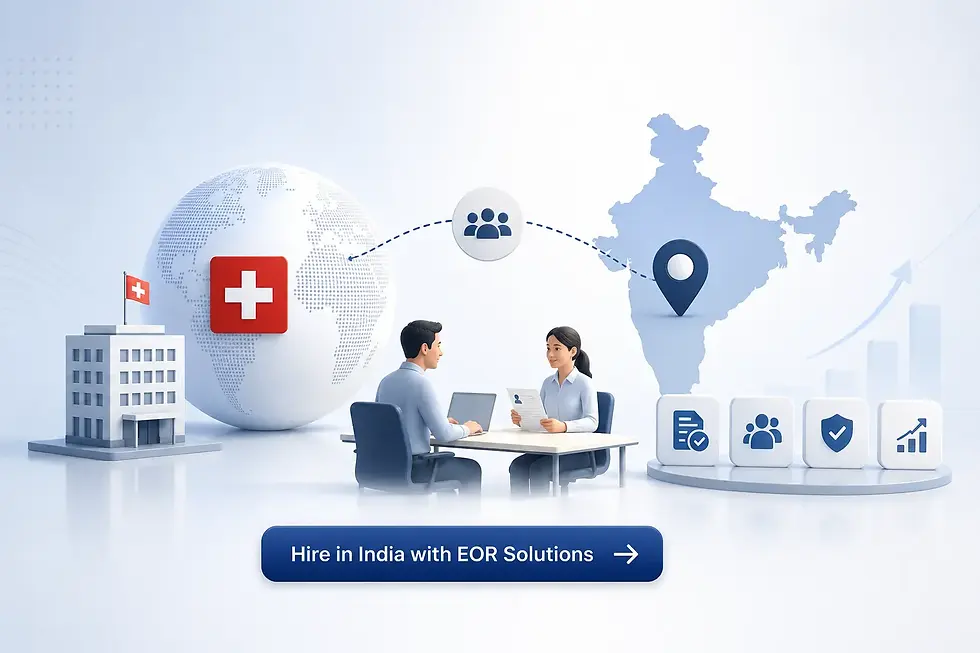
In our experience closing 500+ cross-border tech mandates, a mid-level software or cloud engineer in Switzerland carries a total annual cost of CHF 130,000 to 160,000 for the employer, including social charges and benefits. The same experienced professional, hired compliantly from India, allows Swiss firms manage hiring in India through EOR solutions at roughly 30-40% of that cost while delivering equivalent or faster output. This stark difference explains why Swiss pharma, fintech, banking, and precision manufacturing companies are rapidly expanding their Indian tech teams without setting up a local entity.
By appointing a compliant Indian Employer of Record (EOR), Swiss companies can handle local employment, payroll, PF, ESI, gratuity, and all statutory obligations while retaining full operational control over the team. This model has become the preferred route for many of our Swiss clients seeking speed without heavy administrative burden.
Why Swiss Companies Struggle to Hire Tech Talent Locally And Turn to India
Swiss firms headquartered in Zurich, Geneva, Basel, and Lausanne are operating in one of Europe’s most competitive talent markets. Local unemployment in the IT sector remains extremely low, and the supply of experienced engineers in areas like cloud infrastructure, cybersecurity, DevOps, AI/ML integration, and enterprise software simply cannot keep pace with demand.
From what we see in live mandates, a typical senior DevOps or cloud architect role in Switzerland stays open for 6 to 9 months. Companies face salary expectations starting at CHF 140,000-180,000 base for mid-to-senior levels, plus 20-30% additional employer contributions for pension (AHV/ALV/BVG), accident insurance, and other benefits. Strong protections under Swiss law also make termination complex and costly, reducing hiring flexibility.
This talent crunch is especially acute in highly regulated sectors. Swiss pharmaceutical giants and private banks require engineers who understand GxP, audit-ready systems, data privacy, and high-availability infrastructure. Local candidates with this exact blend are scarce and expensive. As a result, forward-looking Swiss organizations use Swiss firms manage hiring in India through EOR solutions our team Anjusmriti Global to build hybrid delivery models with strong Indian extensions.
India offers scale, depth, and cultural compatibility. Over 328 Swiss companies already have a presence in India, employing more than 146,000 professionals. The time zone overlap of 3.5 to 4.5 hours between IST and CET allows meaningful daily collaboration. Morning Zurich meetings align perfectly with Indian afternoon hours. Our team has observed that Swiss precision and quality focus combine effectively with Indian engineers’ strong problem-solving abilities and execution speed.
However, success is not automatic. Swiss teams value detailed documentation, proactive risk reporting, and structured stakeholder updates. Indian engineers sometimes need initial guidance to match these expectations. This is exactly where our recruitment process adds the most value. We don’t just source talent; we prepare both sides for long-term collaboration.
We have helped multiple Swiss mid-sized firms (150-800 employees) move from zero to 15-40 person Indian teams within six months, delivering measurable acceleration in product development cycles. Many of these successes came because they chose to let Swiss firms manage hiring in India through EOR solutions with expert support.
Where to Find the Best Indian Talent for Swiss Tech Requirements
Bengaluru remains the top choice for advanced cloud-native, Kubernetes, Terraform, and AI-augmented roles. The city hosts mature GCCs from several European firms, giving engineers exposure to regulated environments and international collaboration standards.
Hyderabad excels in large-scale enterprise applications, Java/Spring Boot backends, SAP integrations, and data engineering. These skills are ideal for Swiss banks and pharma companies modernizing core systems.
Pune and Chennai deliver strong infrastructure automation, QA automation, and cybersecurity talent at competitive rates. Delhi-NCR provides full-stack and AI/ML engineers with excellent English communication skills, making them suitable for direct interaction with Zurich-based product owners.
Indian engineers typically bring deep hands-on expertise in modern stacks: AWS, Azure, GCP, Docker, Kubernetes, CI/CD pipelines, monitoring tools like Prometheus and Grafana, and IaC practices. Many have worked on projects requiring high compliance and uptime. These skills are directly transferable to Swiss requirements.
What they occasionally lack is instinctive familiarity with Swiss-level documentation rigor and proactive escalation culture. Swiss projects often demand extremely detailed audit trails, change management records, and clear risk communication.
We address this through targeted vetting:
Live Kubernetes cluster troubleshooting scenarios
Architecture design sessions with real Swiss compliance constraints
Mock stakeholder presentations
Scenario-based interviews on data privacy and incident handling
Our 10+ years of experience show that engineers who have previously worked with European or US clients adapt faster. We always include cultural alignment sessions during onboarding to bridge any remaining gaps. This preparation is a key reason why Swiss firms manage hiring in India through EOR solutions deliver consistently strong results.
We also maintain strong networks in these cities, allowing us to tap both active and passive talent pools effectively. This combination of technical depth and our ability to assess “Swiss-fit” has consistently delivered high retention rates for our clients.
Legal & Compliance Breakdown for Swiss-India EOR Hiring
How Swiss Firms Manage Hiring in India Through EOR Solutions requires a clear understanding of the legal framework on both sides. In Switzerland, employment relationships are primarily governed by the Swiss Code of Obligations (CO) and the Federal Act on Work in Industry, Trade and Commerce (ArG). These laws set strict standards for contracts, working hours, notice periods, and termination when hiring locally.
When engaging Indian talent, the EOR model changes the equation. The Indian EOR partner becomes the legal employer, handling all obligations under Indian laws such as the Industrial Disputes Act, Contract Labour (Regulation & Abolition) Act, Employees’ Provident Fund and Miscellaneous Provisions Act, Employees’ State Insurance Act, Payment of Gratuity Act, and various state Shops and Establishments Acts.
This structure keeps the Swiss company in a service-recipient position, significantly reducing direct employment liabilities. The Swiss firm signs a master service agreement with the EOR provider and issues work directions, while the EOR manages employment contracts, payroll in INR, statutory deductions, tax withholding, and compliances.
A common and costly mistake we see is Swiss companies attempting to engage Indian freelancers directly through consulting contracts. This approach often leads to misclassification risks, incomplete tax withholding, missing PF/ESI contributions, and potential disputes. In worst cases, it can create permanent establishment concerns or compliance issues with Indian authorities.
Professional EOR arrangements eliminate these headaches. The provider issues clean monthly invoices (usually in CHF or USD), assumes full statutory responsibility, and ensures proper IP assignment clauses flow back to the Swiss company. We always recommend including strong data protection, confidentiality, and non-solicitation terms aligned with both Swiss expectations and the Federal Act on Data Protection (FADP) principles.
This model also offers excellent flexibility for scaling up or down without complex severance processes landing on the Swiss balance sheet. That is why more Swiss firms manage hiring in India through EOR solutions every quarter.
EOR vs Other Models: Real Timelines, Risks & Costs for Swiss Companies
Here is a practical, battle-tested comparison grid we share with every Swiss client during initial discussions:
Option | Time to First Hire | Total Monthly Cost (Mid-level) | Risk Level | Best For | Scalability |
Direct Freelance | 4-8 weeks | ₹1.8-2.5L | High | Short 1-3 month experiments | Poor |
Own Indian Entity | 4-6 months | High fixed + admin costs | Medium | Long-term 75+ headcount | High |
EOR Model | 3-6 weeks | ₹2.2-3.0L (all-in) | Low | 5-50 person teams | Excellent |
The EOR model stands out for most Swiss firms in the exploration or growth phase. It delivers full legal compliance, predictable budgeting, and the ability to ramp teams quickly. We layer our specialized technical recruitment and cultural integration support on top of the EOR infrastructure, something pure payroll providers rarely offer.
Clients particularly appreciate the ability to convert high-performing EOR resources to their own entity later if the India presence grows significantly.
How We Execute Swiss-India Tech Hiring Real Mandate Breakdown
Our proven process is built from hundreds of successful mandates. It begins with a detailed discovery call where we map the client’s exact tech stack, compliance requirements, team structure, and collaboration preferences. We then create a targeted search strategy across the best Indian cities.
Technical assessment includes three rigorous stages: coding/infrastructure challenges, system design discussions under Swiss regulatory scenarios, and behavioural interviews focused on communication and ownership. We also conduct reference checks and background verification.
Real Client Proof Point: A mid-sized Swiss fintech company (approximately 200 employees globally) wanted to accelerate their payment platform modernization. They needed 8 experienced backend and DevOps engineers. After several months of poor results through direct sourcing and generic recruiters, they approached us.
We delivered all 8 hires within 10 weeks. One senior DevOps candidate showed excellent technical skills but had limited exposure to strict European data handling protocols. Our team identified this during vetting, arranged targeted knowledge-sharing resources, and coordinated a two-week overlap with the Zurich architect. This small intervention proved decisive.
Six months later, the entire team achieved 100% retention. They successfully delivered two major platform releases ahead of schedule. The client reported per-engineer cost savings of more than 60% compared to equivalent Zurich hires, allowing them to invest savings into additional product and architecture roles in Switzerland.
This case perfectly demonstrates how the right recruitment partner combined with EOR delivers both speed and quality. It further validates why Swiss firms manage hiring in India through EOR solutions is gaining strong traction.
Complete Cost Comparison: What Swiss Firms Actually Pay via EOR in India
All-in monthly costs through our EOR + recruitment model (as of 2026, including employer contributions, EOR margin, and our agency fee):
Mid-level Engineer (4-7 years experience): ₹2.2 – 2.8 lakhs per month (approximately CHF 2,400 – 3,100)
Senior Engineer (8-12 years): ₹3.0 – 4.0 lakhs per month (approximately CHF 3,300 – 4,400)
Lead/Architect (12+ years): ₹4.5 – 6.0+ lakhs per month (approximately CHF 5,000 – 6,600)
In contrast, a comparable mid-level role in Switzerland easily exceeds CHF 13,000 – 16,000 per month in total employer cost. The savings are not only substantial but highly predictable, with no hidden severance or statutory surprises.
Most of our Swiss clients reinvest 30-50% of these savings into strengthening their core teams in Switzerland, advanced training programs, or faster product iteration cycles. Return on investment is typically visible within 4-6 months through accelerated delivery velocity. This financial reality drives more Swiss firms manage hiring in India through EOR solutions.
We provide complete cost transparency with detailed monthly breakdowns and help clients model 12- and 24-month scenarios.
Conclusion
We are currently seeing strong momentum in live mandates where Swiss firms are strategically blending core innovation and client-facing work in Switzerland with high-velocity execution teams in India. Over the next 12-18 months, we expect surging demand for AI-enabled DevOps engineers, cloud security specialists, and compliance-focused developers as Swiss companies accelerate digital transformation while navigating evolving regulatory requirements.
Swiss firms manage hiring in India through EOR solutions as one of the smartest, lowest-risk, and most scalable approaches available today when partnered with an experienced recruitment team that understands both markets deeply.
Our clients who adopt this route early gain a clear competitive advantage in speed and cost efficiency.
Ready to build your high-performing Indian tech team?
Fill this short form and our team will connect with you within 24 hours.
Interesting Reads:
FAQs
1.Does the Swiss Code of Obligations create any complications when using EOR for Indian hires?
No direct employment relationship is created under Swiss law. The Swiss company enters into a service agreement with the EOR provider, while the individual engineer is employed under Indian contracts. We ensure all agreements include robust IP assignment, confidentiality clauses meeting Swiss standards, clear KPIs, and governance mechanisms for smooth collaboration.
2.Which Indian cities give Swiss companies the best talent fit for regulated industries?
Bengaluru is preferred for cloud-native, Kubernetes, and AI work due to its GCC maturity. Hyderabad is excellent for enterprise backend, SAP, and data engineering roles common in banking and pharma. We frequently recommend distributed teams across two or three cities to balance cost, availability, and skill depth.
3.What compliance risks do Swiss firms avoid by using a professional EOR in India?
Swiss companies avoid becoming the legal employer in India. This removes responsibility for PF contributions, ESI, gratuity accrual, income tax withholding at source, labour law disputes, and exit formalities. The EOR manages all local requirements and provides consolidated, clean invoicing.
4.How quickly can a Swiss company onboard the first engineer through EOR?
From profile shortlist to productive day, the timeline averages 3-6 weeks. This includes EOR contract finalization, offer issuance, background verification, and structured knowledge transfer. Repeat clients or urgent roles can move even faster.
5.Is there permanent establishment risk for Swiss companies using EOR in India?
When structured properly through a legitimate service agreement, PE risk remains low. The EOR acts as the employer and service provider. We recommend review by legal counsel for teams planning to scale beyond 30-40 people, but this model is used successfully by hundreds of European companies.
6.What specific skills do you test when recruiting for Swiss clients?
Beyond core technical proficiency, we evaluate documentation discipline, risk anticipation, clear communication with non-technical stakeholders, and adherence to audit-ready processes. Pharma and fintech roles receive additional scenarios on data security, change control, and compliance reporting.
7.How do you handle IP ownership and data protection in EOR arrangements?
All work product IP is assigned to the Swiss company through explicit contract clauses. NDAs are aligned with Swiss confidentiality standards, and we incorporate data protection practices consistent with FADP expectations. Mandatory background checks and secure device policies provide additional safeguards.
8.Can Swiss firms use EOR + recruitment for rapid bulk hiring?
Yes. We have successfully supported ramps of 20-50+ roles within a single quarter. Dedicated sourcing teams work in parallel while the EOR partner ensures seamless payroll and compliance scaling.
9.How do Swiss teams overcome timezone differences with Indian EOR hires?
The 3.5-4.5 hour overlap supports daily stand-ups and key meetings. We help clients implement strong asynchronous practices, shared documentation standards, recorded sessions, and occasional flexible overlap adjustments for critical project phases.
10.When does it make sense for a Swiss company to move from EOR to its own Indian entity?
Typically after the team size crosses 50-75 people or when committing beyond 18-24 months. EOR serves as the ideal low-risk bridge for market validation and initial scaling before investing in a full subsidiary setup.
Comments