.png)


Why Do Switzerland Banks Use EOR India for Offshore Tech Teams?

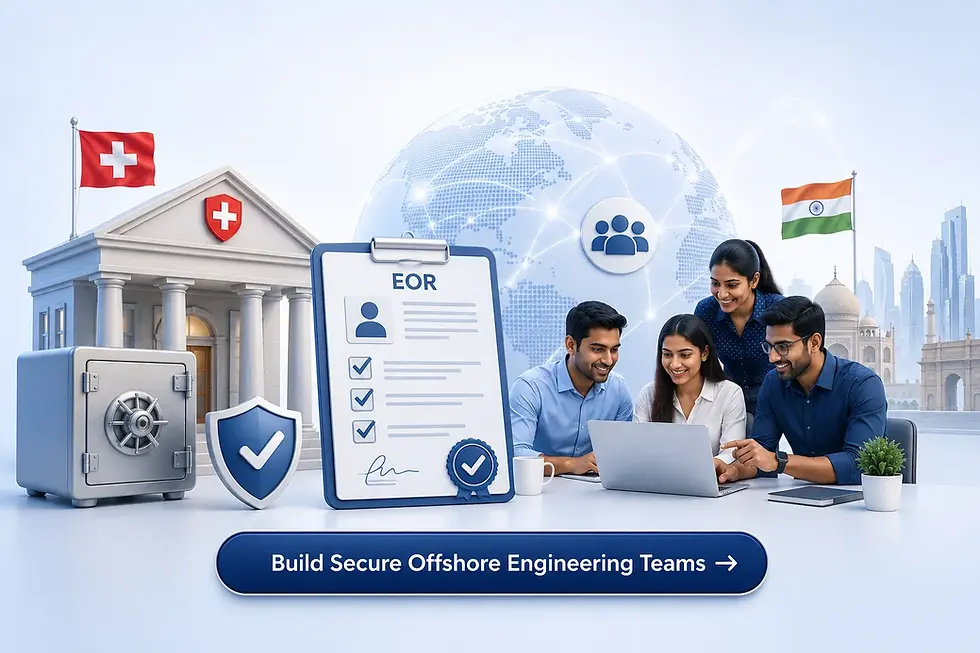
A senior Java engineer in Zurich costs a bank roughly CHF 145,000 to CHF 165,000 a year before employer contributions. The same engineer, hired through an Employer of Record in Pune or Bengaluru, costs the same bank the equivalent of CHF 42,000 to CHF 55,000 all in, salary, employer contributions, and EOR fee included. We have run this comparison for three Swiss private banking clients, and it is usually the number that gets a CFO to say yes in the same meeting. Switzerland banks use EOR India for offshore tech teams because it lets them build compliant, FINMA aware engineering capacity without opening an Indian entity or absorbing Swiss scale salary costs on every hire.
This is not a generic cost story. Swiss banking carries specific regulatory weight, from FINMA oversight to Swiss banking secrecy rules around client data. Below is what we have actually seen work, and where it breaks, across mandates for private banks, retail banks, and wealth platforms based in Zurich, Geneva, and Basel.
What Is Driving the Offshore Hiring Shortage in Swiss Banking?
Switzerland's banking sector has a structural engineering problem that has nothing to do with budget. It is supply. ETH Zurich and EPFL graduate only a few thousand computer science students a year, and a large share go straight into fintech startups or big tech's Zurich hubs rather than bank IT departments. At the same time, Swiss banks are running core banking modernisation programmes, cloud migrations off on premise mainframes, Basel III and IV reporting automation, and AI powered risk and fraud detection tooling, all needing engineers at once.
We have placed engineers into two kinds of Swiss banking clients: private banks rebuilding core platforms, and retail banks automating compliance reporting under FINMA's operational risk circulars. In both cases, local contractor rates in Zurich for a mid level DevOps or backend engineer have climbed close to CHF 130 to 160 an hour, and candidates with real banking domain knowledge such as SWIFT messaging or Avaloq scripting still take 10 to 14 weeks to source. This is the gap Switzerland banks use EOR India for offshore tech teams to close.
The timezone overlap is workable. India Standard Time sits three and a half hours ahead of Central European Time in winter and two and a half hours ahead during Swiss summer time, giving a daily overlap window of roughly four to five hours, typically 1:30 PM to 6:30 PM IST against 10:00 AM to 3:00 PM CET. That is enough for a shared standup and code review, provided sprints are planned around it rather than assumed to be fully synchronous.
Which Indian Cities Have the Right Talent for Swiss Banking Roles?
For Swiss banking mandates specifically, we source almost entirely from Pune, Bengaluru, and increasingly Hyderabad. Pune has the deepest bench for core banking platform work because of the concentration of BFSI captive centres there, Deutsche Bank, Barclays, and Credit Suisse's former India operations all built engineering teams in Pune, leaving over a decade of engineers who have touched Avaloq, Murex, or Temenos T24 directly.
Bengaluru gives us the stronger cloud and AI engineering bench, since most of our cloud engineering mandates for European financial clients now include cloud native infrastructure work on AWS or Azure alongside AI assisted monitoring tools.
At AnjuSmriti Global, what we consistently see Indian engineers bring to Swiss banking work is strong Java, Spring, and .NET fundamentals, hands on SWIFT and ISO 20022 messaging exposure from captive centre work, and growing comfort with AI powered code review tooling now standard in modern banking stacks. Where they typically fall short is regulatory context, understanding why a change to a client facing calculation engine triggers a FINMA notification, not just building to a ticket.
We test for this with a scenario based technical round where candidates design an audit trail for a transaction processing change, since engineers who reason about regulatory intent make fewer costly mistakes than engineers who only follow specifications literally. This is one reason Switzerland banks use EOR India for offshore tech teams rather than sourcing purely on stack keywords.
Why Do Swiss Banks Turn to EOR India Instead of Direct Hiring Under Swiss Law?
The relevant Swiss employment framework is the Swiss Code of Obligations (Obligationenrecht, OR), specifically Articles 319 to 362, governing individual employment contracts. Here is the point Swiss banks often miss at first: when a bank engages an engineer through an Indian EOR, the OR does not apply to that engineer at all. The engineer is employed under Indian labour law by the EOR entity, and the Swiss bank has no direct employer employee relationship under Swiss law.
This distinction is exactly why Switzerland banks use EOR India for offshore tech teams instead of running payroll themselves, and why misclassifying the arrangement is the most common mistake we see.
The mistake usually looks like this: A bank's internal legal team, unfamiliar with EOR structures, tries to write Swiss style probation clauses or notice periods directly into the statement of work with the EOR employed engineer. That is a category error, those terms belong in Indian employment contracts, not Swiss law documents, and this is precisely the difference between contract hiring and full time direct employment. Contract hiring through an EOR keeps the bank's Swiss legal exposure limited to the services agreement, while a full time direct hire in Switzerland would mean the bank itself carries every OR obligation, from notice periods to social contributions.
The second compliance layer specific to banks is data residency under Article 47 of the Swiss Banking Act. Swiss banks cannot grant an offshore engineer production access to client account data. Every mandate we run uses a masked or synthetic data environment for offshore development, with production access restricted to a small Switzerland resident team. This needs to be designed into the SOW before hiring starts, not added after an audit flags it.
EOR vs Entity vs Contract Hiring: Which Model Fits a Swiss Bank?
Here is the framework we walk every Swiss banking client through before choosing a hiring model.
Factor | EOR (India) | Own Entity in India | Direct Contract Hiring |
Time to first hire | 3 to 5 weeks | 4 to 6 months | 6 to 10 weeks |
Upfront compliance cost | None, bundled in EOR fee | CHF 25,000 to 40,000+ setup | None, but liability risk is high |
FINMA data residency control | High, defined in the SOW | High, but bank owns the burden | Low, hard to enforce contractually |
IP ownership clarity | Clear, assigned in the EOR contract | Clear, bank owns the entity | Often ambiguous without heavy negotiation |
Best for | Scaling 3 to 25 engineers without a legal entity | 25+ engineers, multi year presence | Short, narrowly scoped project work |
Termination flexibility | Indian labour law, generally 30 to 90 days notice | Same, but direct bank liability | Contract dependent, higher dispute risk |
Full time hiring only starts making sense once an offshore team grows past roughly 25 to 30 engineers, at which point the fixed cost of an employer of record fee across a large headcount starts to outweigh the cost of setting up a GCC. Below that size, EOR remains the faster and lower risk route for most Swiss banks.
How We Build Offshore Banking Teams and What Actually Happens on a Live Mandate
Our timeline for Swiss banking mandates runs 3 to 5 weeks from kickoff to first engineer starting. Week one is role scoping and the regulatory access control design with the client's compliance team, weeks two and three are sourcing and technical vetting, typically three to four shortlisted candidates per role, and weeks four and five cover final interviews, offer, and EOR onboarding. Technical assessment always includes the regulatory reasoning scenario described earlier, alongside a standard live coding session.
One anonymised example: a mid sized private bank in Geneva, managing a multi billion franc wealth portfolio, needed four backend engineers for a reporting automation project tied to a new FINMA operational risk circular, with an internal deadline eight weeks out. Their recruiter had already spent five weeks trying to hire locally through a Zurich contractor agency with zero placements. We sourced and placed all four engineers, two from Pune and two from Bengaluru, within four weeks.
What almost went wrong: the client's initial SOW granted broader data access than their own compliance policy allowed, something we caught because our review flagged the mismatch against the masked data model above, pausing onboarding for four days while their legal team re scoped the access grant. The project shipped two weeks ahead of the deadline, and the bank has since expanded the offshore team to nine engineers.
What Do Swiss Banks Actually Pay for Offshore vs Local Tech Talent?
Using current CHF market rates for Zurich based banking tech roles compared against Indian EOR based hiring for equivalent skill levels:
Mid level engineer, three to five years experience: Zurich market rate CHF 95,000 to 110,000 a year. Indian EOR equivalent, including salary, statutory contributions, EOR fee, and our recruitment fee: CHF 26,000 to 32,000 a year.
Senior engineer, six to nine years, core banking domain experience: Zurich market rate CHF 145,000 to 165,000 a year. Indian EOR equivalent: CHF 42,000 to 55,000 a year.
Lead or principal engineer, ten plus years, architecture ownership: Zurich market rate CHF 190,000 to 220,000 a year. Indian EOR equivalent: CHF 58,000 to 72,000 a year.
Clients almost always reinvest the savings into either a larger offshore team on the same programme or a second pod for a parallel AI or cloud modernisation initiative. One client redirected savings from a four person hire into a five person team the following quarter, and another used the difference to fund an internal AI tooling pilot without expanding their Swiss headcount budget at all.
Conclusion
Swiss banks are moving further into AI assisted compliance reporting, cloud native core banking platforms, and leaner offshore engineering pods, and the offshore hiring conversation is shifting from a cost question to a capability question. In live mandates right now, we are seeing more Swiss banking clients ask upfront for masked data development environments as a standard SOW clause, a sign the compliance model has matured well past the early adopter stage. If your bank is weighing whether Switzerland banks use EOR India for offshore tech teams as the right path forward, the honest answer from where we sit is that for teams under 25 engineers, it almost always beats entity setup on speed and cost, provided the data access design is done properly from day one.
Ready to scope a Swiss banking hire? Start here.
Interesting Reads:
FAQs
1.Does the Swiss Code of Obligations apply to an Indian engineer hired through an EOR?
No. The engineer is employed by the EOR entity in India under Indian labour law, not under the Swiss Code of Obligations. Your bank signs a services agreement with the EOR, not a direct Swiss employment contract, so Swiss payroll tax and social contribution rules do not apply to that hire.
2.How do Swiss banks meet FINMA data residency rules with engineers based in India?
Offshore teams work against masked or synthetic datasets instead of live production data, with real client data access restricted to a small Switzerland based team. This access model is built into the statement of work before hiring starts, so it becomes an engineering design choice rather than something raised during an audit.
3.Which Swiss banking areas currently have the highest demand for offshore engineers?
Demand is strongest in private banks modernising Avaloq or Temenos platforms, retail banks automating FINMA operational risk reporting, and trade finance teams building ISO 20022 messaging compliance ahead of SWIFT migration deadlines. Core banking platform experience remains the hardest skill to source locally in Switzerland.
4.Can Indian engineers work directly on SWIFT or Avaloq systems for a Swiss bank?
Yes, particularly Pune based talent, given the concentration of BFSI captive centres there with direct Avaloq and Murex exposure. Production access is restricted, so engineers typically work in staging environments that mirror production configuration without live client data.
5.Who owns the IP when an EOR employed engineer builds a Swiss bank's proprietary systems?
IP assignment is written into the engineer's employment contract with the EOR entity, which assigns all work product to your bank under the services agreement. This should be confirmed in the SOW before onboarding, since skipping explicit IP language is the most common source of later disputes.
6.How long does it take to build a five person offshore engineering team for a Swiss bank?
Based on recent mandates, four to six weeks from kickoff to a fully onboarded team, assuming compliance and access control design is agreed in week one. The bottleneck is rarely sourcing, it is usually internal legal sign off on the data access model.
7.Do Swiss banks need an Indian business registration to use EOR hiring?
No. The EOR entity is the legal employer in India, so the bank does not need an Indian corporate presence, tax registration, or business license to hire this way. This is the main structural advantage of EOR over setting up an entity or GCC.
8.Is direct contract hiring cheaper than EOR for a short three month banking project?
For very short, narrowly scoped projects, direct contract hiring can be marginally cheaper since there is no ongoing EOR platform fee. For banking clients specifically, IP assignment and data access liability are much harder to enforce contractually, so the small cost saving rarely justifies the added legal exposure for a regulated institution.
Comments