.png)


Why Belgium Companies Use Employer of Record (EOR) in India

Updated: Jun 20
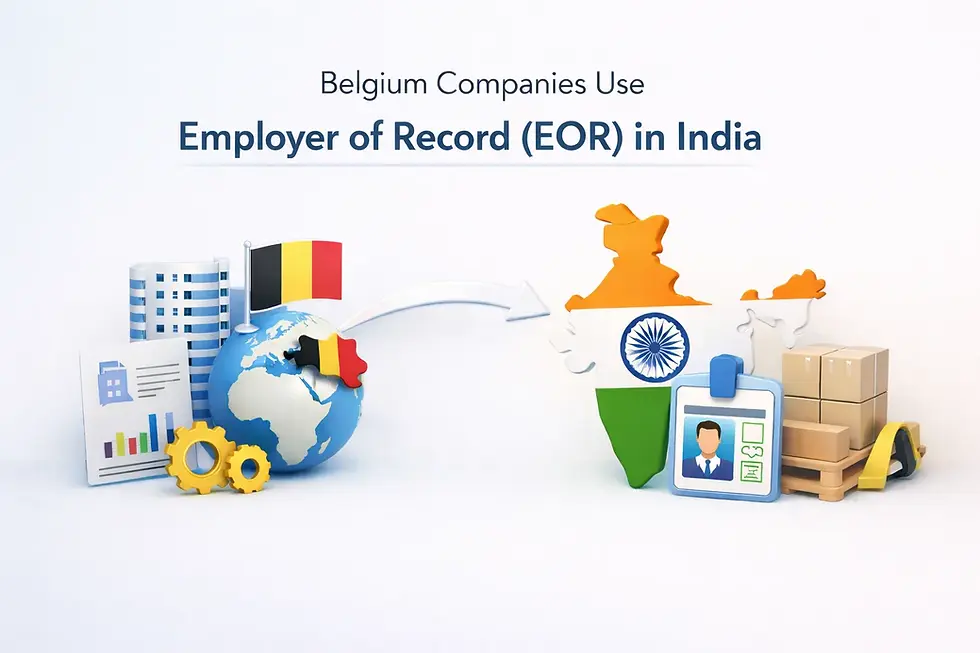
You have engineers, analysts, or operations talent you need in India within weeks, not months. Belgium companies expanding into India often start with a clear hiring plan and a tight timeline, only to discover that opening a legal entity, registering with Indian authorities, and setting up statutory compliance can take far longer than the hiring itself.
Project deadlines do not pause while paperwork moves through Indian ministries. A Belgium manufacturing group waiting on entity approval can lose access to the engineers it identified weeks earlier. Compliance missteps around provident fund, professional tax, or gratuity contributions create financial exposure that nobody budgeted for at the planning stage.
This is exactly why Belgium companies use Employer of Record (EOR) in India when they need to move fast without taking on unnecessary legal and financial risk. An Employer of Record (EOR) becomes the legal employer of your Indian hires while you keep full control over their day-to-day work. Contracts, statutory filings, and local compliance sit with the EOR. Hiring decisions, performance, and direction stay with you.
We have placed engineers, finance professionals, and operations leads for Belgium clients who needed an India team operational within weeks rather than quarters. The rest of this article walks through how the model works, when it makes sense, and where it differs from setting up your own entity.
Why Do Belgium Companies Use Employer of Record (EOR) in India to Move Faster Than Direct Hiring?
Speed is rarely the part of expansion that companies plan for carefully, and it is usually the part that causes the most damage when it goes wrong. A strong candidate in Bengaluru or Pune will not wait three months while a Belgium company finishes incorporating a subsidiary.
This is the practical reason Belgium companies use Employer of Record (EOR) in India before any entity exists on paper. The model lets hiring start the moment a candidate accepts an offer, not the moment a certificate of incorporation arrives.
Consider a Belgium logistics technology company that needed six data engineers in Pune within two months to support a client go-live. Waiting for entity registration would have pushed the start date past the deadline entirely. Using an EOR, the team was contracted and working within three weeks, with payroll and compliance handled locally from day one.
What Slows Down Belgium Companies When They Try to Hire in India Directly?
Direct hiring without an entity is not actually possible under Indian law, so companies that try to shortcut this step usually run into one of the following:
Company incorporation and registration with Indian regulatory authorities
Foreign exchange and remittance compliance for the parent company
Provident fund and professional tax registration before the first payroll run
Opening a local corporate bank account, which itself requires a registered address
Drafting employment contracts that meet Indian labour law requirements
Each step is manageable on its own. Together, they add months to a hiring timeline that a Belgium company may not have.
How Does Employer of Record (EOR) in India Actually Work for a Belgium Company?
The mechanics are simpler than most first-time clients expect. The EOR issues a compliant offer letter and employment contract under Indian labour law, runs monthly payroll, deducts and deposits provident fund contributions, handles professional tax where it applies, and accrues gratuity correctly from the first day of employment.
Your company continues to set objectives, assign work, run performance reviews, and manage the relationship day to day. The EOR never sits between you and the employee operationally. It only sits between you and the Indian government on paperwork.
Onboarding through this model typically takes one to three weeks once an offer is finalized, compared with two to four months for entity setup and registration. If you are ready to start mapping out roles, share your India hiring requirements here and we will walk you through timelines specific to your case.
A Belgium fintech firm used exactly this approach to validate a small India pilot, four hires in Hyderabad, before deciding whether a full Global Capability Center (GCC) made sense. The pilot ran for several months with zero compliance overhead on their side, and the data from that period shaped their longer-term India strategy.
Document collection, background verification, and contract signing happen in parallel rather than in sequence, which is part of why the timeline compresses so significantly. For technical roles spanning Python, Java, or cloud infrastructure work, the candidate experience does not change at all. They sign an offer, complete onboarding paperwork digitally, and start work on the agreed date, with payroll and benefits running in the background.
Employer of Record (EOR) vs Setting Up an Entity in India: What Should Belgium Companies Weigh?
Belgium companies are accustomed to the relative simplicity of Benelux social security and tax systems. India does not work the same way. Professional tax rates differ by state, Shops and Establishment registration is handled at the state level, and provident fund rules apply uniformly but require ongoing filings that an unfamiliar HR team can easily get wrong.
This is one of the clearest reasons Belgium companies use Employer of Record (EOR) in India before committing to incorporation. The EOR absorbs all of that state-by-state variation, so your team is not learning Indian compliance from scratch while also trying to hit hiring targets.
Entity setup still makes sense for companies planning large-scale, long-term India operations, typically once headcount moves well past fifty and the business case for a permanent legal presence is settled. A Belgium industrial automation company we worked with used EOR to place ten engineers in Chennai over eight months before making that exact call, and only then began the incorporation process with real hiring data behind the decision.
The maths usually comes down to fixed cost versus variable cost. Incorporation brings registration fees, statutory audits, and a dedicated compliance function regardless of how many people you employ. EOR scales with headcount instead, which is why it tends to win for smaller, earlier-stage teams and loses some of its cost advantage once a Belgium company is confident it wants twenty, thirty, or more people in India permanently.
What Compliance Risks Do Belgium Companies Avoid by Using EOR in India?
Indian labour law has more moving parts than most European hiring managers expect, and the cost of getting it wrong is rarely visible until an audit or an employee dispute brings it to the surface. Tax deducted at source, gratuity accrual, and state-specific professional tax rules all carry penalties for incorrect handling.
There is also a cross-border angle that is specific to Belgium clients. Where employees in India process data belonging to EU customers or the parent company, Belgium companies remain accountable under EU and Belgian data protection rules regardless of who employs the staff locally. A properly structured EOR contract addresses data handling and access clauses up front, so this obligation does not get overlooked in the rush to hire.
Which Statutory Contributions Does an Employer of Record (EOR) Manage in India?
Provident fund contributions for employer and employee
Professional tax, where applicable by state
Gratuity accrual for employees completing five years of service
Tax deducted at source on monthly salary
Shops and Establishment Act compliance
Getting these right from the first payroll cycle is far easier than correcting them after the fact, which is a large part of why this model exists.
There is a second, quieter risk that surfaces less often in planning conversations: misclassification. Treating an India-based worker as an independent contractor when the working relationship is actually one of employment can trigger back payments and penalties under Indian law. An EOR removes that ambiguity entirely by hiring the person as a proper employee from day one, with a contract that reflects the actual working relationship rather than a label chosen for convenience.
When Is Employer of Record (EOR) the Right Fit for a Belgium Company's India Plans?
Not every hiring situation calls for the same approach, and EOR is not meant to replace incorporation forever for companies planning a large India presence. It works best in specific, recognizable situations.
You will find EOR particularly useful when immediate hiring is required and waiting for entity setup is not an option, when you are testing India as a market before a long-term commitment, when compliance risk needs to be minimized from the first hire, when you are building a remote or project-based team rather than a full office, or when a Global Capability Center (GCC) is planned in phases rather than all at once.
A Belgium SaaS company building a twelve-person GCC in Bengaluru followed exactly this pattern, starting with five EOR hires across Python and Java roles before scaling toward a full entity once the team proved out. If a single specialist role rather than a full team is what you need right now, contract hiring through a fixed-term engagement may be the faster starting point.
There is no fixed headcount at which EOR stops making sense. We have run this model for clients with two employees and for clients with thirty, and the deciding factor is rarely the number. It is whether the business case for a permanent India entity is settled yet. If it is not, EOR keeps every option open while real hiring happens in the meantime.
Conclusion
Expanding into India is rarely the hard part for Belgium companies. Hiring correctly and quickly, without absorbing compliance risk you cannot fully assess from outside the country, is where most plans stall. This is the gap Belgium companies use Employer of Record (EOR) in India to close.
The model gives you a working India team in weeks rather than quarters, keeps statutory obligations like provident fund, professional tax, and gratuity in expert hands, and leaves the door open to incorporate later once you have real data on how your India plans are performing. For companies still deciding between speed and a permanent legal presence, EOR is the lower-risk way to find out which one your business actually needs.
If you are planning to hire in India and want to skip the entity timeline without skipping compliance, tell us who you are looking to hire and we will map out a realistic plan together:
Interesting Reads:
FAQs
1.Can a Belgium company hire employees in India without setting up a local entity?
Yes. An Employer of Record (EOR) lets a Belgium company hire employees in India legally without registering a subsidiary or branch office. The EOR becomes the official employer on paper, handling contracts, payroll, and statutory filings under Indian labour law. The Belgium company directs daily work and performance. This approach is commonly used to test the Indian market or hire a small team quickly before deciding on incorporation.
2.How long does it take to hire someone in India through an EOR?
Most EOR hires in India can start within one to three weeks of finalizing an offer, compared with two to four months needed to incorporate an entity and register for statutory compliance. The exact timeline depends on background checks, contract finalization, and the candidate's notice period at their current employer. Speed is one of the main reasons fast-moving teams choose this route over direct incorporation.
3.What does an Employer of Record (EOR) manage in India?
An EOR manages the employment contract, monthly payroll, provident fund contributions, professional tax where applicable, gratuity accrual, and statutory filings required under Indian labour law. It also handles termination procedures and full and final settlement when an employee exits. The client company retains control over job responsibilities, targets, and day to day direction of the employee's work.
4.Is EOR in India more expensive than hiring directly through an entity?
EOR typically costs a service fee on top of the employee's salary, while direct hiring through an entity carries incorporation costs, ongoing compliance overhead, and dedicated HR resourcing. For roughly one to fifty hires, EOR is usually more cost effective once setup time and compliance risk are factored in. Companies hiring at much larger scale over the long term often find incorporation more economical instead.
5.Can an EOR employee in India be converted to a direct hire later?
Yes. When a Belgium company sets up its own entity in India, EOR employees can transition to direct employment with continuity of service preserved in most cases. The conversion involves a new employment contract issued by the entity and a clean handover of statutory records from the EOR. This path lets companies start small and scale without disrupting the employee's experience.
6.What statutory contributions apply to employees hired in India?
Employees hired in India are typically covered by provident fund contributions, professional tax in applicable states, gratuity once they complete five years of service, and tax deducted at source on salary. Some categories of employees may also fall under Employees' State Insurance. These obligations apply regardless of whether the employer is a registered entity or an EOR acting on the client's behalf.
7.Which Indian cities do Belgium companies typically hire in through EOR?
Bengaluru, Pune, Hyderabad, Chennai, and Delhi NCR are the most common hiring locations because of their established technology and engineering talent pools. The right city usually depends on the specific skill set needed, whether the team works remotely or needs occasional in-person collaboration, and existing client or partner presence in that region. EOR works the same way regardless of city chosen.
8.Does using an EOR in India affect data protection obligations for a Belgium company?
A Belgium company remains responsible for its own data protection obligations under EU and Belgian law, even when employees are hired through an EOR in India. Employment contracts and data handling clauses should clearly define how employees access and process company or client data. Working with an EOR experienced in cross-border arrangements helps ensure these clauses are structured correctly from the outset.
Comments