.png)


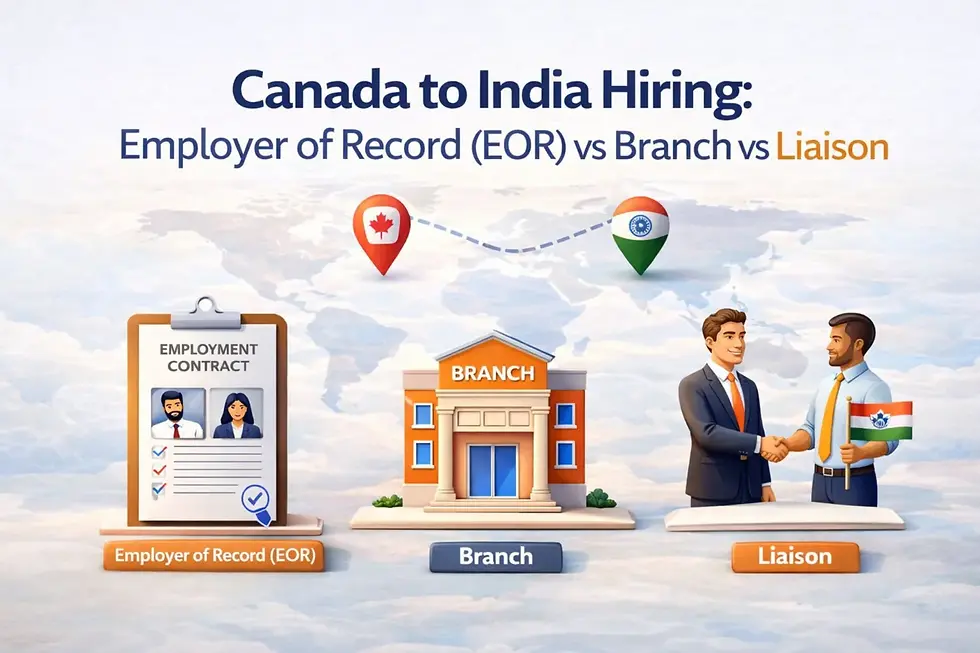
Canada to India Hiring: Employer of Record (EOR) vs Branch Office vs Liaison Office

Updated: Jun 22
You have found the right person. A senior data engineer in Hyderabad. A finance analyst in Pune. A cloud architect in Bengaluru with the exact infrastructure experience your Toronto team has been searching for for three months. The salary works. The skills match. The time zone overlap is manageable.
And then someone in your legal or finance team asks the question that stops everything: how do we actually employ this person legally?
Most Canadian companies lose weeks at this point, sometimes months. The instinct is to research setting up an Indian entity. But very few Canadian founders or HR leaders already know the three distinct legal structures available to them in India, how dramatically they differ in cost and compliance burden, and why one of them is almost always the wrong choice for a company hiring fewer than 25 people.
This guide breaks down the real comparison between Employer of Record (EOR), a Branch Office, and a Liaison Office in India, with full cost and timeline context for Canadian companies at different stages of their India journey.
Why Canadian Companies Are Increasingly Building Teams in India
The case for India has never been stronger for Canadian businesses. Senior software engineers in Bengaluru cost 50 to 65% less than equivalent hires in Toronto or Vancouver. The talent pool spans cloud infrastructure, fintech compliance, data engineering, QA, and enterprise software.
India consistently produces over 1.5 million STEM graduates annually. For Canadian SaaS companies, financial services firms, logistics players, and healthcare technology businesses, building a remote India team is no longer an edge strategy. It is a core operational decision.
But the compliance landscape is genuinely layered. India has 28 states, each with its own Shop and Establishment Act. Labour law obligations vary by state, salary band, and employee count. Provident Fund (PF), Employee State Insurance (ESIC), gratuity, and professional tax all need to be correctly administered from the very first hire.
Getting this wrong creates financial penalties and reputational risk that no Canadian company wants when hiring its first Indian employee. Understanding the three legal pathways upfront saves months of expensive course correction.
A Series B Canadian SaaS company recently came to us needing three backend developers and a QA lead in Bengaluru within 30 days. They had already spent six weeks trying to research entity incorporation before realising the timeline made that option impossible. We placed all four through EOR within seven days of engagement.
What Is an Employer of Record (EOR) in India and How Does It Work for Canada Companies?
When a Canada company uses Employer of Record (EOR) in India, the EOR becomes the legal employer of your Indian staff on paper. You control everything about the actual work: goals, deliverables, team structure, and day-to-day management. The EOR owns the statutory compliance.
That means PF registration, ESIC contributions, gratuity provisioning, employment contracts under Indian law, monthly payroll processing, and all government filings. You do not need a legal entity in India. You do not need an Indian bank account. You do not need a Company Secretary, statutory auditor, or local director.
For Canada to India hiring, the EOR model resolves the single biggest problem: you can extend an offer and close the hire before your competitor's RBI approval paperwork even gets filed.
Here is what the statutory obligations look like every month when using EOR in India:
PF: 12% employer contribution on basic salary per employee, filed monthly with EPFO
ESIC: 3.25% employer contribution on gross wages for employees earning below INR 21,000 per month
Gratuity: accrues from day one of employment, payable in a lump sum after 5 years of continuous service
Tax Deducted at Source (TDS): calculated, deducted, and remitted with every payroll run
Professional Tax: state-specific registration and filing required in Karnataka, Maharashtra, Telangana, and others
A specialist EOR handles every one of these automatically, every month, across every state where your employees are located. India-specialist EOR providers typically charge $100 to $150 per employee per month. For a team of five, that is $500 to $750 per month with zero setup cost and first hire onboarded within five to seven business days.
When Should a Canadian Company Move Beyond EOR?
The EOR model is not permanent by design. When your India headcount approaches 25 to 30 employees with a clear multi-year growth commitment, the financial case for owning an Indian entity begins to strengthen. A Private Limited Company offers stronger employer branding for senior hires and a lower per-head cost at scale compared to cumulative EOR fees.
The right time to make this transition is when your India operations are stable, your leadership is in place on the ground, and you have 12 to 18 months of runway to absorb setup complexity without disrupting delivery. Anjusmriti Global manages the full transition, including employment contract novation, PF and ESIC transfers, and payroll migration, so your employees experience zero disruption through the change.
What Is a Branch Office in India and Should a Canadian Company Use One?
A Branch Office is a formal extension of your Canadian parent company operating on Indian soil. It can carry out business activities, enter into contracts, and generate revenue in India. The Reserve Bank of India (RBI) must approve Branch Office registrations, and the process involves filing with both the RBI and the Registrar of Companies.
The compliance burden is significant. A Branch Office requires:
A local statutory auditor
Annual ROC (Registrar of Companies) filings
FEMA compliance documentation
Transfer pricing documentation for transactions with the Canadian parent
A minimum net worth requirement of USD 100,000 for the parent company
Setup alone typically takes four to six months. Annual compliance costs run INR 4 to 8 lakh or more depending on headcount and transaction volume. RBI approval fees, company secretarial charges, legal fees for FEMA structuring, and professional fees for the initial ROC filing typically add between INR 2.5 to 5 lakh in initial setup costs on top of that.
A Branch Office makes sense when your India operations are generating revenue, entering into significant local contracts, or when regulatory or client requirements specifically demand a registered Indian presence. For hiring engineers or analysts to support a Canadian product team remotely, it is almost always over-engineered for the need.
A Canadian logistics firm we work with had been running their India team on EOR for 18 months. When they decided to scale to 40 employees with a country head in Hyderabad, that was the right moment to evaluate a Branch Office transition. The fixed annual compliance cost of the Branch Office started to compete favourably with EOR fees at that headcount, and a named Indian legal presence supported enterprise client conversations in the region.
What Is a Liaison Office in India and Why Is It the Wrong Choice for Most Canadian Employers?
A Liaison Office is the most restrictive of the three structures. Approved by the RBI under FEMA regulations, a Liaison Office can only represent the parent company, promote its interests, and gather market intelligence. It cannot generate revenue in India, cannot execute contracts, and cannot take on operational functions. All expenses must be funded directly from the parent company abroad.
This is where many Canadian companies run into serious and unexpected legal exposure.
If a Canadian company tries to employ engineers or analysts through a Liaison Office structure and has those employees performing productive work for the Canadian parent's commercial operations, it creates a Permanent Establishment (PE) risk. India's tax authorities may deem the parent company to have a taxable presence in India even though the Liaison Office is explicitly not permitted to conduct business.
Beyond the PE risk, a Liaison Office creates operational friction most Canadian companies never anticipate. Indian employees technically cannot be issued employment contracts under the Liaison Office structure for billable work. Their salaries must come from foreign remittances, which creates payroll delays and currency conversion complications.
Most RBI approvals for Liaison Offices are valid for three years, after which renewal is required with full compliance documentation. As the team grows, the risk profile escalates rather than diminishing. For most Canadian tech and finance companies building remote delivery teams, a Liaison Office solves no actual hiring problem.
A Canadian fintech company exploring the Indian market may legitimately use a Liaison Office to post two people for regulatory research and partner meetings where no commercial activity is planned. The moment those two people start supporting the Canadian product, compliance, or engineering team in any substantive way, the structure becomes legally exposed.
Canada to India Hiring: Real Cost and Timeline Comparison Across All Three Structures
The numbers matter here because Canadian companies consistently underestimate the true cost of the entity route until they are already committed to it. This comparison is based on realistic cost ranges for a team of five to ten people over the first 24 months of India operations.
EOR in India:
Setup cost: Zero
Setup timeline: 5 to 7 business days
Monthly cost: $100 to $150 per employee per month
Compliance burden on Canadian company: Minimal
PE risk: None when structured correctly
Suitable team size: 1 to 30 employees
Branch Office:
Setup cost: INR 2.5 to 5 lakh (legal, secretarial, RBI filing fees)
Setup timeline: 4 to 6 months
Annual ongoing compliance: INR 5 to 10 lakh
Compliance burden on Canadian company: High (FEMA, ROC, audit, transfer pricing)
PE risk: Managed but requires ongoing documentation
Suitable team size: 25 or more, with India revenue generation
Liaison Office:
Setup cost: INR 1.5 to 3 lakh
Setup timeline: 3 to 4 months for RBI approval
Annual ongoing compliance: INR 2 to 4 lakh
Compliance burden on Canadian company: Moderate to high
PE risk: High if used for productive commercial work
Suitable team size: Not suitable for operational hiring
The pattern is consistent across the global companies we support through Anjusmriti Global: most companies do best by starting with EOR to validate their India hiring model and making the entity decision from experience rather than assumption. Every month spent waiting for Branch Office approval is a month your hired candidate is either sitting idle or receiving competing offers from companies already set up to onboard them.
Conclusion
Canada to India hiring does not have to be slow, legally uncertain, or buried in paperwork. The choice between EOR, a Branch Office, and a Liaison Office is not complicated once you know what each structure actually does and does not allow.
For most Canadian companies hiring their first ten to twenty people in India, EOR is not just the easiest path. It is the only path that combines full statutory compliance, speed to first hire, and zero Permanent Establishment exposure from day one. The Branch Office becomes worth evaluating when you are scaling past 25 people and generating revenue on Indian soil. The Liaison Office, for operational hiring purposes, rarely serves a Canadian employer well at any stage.
You can also explore what hiring in India without a local entity looks like at different scales before committing to the entity investment.
Interesting Reads:
FAQs
1.What is the fastest way for a Canadian company to hire employees in India legally?
The fastest legal route for a Canadian company to hire in India is through an Employer of Record. An EOR becomes the legal employer of your Indian staff, handling all statutory compliance including provident fund, ESIC, and gratuity under Indian labour law. The onboarding timeline is typically five to seven business days from document collection to first payroll. No Indian entity, no RBI approval, and no Indian bank account are required.
2.Do Canadian companies need to set up an Indian entity to hire in India?
No. Canadian companies can hire in India without setting up a local entity by using an Employer of Record. The EOR holds the legal employment relationship and manages all statutory obligations under Indian law on your behalf. This approach is compliant, cost-effective, and significantly faster than incorporating a Branch Office or Private Limited Company, which can take four to six months to set up.
3.What is the difference between an EOR, a Branch Office, and a Liaison Office in India?
An EOR allows a foreign company to hire employees in India without a local entity, with full statutory compliance managed by the EOR provider. A Branch Office is a registered Indian extension of the foreign parent company that can conduct business and generate revenue in India but requires RBI approval and carries significant ongoing compliance costs. A Liaison Office can only represent the parent company, cannot generate revenue, and creates Permanent Establishment risk if used for operational work.
4.What are the statutory obligations for employers hiring in India?
Every employer in India must comply with Provident Fund contributions of 12% of basic salary, ESIC contributions where applicable, gratuity accrual from the first day of employment, Tax Deducted at Source on every payroll run, and state-specific Professional Tax filings. These obligations apply from the very first hire regardless of whether the employer uses EOR or a local entity. Missing even one month of filings creates financial penalties.
5.How much does it cost to hire someone in India as a Canadian company using EOR?
India-specialist EOR providers typically charge between $100 and $150 per employee per month. This covers employment contracts, payroll processing, all statutory filings including PF and ESIC, and gratuity provisioning. There are no setup costs and no regulatory approval fees. For a team of five people, the total monthly EOR cost typically runs between $500 and $750, which is a fraction of the annual compliance cost of maintaining a Branch Office.
6.When does a Canadian company need a Branch Office in India instead of EOR?
A Branch Office becomes the right choice when a Canadian company is generating revenue in India, entering into significant local contracts, or when enterprise clients or regulators require a registered Indian legal presence. The financial case for a Branch Office also becomes stronger when the India headcount exceeds 25 to 30 employees with a multi-year commitment. Below that threshold, the setup cost and compliance burden of a Branch Office rarely makes financial sense compared to EOR fees.
7.Can a Canadian company use a Liaison Office to hire developers or engineers in India?
A Liaison Office cannot be used to employ developers or engineers performing productive commercial work for a Canadian parent company. A Liaison Office is only permitted to represent the parent company, gather market intelligence, and promote its interests. Placing productive employees under a Liaison Office structure creates Permanent Establishment risk, which means Indian tax authorities may deem the Canadian company to have a taxable presence in India, with significant financial consequences.
8.What happens when a Canadian company wants to convert EOR employees to direct hires in India?
When a Canadian company is ready to transition from EOR to direct employment through its own Indian entity, the process is called employment contract novation. The EOR provider manages the transfer of employment contracts, PF and ESIC registrations, and payroll infrastructure to the new Indian entity. Employees experience no disruption in payroll or benefits through this process. The transition typically takes two to three months to complete and requires the Indian entity to be fully registered and compliant before the transfer is finalised.
Comments