.png)


How to Hire Employees in India Without a Local Entity for US Companies

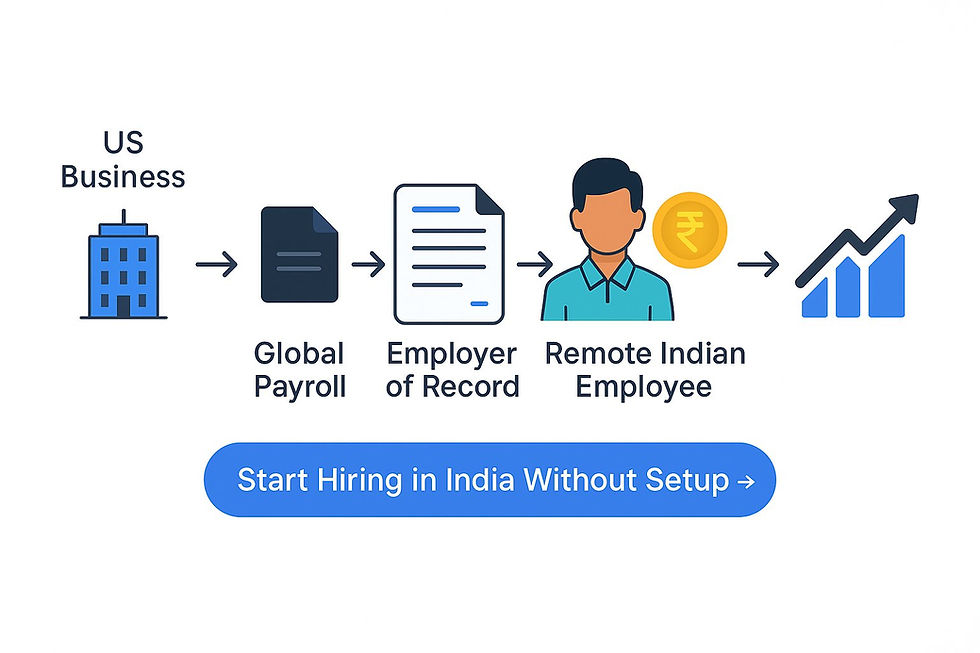
If you’re a U.S.-based business targeting growth in one of the world’s most dynamic talent markets but don’t want to navigate the burdensome process of setting up a legal entity in India then hiring employees in India without a local entity is a smart, efficient strategy. You’re probably facing questions like “How do I hire talent in India without registering a subsidiary?”, “What are the compliance challenges?”, “How can I ensure smooth payroll and employment outsourcing for India hires?” Let me walk you through exactly how you can do this, in plain English, with a people-first approach, and how partnering with AnjuSmriti Global (Recruitment, Staffing & EOR Partner) can make it genuinely simple, reliable and scalable.
When you’re scaling globally, you face the problem of wanting to tap into the rich engineering and tech talent in cities like Delhi, Bengaluru, Hyderabad, Mumbai, Pune or Noida but you’re agitated by the legal entity, tax registration, employment law and payroll burden of India. The solution lies in leveraging an Employer of Record (EOR) model: you hire talent from India, but you don’t have to establish your own Indian subsidiary or entity. You get the benefits of local hiring access to skilled developers in Java, Python, Angular, React, Kubernetes, DevOps, Azure/AWS, data science, machine learning, QA automation without managing the full back-office yourself.
Here, I’ll walk you through how to hire employees in India without a local entity, step by step, the key questions hiring managers ask, how we at AnjuSmriti Global (Recruitment, Staffing & EOR Partner) deliver IT staffing, IT recruitment, IT leadership hiring services. I’ll share real-world examples of how we’ve helped clients, and give you the practical questions to ask as you evaluate an Employer of Record (EOR) for India.
Why consider hiring in India without an entity?
When you’re a global business from 10-10,000 employees in size, one of your growth levers is to tap into India’s talent hubs. But setting up a full local entity (subsidiary, branch, LLP) takes time, cost and risk. Labour statutes, multiple state regulations, payroll tax, Provident Fund, gratuity, employee benefits can become complex. An Employer of Record (EOR) model allows you to immediately hire in India while the Employer of Record (EOR) takes on the legal employer role.
For example: You need a senior AWS Solutions Architect in Bengaluru, or you’re building a DevOps pod in Gurugram with 5 engineers skilled in Terraform, Docker, Kubernetes, Python. Rather than creating an Indian business structure first, you engage AnjuSmriti Global (Recruitment, Staffing & EOR Partner) and start recruiting right away. We act as the legal employer for those Indian hires, while you manage the workload and output directly.
This approach gives you:
Faster time-to-hire (no entity set-up delays)
Access to India’s tier-1 cities: Bengaluru, Hyderabad, Chennai, Pune, Delhi-NCR, Noida, Gurugram
Relief of employment compliance burden (statutory filings, state-labour compliance, payroll, TDS, EPF/ESI)
Flexibility to scale up or down, especially in tech hiring, without entity overhead
In short: for companies looking to recruit in India without local entity cost and complexity, the Employer of Record (EOR) route is a growth-enabler.
Want results like our global clients hiring fast, compliant, and cost-effectively in India? Let’s build your first 5–50 hires through our Employer of Record (EOR) service. Get in Touch with Our Employer of Record (EOR) Team →
Key questions people ask: “Why can’t I hire in India without an entity?” “How does Employer of Record (EOR) work in India?”
Let’s answer these in depth.
Why can’t I just hire in India without an entity and without Employer of Record (EOR)?
You might think “I’ll just hire a contractor or set up direct payroll in India.” But that comes with risks. Indian employment laws, especially for full-time employees, impose liabilities on the employer: statutory benefits, termination rules, labour regulations. Without the proper legal entity you may be exposed.
Many companies face surprise liabilities because they treated hires in India like contractors, but local law treats them as employees; or they used a local payroll vendor but retained legal liability for employment terms. The cost of getting it wrong can be high.
Here's the Solution: Use an Employer of Record (EOR) who acts as the legal employer. The Employer of Record (EOR) takes on the employer of record responsibility the legal employment contract is between the Employer of Record (EOR) and the employee in India. You direct the work. This model is recognized and legal in India.
How does Employer of Record (EOR) work in India?
You’re not sure how the Employer of Record (EOR) model functions, what you control vs what the Employer of Record (EOR) controls, and what you still need to manage.
If you’re hiring senior IT leadership or an entire tech team, you need clarity: who does onboarding, contracts, benefits, severance, performance management, termination? You might worry about your brand or employee experience being compromised by the Employer of Record (EOR).
Solution here for you: We at AnjuSmriti Global (Recruitment, Staffing & EOR Partner) provide a comprehensive Employer of Record (EOR) solution specifically built for tech staffing, IT recruitment and leadership hiring in India so you retain the day-to-day management of your team while we handle contracts, payroll, local compliance, benefits, off-boarding and statutory filings.
Here’s how it typically works:
You identify the candidate (or we recruit them: our IT staffing and IT leadership hiring specialization).
We set up the employment contract with the Indian hire on behalf of you (but you define job description, deliverables, tools).
We handle onboarding: documentation (PAN, Aadhaar, bank account, tax registration), benefits enrolment (as per Indian law), monthly payroll, statutory contributions (Provident Fund, Employee State Insurance if applicable) and tax withholdings.
You manage the candidate’s performance, deliverables, integration with your global team, schedule (working hours across India vs US timezone) etc.
When you decide to scale up, add more hires, or scale down, we provide flexibility to do so without you having a local entity.
When off-boarding happens, we manage termination compliance according to Indian labour law, ensure clearance of dues, give you the exit documentation.
In this way, hiring in India without entity becomes doable, scalable and reliable.
Practical steps to hire employees in India without a local entity
Let me outline the process you can follow tailored for IT hiring, staffing and leadership roles. I’ll also highlight how we deliver each step at AnjuSmriti Global (Recruitment, Staffing & EOR Partner).
Step 1: Decide scope of hiring and role (IT team, leadership, contract/perm)
Many companies jump into “let’s hire in India” without clear role definitions, seniority, required technologies, and whether the hire is full-time or contract.
You may waste time and budget recruiting mismatch candidates, or face local compliance issues if you misclassify employment status.
Define exactly what you are hiring: e.g., a Senior Java Microservices Engineer (Spring Boot, Kubernetes) in Bengaluru for your global product; or an IT Director for your shared services hub in Pune. Determine whether you want full-time employment (so requires local benefits) or a term contract (for a fixed-term project). At AnjuSmriti Global (Recruitment, Staffing & EOR Partner) we help you craft the job description, market map, candidate benchmarking and compensation data (we cover tech stacks: Java, Python, React, Angular, AWS, Azure, DevOps, data engineering, machine learning) informed by our previous articles and specialist IT recruitment practice.
Step 2: Engage an Employer of Record (EOR) service provider and decide the model
You may not know what to look for in an Employer of Record (EOR), or what hidden costs or capabilities matter. Choosing the wrong Employer of Record (EOR) could mean lack of local compliance in India, bad payroll experience, unhappy employees, brand damage or even legal penalties. As we saw in recent guides, Indian labour law is complex across states.
Choose a provider like AnjuSmriti Global (Recruitment, Staffing & EOR Partner) who specializes in India and understands IT staffing and leadership hiring for global companies. Key criteria:
Deep expertise in Indian employment laws, payroll, benefits, termination rules
Transparent pricing and service SLAs
Ability to hire across major cities (Delhi/NCR, Bengaluru, Hyderabad, Pune, Chennai, Mumbai, Noida, Gurugram)
Integrated service: from recruiting (IT staffing) through payroll & outsourcing to off-boarding
Technology platform for employee onboarding, payroll reporting, dashboards
Strong track record of supporting companies of scale (10-10,000 employees)
You fill out our contact form and we’ll run you through how we’ve helped other global clients build tech delivery teams in India.
Step 3: Recruiting and candidate sourcing (IT staffing & IT leadership)
Hiring in India may be competitive developers and leadership expect competitive compensation, modern tech stacks, remote or hybrid flexibility, and often work across time zones. Without local knowledge you may mis-price roles, fail to match candidate expectations, or face higher attrition. As your recruitment partner, AnjuSmriti Global (Recruitment, Staffing & EOR Partner) draws on its deep network across tier-1 Indian cities and maintains candidate pipelines for common technology stacks: Java/SpringBoot, .NET/Core, Python/Django, Ruby on Rails, React/Angular, Mobile (iOS/Android), DevOps (Kubernetes, Docker, Terraform, AWS/Azure/GCP), Data Engineering (Spark, Hadoop, Kafka), Machine Learning (TensorFlow, PyTorch). We partner with you to define the role, drill into seniority and leader metrics, and manage offer-negotiation, candidate engagement and onboarding via our Employer of Record (EOR) platform.
Step 4: Contracting and onboarding via Employer of Record (EOR)
Once you select a candidate, you need to execute an employment contract that satisfies Indian labour laws, handle payroll setup, benefits, deductions, tax registration. Mis-drafted contracts, incorrect deductions, or non-compliance with EPF/ESI can expose you to liability. For example, different Indian states have different minimum wage rules or labour regulations. At AnjuSmriti Global (Recruitment, Staffing & EOR Partner), we craft compliant employment agreements in India on your behalf, handle onboarding (employee documents, including PAN/Aadhaar, bank, tax forms), register statutory contributions (Provident Fund, etc.), set up payroll. You manage the employee’s daily work and metrics; we manage the employment back-office.
Step 5: Payroll, benefits & compliance management
Indian payroll and benefits are complex: you need to calculate gross-to-net salary, withhold tax, contribute to PF, manage gratuity, ensure correct leave policies, and adhere to termination requirements. Mistakes here can lead to penalties, unhappy employees, or reputational risk. We provide global payroll outsourcing and employment outsourcing. AnjuSmriti Global (Recruitment, Staffing & EOR Partner) service includes payroll processing, statutory filings, benefits administration, local HR support, and employee leasing/PEO if required. You get a dashboard for visibility, you focus on your tech team’s output; we keep HR and compliance running smoothly.
Step 6: Ongoing management, scaling, and off-boarding
After hiring, you’ll want to scale your team up or down, adapt roles, manage performance, and eventually off-board. Without entity, you may worry about how to exit or scale smoothly. If you mis-manage termination or leave accumulation, severance or compliance may bite you. Because you used the Employer of Record (EOR) route, scaling up means simply allocating more headcount under our service. Scaling down or terminating: our service includes legal compliant off-boarding, final settlement, clearance of funds, and handing you the data you need. You remain in control of talent management; we handle the employment lifecycle.
What you should look for in your Employer of Record (EOR) provider and why AnjuSmriti Global (Recruitment, Staffing & EOR Partner) stands out
When you’re evaluating Employer of Record (EOR) services to hire in India without a local entity (especially for IT staffing, global payroll and leadership hiring), ask these questions:
Do you have deep expertise in Indian labour laws and state-specific regulations?
Can you hire across multiple Indian states and cities (Delhi/NCR, Bengaluru, Hyderabad, Mumbai, Pune, Chennai, Noida, Gurugram)?
Do you handle recruitment and staffing (not just payroll) so we can tie in IT staffing, leadership hiring and employee leasing?
Do you provide transparent pricing, SLA commitments, onboarding timelines and a technology platform?
How quickly can you onboard a candidate once selected?
How do you handle terminations, severance, off-boarding compliance in India?
Can you support global businesses of size 10-10,000 employees and not just startups?
Will you integrate with our HRIS, global payroll systems or our tech stack for monitoring?
At AnjuSmriti Global (Recruitment, Staffing & EOR Partner):
We specialise in IT recruitment, IT staffing, IT leadership hiring (so your tech roles across Java, Python, React, DevOps, ML are covered).
We deliver Employer of Record (EOR) Service, Global Payroll & Employment Outsourcing, International Staff-on-Payroll Service, and Employee Leasing/PEO all integrated under one umbrella.
We have deep experience supporting global businesses expanding in India, meaning we know how to communicate with hiring managers, translate your corporate culture into India operations, and deliver an excellent candidate/employee experience.
Our model allows you to hire quickly in India without entity, scale up, integrate with your global team, and keep your brand consistent.
We take a people-first approach: your Indian hire is an employee of record, receives full support, and you remain their manager; we focus behind-the-scenes on compliance, payroll, benefits, making sure they’re motivated and productive.
If you’re serious about hiring in India without entity and want a partner who understands your needs as a global recruiter or hiring manager contact us now via our form: Fill our form and we’ll show you how we can support your next hire.
How we helped clients
Scenario A – Scaling an engineering pod in Bengaluru for U.S. product company
A U.S. SaaS company had a hard deadline to hire 8 backend engineers (Java/Spring Boot, Kubernetes, AWS) in Bengaluru and Hyderabad. They didn’t want to wait 6-9 months to set up an Indian subsidiary. We deployed our Employer of Record (EOR) model: sourced candidates through our IT staffing network, handled employment contracts, payroll, statutory filings, and got all 8 onboard within 4 weeks. The client managed the sprint planning, tasks, deliverables. We kept compliance up-to-date across Karnataka and Telangana. This allowed the client to hit its product roadmap without entity drag.
Scenario B – Hiring a regional IT Director in Noida for a global services firm
A multinational wanted to hire an IT Director in India to lead a delivery center in Noida someone with DevOps, cloud (Azure/AWS), data engineering and agile experience. Using our leadership hiring and Employer of Record (EOR) service, we identified, screened, and placed the director, set up their employment through our Employer of Record (EOR), and provided payroll and benefits. The client retained control of strategic leadership; we took care of employment obligations. The hire was live in 6 weeks. The client benefitted from our expertise in leadership recruitment and entity-free employment.
Scenario C – Employee leasing for contract-heavy staffing requirement
A U.S. services company had a short-term project in Pune requiring 25 QA Automation engineers (Selenium, Cypress, Python). They needed to ramp quickly and scale down after 9 months. Instead of entity setup, they used our employee leasing/PEO service via Employer of Record (EOR): we employed the engineers, handled payroll and benefits, and the client arranged the project scope and supervision. As the project ended, we handled the off-boarding seamlessly. The client avoided long-term commitments, startup cost and legal risk.
In each of these, the common theme: you get the talent you need in India, fast, compliant, without entity overhead but you retain operational control. That’s the Employer of Record (EOR) value.
Benefits of using an Employer of Record (EOR) to hire in India without a local entity
From a strategic point of view (especially when you’re looking for long-tail keywords like employer of record India, hire in India without entity, global payroll outsourcing, employee leasing India, Employer of Record (EOR) services for startups, Employer of Record (EOR) for multinationals) the benefits are compelling:
Speed to market: You don’t wait months for company registration; you can hire in days/weeks.
Lower cost and risk: You avoid local entity setup costs, legal risks of mis-classification, audit exposure.
Access to Indian talent: India offers deep pools of engineers, developers, data scientists, cloud specialists and leadership in major cities.
Scalability and flexibility: Scale up/down headcount without entity administrative burden.
Compliance assurance: A specialist Employer of Record (EOR) manages Indian payroll, tax, statutory contributions, labour law changes, state compliance.
Focus on core business: You spend your energy on product, delivery, integration, leadership, while the Employer of Record (EOR) handles the employment mechanics.
Global payroll/international staff-on-payroll harmony: If you already have global hires, adding India via Employer of Record (EOR) integrates neatly into your global payroll and employment outsourcing strategy.
For any global business, whether you’re refurbishing your tech delivery, establishing an offshore center, or hiring remote talent in India, using an Employer of Record (EOR) is a strategic lever.
Potential challenges and how to overcome them
Of course, nothing is entirely frictionless. Here are key risks you should manage—and how we at AnjuSmriti Global (Recruitment, Staffing & EOR Partner) help mitigate them.
1.Mis-alignment of employment contract vs actual role: If your job description isn’t well defined, or comp is below market, you’ll struggle to hire. We assist in benchmarking compensation (for example senior full-stack developer salary in Bengaluru with React/Node, or DevOps engineer with AWS), and advising on role design to meet candidate expectations.
2.State-specific labour laws: India is not one uniform employment law regime; states like Maharashtra, Karnataka, Tamil Nadu, Delhi each have rules. Our team covers all major states and ensures compliance across your hires in different cities.
3.Employee experience and employer branding: Because the legal employer is the Employer of Record (EOR), you need to maintain your brand, culture, and degree of interaction. At AnjuSmriti Global (Recruitment, Staffing & EOR Partner) we facilitate onboarding materials, align with your culture, ensure LMS, remote integration and collaboration with your HQ.
4.Time-zone & remote integration: You may have U.S. business hours; Indian team might need overlap. We advise on shift models, collaboration tools, and integrate hires smoothly.
5.Termination and exit compliance: Indian termination rules vary; notice periods, severance, gratuity obligations. We handle these so you don’t get stuck with unexpected liabilities.
6.Intellectual property, data security, remote tools: Especially important when hiring tech staff in India. We ensure your employment contracts have IP protection, NDAs, data security clauses, and that the Employer of Record (EOR) complies with our standards.
By anticipating and managing these, you’ll have a smooth experience hiring in India without a local entity.
Why now is a good time to act
The global trend is clear: the Employer of Record (EOR) market is booming as companies look for agile hiring solutions in emerging markets. For India, the value proposition is strong large talent pools, English proficiency, strong tech education, competitive cost base.
In parallel, global companies are increasingly comfortable with remote and hybrid teams, and recognize they don’t always need local entity presence to build an operational team in another country. With the right provider, you get full employment functionality without the entity prerequisite.
If you’re actively expanding your team this year and looking at a headcount in India whether it’s a DevOps squad in Hyderabad, a data engineering hub in Pune, QA automation centre in Noida, or leadership hire in Mumbai this is the right moment to engage an Employer of Record (EOR) and move quickly.
If you’re a U.S. based company, or any global business from 10 to 10,000 employees, and you’re looking to hire engineers, tech leadership or build a staffing centre in India without the overhead of establishing a local entity then the Employer of Record (EOR) route is a highly effective, people-first and safe strategy.
At AnjuSmriti Global (Recruitment, Staffing & EOR Partner) we are specialists in exactly this: IT staffing, leadership hiring, combined with Employer of Record (EOR) service. We understand the tech roles, the global hiring manager mindset, the compliance requirements and the candidate expectations in cities like Bengaluru, Hyderabad, Chennai, Mumbai, Pune, Noida and Gurugram.
If you want to talk about your next hire, set up a tech delivery team in India, or get a roadmap for expanding without local entity, let’s connect. Fill our form here and I’ll personally guide you through how we can help you hire in India without entity, compliantly, and start scaling quickly.
Let’s make your India hiring strategy a reality fast, compliant, with the right talent and minimal administrative drag.
Interesting Reads:
FAQs
1. How can US companies hire employees in India without setting up a local entity?
US companies can legally engage talent in India by partnering with an Employer of Record (EOR) that acts as the local legal employer on their behalf. This structure allows businesses to onboard employees, manage payroll, ensure statutory compliance, and handle tax obligations without incorporating a subsidiary. For global companies expanding into India, this approach removes regulatory friction and accelerates hiring timelines. It enables immediate workforce deployment while eliminating the need for complex registrations and compliance management.
2. Is it legal to employ staff in India without registering a company locally?
Yes, it is legally possible when the employment relationship is structured through a compliant third-party model such as an Employer of Record (EOR). The Employer of Record (EOR) becomes the legal employer while the US company retains operational control over the employee’s role and responsibilities. This setup ensures adherence to Indian labor laws, payroll regulations, and statutory benefits. For US firms looking to build teams in India quickly, this model provides both speed and legal security.
3. What are the advantages of hiring talent in India without opening a subsidiary?
Avoiding entity setup significantly reduces time, cost, and administrative burden. Incorporating a company in India involves regulatory filings, local directors, tax registrations, compliance audits, and ongoing governance requirements. By contrast, engaging employees through an Employer of Record (EOR) model allows US companies to focus on product development, sales, or operations rather than legal infrastructure. Many global businesses choose this route to test the Indian market before committing to a permanent establishment.
4. How long does it take to onboard employees in India without a local entity?
When using a compliant hiring structure, onboarding can typically happen within weeks rather than months. Setting up a subsidiary may take significantly longer due to regulatory approvals and registrations. US companies that need to build engineering, support, or operations teams quickly often prefer an Employer of Record (EOR) solution because it shortens time-to-productivity. Faster onboarding translates directly into faster execution and revenue acceleration.
5. Who handles payroll, taxes, and compliance when hiring in India without an entity?
In a structured global employment model, payroll processing, income tax deductions, statutory benefits, employment contracts, and compliance filings are managed by the local legal employer. This protects US companies from regulatory exposure while ensuring employees receive benefits aligned with Indian labor law. From a global expansion perspective, this reduces internal legal workload and removes compliance uncertainty.
6. Can US companies offer competitive benefits when hiring employees in India remotely?
Yes, competitive compensation packages, statutory benefits, insurance coverage, and performance incentives can all be structured within a compliant framework. Hiring without a local entity does not mean compromising on talent quality or employee experience. In fact, many global organizations successfully build high-performing remote teams in India while maintaining global standards of compensation and engagement.
7. What risks should US companies consider before hiring in India without incorporation?
The primary risks involve misclassification, non-compliant contractor arrangements, and tax exposure if the structure is not handled properly. Attempting to hire independent contractors in place of employees without proper safeguards can lead to penalties. A compliant employment model ensures that employment contracts, benefits, payroll taxes, and statutory contributions are managed correctly. Risk mitigation is one of the main reasons global companies prefer structured hiring models over informal arrangements.
8. How does hiring in India without a local entity compare to setting up a subsidiary?
Establishing a subsidiary offers long-term control but requires higher upfront investment, regulatory oversight, and ongoing compliance management. Hiring without incorporation provides flexibility, lower entry cost, and faster market access. Many US companies begin with an Employer of Record (EOR)-based hiring model to validate market opportunity, and later transition to a subsidiary once operations reach scale. This phased approach reduces financial and operational risk.
9. What types of roles can US companies hire in India using this model?
US businesses commonly hire software engineers, DevOps professionals, finance teams, customer support staff, product managers, data analysts, and back-office operations personnel. The model supports both individual hires and full team builds. From a global workforce perspective, India offers access to skilled professionals across technology, analytics, and operations without requiring immediate physical presence in the country.
10. When should a US company choose to hire in India without a local entity instead of opening one?
This approach is ideal when speed is critical, headcount is still evolving, or the company wants to test the market before committing capital. If the priority is rapid team deployment with minimal regulatory burden, hiring through a compliant local employment structure is often the smarter first step. Many global companies adopt this model during early expansion phases, preserving flexibility while building scalable teams.
Comments