.png)


Which EOR Providers Are Best for UAE Companies Hiring in India?

Updated: Aug 31
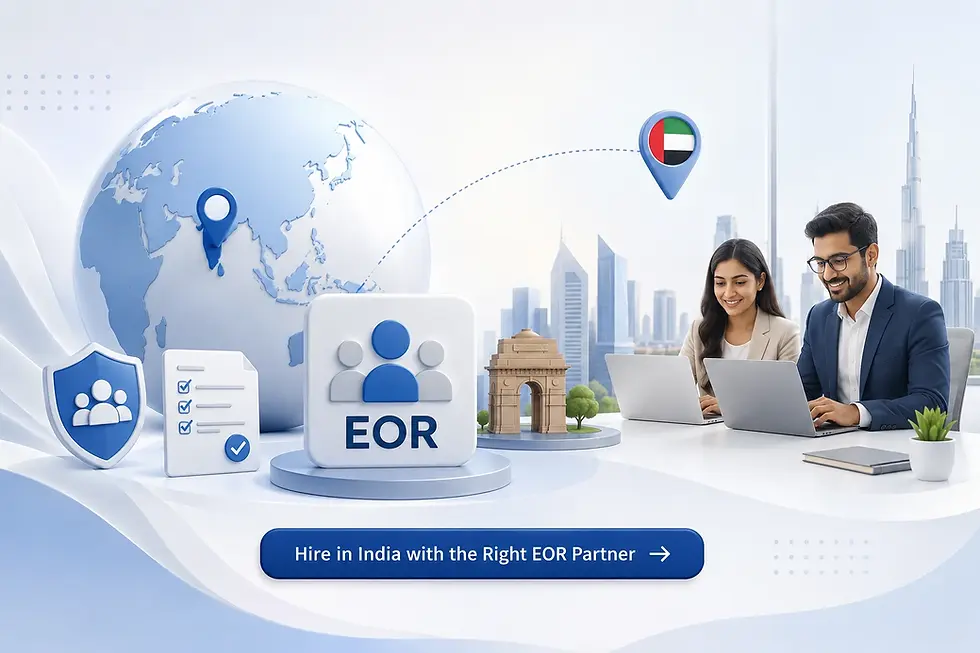
We have placed engineers for eleven different UAE headquartered companies in the last three years, and almost every one of them asked the same question on the first call: do we need our own entity in India, or can we just use an EOR? The answer is almost always EOR, and the harder question underneath it is which EOR providers are best for UAE companies hiring in India, because the right answer changes depending on your regulator, your city, and how many people you plan to hire.
Trade between the UAE and India crossed roughly USD 85 billion in FY 2022 23, and the Comprehensive Economic Partnership Agreement (CEPA) has made cross border services trade, including talent, noticeably easier to structure. What has not gotten easier is picking the right compliance partner on the Indian side.
Why UAE Companies Are Turning to EOR Providers to Hire in India
DIFC and ADGM now host thousands of active registered firms, and almost none of them can staff engineering teams locally at the speed or price they need. UAE tech salaries for a mid level backend engineer routinely run AED 15,000 to 22,000 a month, and even at that price, competition from local super apps, delivery platforms, and Gulf banks for the same small talent pool is intense.
So UAE companies look east. A Dubai fintech raises a funding round, needs eight to twelve engineers within a quarter, and its board decides an Indian subsidiary is not worth the compliance overhead for a team that size. That is exactly the situation an employer of record structure solves, and it is why this has become the default way UAE companies build India teams rather than a fallback option.
Some EOR providers run little more than a payroll shell with a thin compliance layer. Others run full statutory administration, background verification, and technical vetting. Working out which EOR providers are best for UAE companies hiring in India usually comes down to that gap, and it is the difference between a smooth first year and a labour inspector's notice landing on a registered address six months in.
What Makes an EOR Provider the Right Fit for a UAE Company?
Figuring out which EOR providers are best for UAE companies hiring in India starts with one question: is the provider legally bound and actively registered in the exact state where your hire will sit, or just claiming national coverage on a website. The entity that legally employs your Indian hire is bound by Indian law, not UAE law, and this is where most UAE founders get caught off guard. Employment falls under India's consolidated Labour Codes, alongside the Employees' Provident Funds and Miscellaneous Provisions Act, 1952 and the Payment of Gratuity Act, 1972.
Whichever provider you choose has to be actively registered under the relevant state Shops and Commercial Establishments Act, Karnataka's version for Bengaluru hires, Telangana's for Hyderabad hires, and must be filing PF contributions through EPFO on a real, verifiable establishment code, not a shared umbrella code stretched across hundreds of unrelated clients.
Not sure your shortlist meets these bars? Share your hiring plan with our team and we will check it against your city and regulator before you sign anything.
Best Indian Cities for UAE Companies Building a Tech Team
Bengaluru has the deepest bench for the roles UAE companies ask for most: backend engineers with fintech or payments experience, DevOps engineers who have run high availability systems, and data engineers comfortable with real time pipelines. This matters for UAE clients specifically, since DIFC and ADGM regulated firms need engineers who already understand transaction monitoring and audit trail requirements.
Hyderabad is our second recommendation for UAE clients focused on cloud infrastructure and SAP, with a strong concentration of engineers holding AWS and Azure architecture experience. Pune suits UAE manufacturing and logistics adjacent companies looking for ERP and industrial software talent.
What Indian engineers generally lack for UAE specific mandates is regulatory fluency, not technical skill, meaning familiarity with DIFC Data Protection Law No. 5 of 2020 or Central Bank of UAE cybersecurity circulars. We test for this by asking candidates to design a system around a data residency constraint rather than simply naming AWS services. Engineers who have worked with EU clients under GDPR usually transfer that thinking fastest.
Contract Hiring vs Full Time Hiring Through an EOR
One question we get on almost every UAE call is whether to bring someone on as a contractor or as a full time EOR employee. Contract hiring works well for short, defined projects: a three month migration, a proof of concept build, or a specialist brought in for a single audit cycle. It is faster to start and easier to end, but contractors in India cannot legally be treated like employees on paper while being managed like one day to day. Indian authorities look at the actual working relationship, not just the label, and a misclassified contractor exposes both the EOR and, indirectly, your UAE company.
Full time hiring through an EOR is the right call when the role is core to your product roadmap and you expect the person to stay a year or longer. It costs more upfront because of PF, gratuity accrual, and benefits, but it gives you a stable team member with proper statutory protection and far less legal exposure. Most UAE companies we work with start a role as a contract engagement to validate fit, then convert to full time EOR employment once the engagement proves out, usually between month two and month four.
Best EOR Provider Evaluation Checklist for UAE Companies Hiring in India
This is the checklist we use to answer which EOR providers are best for UAE companies hiring in India on a case by case basis, and it is the section our UAE clients screenshot and send to their own finance and legal teams before signing anything.
Evaluation Criterion | What Good Looks Like | Red Flag |
Statutory registration | Own EPFO code plus state specific Shops Act registration for each hiring city | Shared umbrella code across hundreds of clients |
Contract structure | Clear India law contract with an IP assignment clause naming the UAE entity as beneficiary | Vague service agreement with no IP clause |
Statutory benefits admin | PF, gratuity, ESIC where applicable, and professional tax filed monthly and auditable | We handle it, with no filing evidence on request |
Time zone support overlap | Account contact available during the GST UAE, 9am to 1pm overlap window | Support only in IST hours with no overlap |
Termination and notice handling | Written offboarding process matching Indian notice period norms, 30 to 90 days by seniority | No documented offboarding process |
Data residency clause | Explicit terms on where employee data is stored and processed | Silent on data location entirely |
Pricing transparency | Flat per employee monthly fee, itemized against PF, gratuity, and insurance | Bundled all inclusive fee with no breakdown |
Technical vetting support | Optional or included technical screening before onboarding | No involvement beyond payroll |
The two rows UAE founders skip most often, and regret skipping, are time zone overlap and the IP assignment clause. UAE runs on GST (UTC+4), India runs on IST (UTC+5:30), so the working overlap is naturally about 1.5 to 3 hours. An EOR with no one available during that window means every escalation waits a full day. An IP clause that does not explicitly name your UAE entity as the assignee of work product has caused real disputes our team has had to help untangle after the fact.
Real Salary and Cost Data for UAE Companies Hiring in India
For a backend or DevOps engineer hired through an EOR into Bengaluru, current market contract and EOR rates run approximately:
Mid level (3 to 5 years): INR 14 to 20 lakh per annum, roughly AED 620 to 880 per month equivalent in fully loaded cost
Senior (6 to 9 years): INR 24 to 35 lakh per annum
Lead or architect (10+ years): INR 42 to 60 lakh per annum
Budget employer PF at 12% of basic salary, gratuity accrual at roughly 4.81% of basic, and the EOR's own fee, typically 8% to 15% of gross salary. A UAE company hiring a senior engineer at INR 30 lakh should model a fully loaded annual cost around INR 36 to 39 lakh once PF, gratuity, and EOR fees are included, still meaningfully below the AED equivalent of hiring the same seniority inside the UAE.
There is no UAE India social security totalization agreement, so Indian employees hired through an EOR are fully subject to standard PF and gratuity obligations with no offset. Build this into your total cost model as a fixed line item, not something to negotiate away. For companies planning six or more hires, it is also worth comparing this against setting up your own entity. The breakeven point where direct entity ownership beats EOR fees typically lands around 25 to 30 headcount, not before, which is another reason cost alone should never decide which EOR providers are best for UAE companies hiring in India.
Converting a contract role to full time under the same EOR is usually straightforward on paper but easy to get wrong on timing. The contract needs to be rewritten, not amended, to reflect statutory benefits, notice periods, and the IP assignment clause in full. We have seen UAE companies delay this for months after already deciding internally to keep someone long term, which leaves the engineer without gratuity accrual credit for that period. The cleanest fix is a firm decision date, typically 60 to 90 days into the engagement, rather than letting it drift.
What Almost Went Wrong Once, and What We Fixed
A DIFC regulated payments company, under 50 employees at the time, needed four backend engineers with PCI DSS adjacent experience within six weeks of closing a funding round. We placed all four through an EOR partner within that window, but three weeks in we discovered the EOR had registered the establishment code under a Maharashtra Shops Act filing while two of the hires were actually working out of Bengaluru, a Karnataka jurisdiction mismatch that would have invalidated their PF filings on audit.
We caught it during a routine compliance check, re registered the correct code within a week, and back filed the affected month before it became visible to any inspector. All four engineers are still with that client, and the team has since grown to eleven.
Hiring Trends Shaping Which EOR Providers Are Best for UAE Companies
Hiring patterns between the UAE and India have shifted noticeably over the past year. AI and machine learning engineering roles, especially applied ML and LLM integration work, are now a standard part of UAE hiring mandates rather than a specialist add on, and Bengaluru and Hyderabad both have growing pools of engineers with production AI experience. Cloud cost optimization and platform engineering have become their own specialization as UAE companies scale infrastructure spend alongside headcount, and providers that support technical vetting for these newer skill categories have a real edge over generalist payroll only options.
Remote first team structures have also matured. Instead of hiring individuals reactively, UAE companies are increasingly planning full pods of ten to fifteen engineers from the outset, anchored by a named technical lead in India managing day to day delivery while the UAE side owns product direction. This shift is why the question of which EOR providers are best for UAE companies hiring in India has become a board level decision rather than an HR checkbox.
AnjuSmriti Global works these mandates from the India side because most UAE companies do not have the bandwidth to audit EOR compliance continuously while also running their core business, and continuous auditing, not a one time onboarding check, is what actually prevents the kind of jurisdiction mismatch described above.
Conclusion
Expect the UAE India EOR corridor to keep growing on the back of CEPA driven services trade and continued expansion of DIFC and ADGM fintech registrations, both of which are adding regulated entities faster than their local tech hiring capacity can keep up. Deciding which EOR providers are best for UAE companies hiring in India will keep moving from a background HR task to a genuine board level call as headcount scales.
Planning your own India expansion? Share your roles and timeline with our team here and we will map out the right EOR structure for your city and regulator.
Interesting Reads:
What Do Australian Companies Need to Know About EOR in India? Which Skills Are in Highest Demand in India's Workforce?
FAQs
1.Does India's Shops and Establishments Act apply the same way in every city we hire in?
No, it is a state level law, so registration requirements differ by state even though the underlying framework is similar. A Karnataka Shops Act registration for a Bengaluru hire does not cover a Telangana based hire in Hyderabad, each city requires its own filing. This is one of the most common gaps found when auditing EOR arrangements for UAE clients who assumed a single registration covered their whole India team.
2.How does IP ownership work when our engineer is on an Indian EOR's payroll but building product for our UAE company?
The EOR is the legal employer of record, but the employment contract should explicitly assign all work product and intellectual property to your UAE entity, not to the EOR itself. This has to be written into the contract at onboarding since it is not automatic under Indian law simply because you are the paying client. Review this clause before any offer goes out, since fixing it after a dispute is far harder.
3.Is there a social security totalization agreement between the UAE and India that reduces our EOR costs?
No. Unlike some EU countries with bilateral social security agreements with India, there is currently no UAE India totalization agreement, so Indian employees hired through an EOR are fully subject to standard PF and gratuity obligations with no offset. Budget the full 12% employer PF contribution and gratuity accrual as fixed costs, not a negotiable line item.
4.Which Indian cities have the best fintech experienced engineers for a DIFC regulated company?
Bengaluru has the deepest bench because of its dense fintech and payments ecosystem, since companies building transaction monitoring, KYC automation, and real time settlement systems are concentrated there, and the local talent pool already understands audit trail and compliance constraints. Hyderabad is a strong secondary option, particularly for engineers with prior BFSI captive center experience.
5.Can our UAE company terminate an India based EOR employee the same way we would in the UAE?
No, Indian termination norms differ meaningfully from UAE practice, particularly around notice periods and, in some cases, statutory severance depending on tenure and role classification. Notice periods commonly range 30 to 90 days depending on seniority, and abrupt termination without documented cause can expose both the EOR and your UAE company to a labour dispute.
6.Do we need a DIFC or ADGM data protection clause in our India EOR contract, or does Indian law cover it?
Both need to be addressed separately. India's Digital Personal Data Protection Act governs how the EOR itself must handle your employee's personal data, but it does not extend DIFC Data Protection Law No. 5 of 2020 obligations to how your India based engineers handle UAE customer data. If engineers will touch DIFC regulated customer data, your EOR contract needs its own explicit data handling clause.
7.How fast can a UAE company realistically go from decision to first hire onboarded in India?
For a single specialized role, two to three weeks is realistic from kickoff to onboarding, assuming technical rounds are scheduled within the GST IST overlap window. Bulk hiring of six or more roles typically takes five to six weeks because of parallel technical vetting and staggered EOR onboarding. Timelines stretch further for niche regulatory context roles like DIFC specific fintech engineers.
8.Should a UAE company use a single EOR provider for all India hires, or split providers by city?
Using a single EOR with verified multi state registration is almost always simpler for UAE companies below 30 to 40 headcount in India, since it centralizes reporting and compliance oversight into one relationship. This is usually the deciding factor for smaller teams. Splitting providers by city only makes sense at larger scale, and even then most companies consolidate once they cross roughly 25 hires.
Comments