.png)


Why Hire DevOps Engineers in India with Employer of Record (EOR)?

Updated: May 23
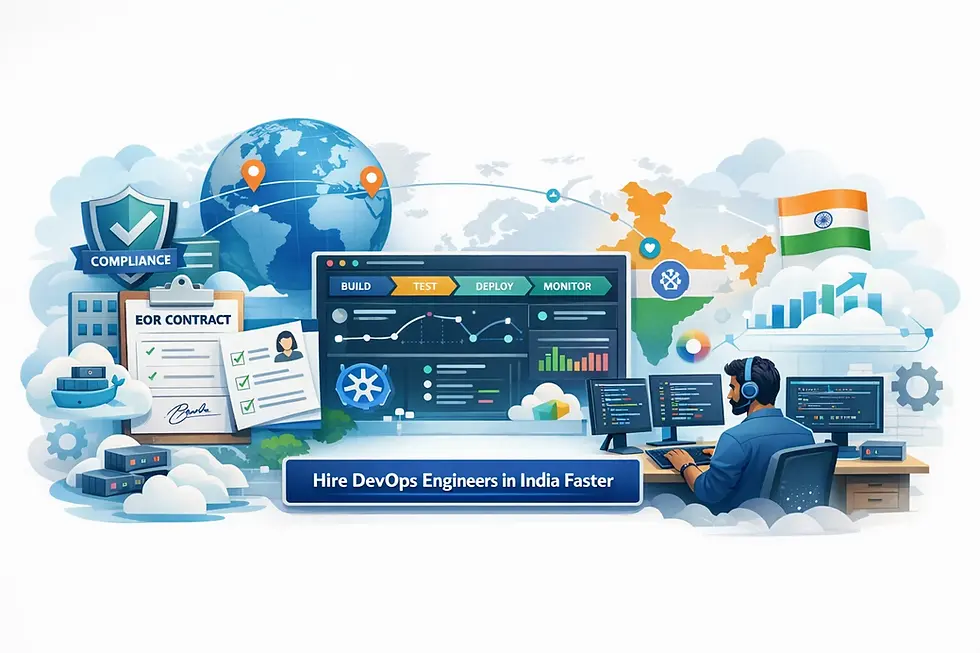
You have found the right DevOps talent. They are based in Bengaluru or Hyderabad, their skills match perfectly with your infrastructure needs, and the cost makes sense for your budget. But then the legal and compliance questions start rolling in.
How do you pay them? What about employment contracts under Indian labor law?
Who owns the tax filings and provident fund contributions?
If you do not have a registered legal entity in India, suddenly that perfect hire feels like a complicated risk you are not sure how to take on.
This is exactly the situation hundreds of global companies find themselves in every quarter. You are expanding your DevOps team, you know India has the talent, but the operational complexity of hiring across borders without local infrastructure is slowing you down. Meanwhile, your competitors are already running lean DevOps and Site Reliability Engineering (SRE) teams out of India, deploying faster, scaling smarter, and cutting infrastructure costs significantly. The longer you wait to solve the compliance and hiring puzzle, the further behind you fall.
Employer of Record (EOR) services for DevOps hiring in India solve this problem directly and cleanly. You find the talent, we handle everything else, from legally compliant employment contracts and payroll processing to statutory benefits, labor law adherence, and ongoing HR management. There is no entity setup needed, no legal exposure, just the DevOps engineering capacity you need, working inside your systems, reporting to your team, fully operational.
What Makes India the Right Market for Your DevOps and Cloud Engineering Talent Strategy?
India is not just a cost-saving option anymore. It has become a genuine engineering hub for some of the world's most ambitious technology companies. The country produces a substantial volume of software engineers and infrastructure specialists annually, and a significant portion of that talent flows into DevOps, cloud architecture, containerization, and automation roles. Cities like Bengaluru, Hyderabad, Pune, and Chennai are home to deep talent pools in tools and platforms like Kubernetes, Docker, Terraform, Jenkins, GitHub Actions, AWS, Google Cloud Platform (GCP), Microsoft Azure, Ansible, Prometheus, and Grafana.
For companies running modern microservices architectures, building CI/CD pipelines, or managing hybrid cloud environments, India-based DevOps engineers bring both depth and velocity to your engineering operations. The timezone overlap with Europe and partial overlap with the US East Coast makes teams located in Bengaluru or Hyderabad practical for real-time collaboration, incident response, and sprint participation.
What companies from the US, UK, Germany, Australia, the Netherlands, and the UAE are discovering is that Indian DevOps talent is not just affordable, it is highly capable at senior and principal engineer levels. Infrastructure engineers with expertise in platform engineering, GitOps workflows, service mesh implementations, and cloud cost optimization are increasingly available and are actively building careers with global companies through remote and hybrid models.
How Does Employer of Record (EOR) Work for DevOps Hiring in India?
If your company does not have a legal entity in India, you cannot directly employ someone there. That is where an Employer of Record (EOR) steps in. The Employer of Record (EOR) becomes the legal employer of your DevOps engineers on paper, handling all employment obligations under Indian law, while you maintain full operational and managerial control over the talent. Who to hire, what they work on, and how they grow are decisions entirely yours to make. Everything that makes that employment legally and operationally sound sits with the EOR.
Here is what that looks like in practice for a company building or scaling a DevOps function in India:
Your selected DevOps engineer is onboarded under a compliant employment contract that meets Indian labor law requirements, including the applicable state-level Shops and Establishment Act provisions.
Monthly payroll is processed accurately with all statutory deductions, including Employee Provident Fund (EPF), Employee State Insurance (ESI), professional tax, and Tax Deducted at Source (TDS) calculated under the correct tax regime.
Offer letters, appointment letters, compensation structures, variable pay components, and benefits packages are all structured to meet compliance requirements while staying competitive in the Indian market.
Gratuity eligibility, leave balances, and separation processes are managed according to applicable statutory requirements, including the Payment of Gratuity Act and applicable state-level labor codes.
Ongoing HR administration including payroll revisions, performance documentation, disciplinary processes, and exit management are handled end to end.
For companies that have never hired in India before, this removes months of setup time and eliminates the risk of non-compliance penalties that can
If you are evaluating Employer of Record (EOR) options for your DevOps hiring in India and want to understand how the process would work for your specific situation, our team at AnjuSmriti Global can walk you through the full operational model. Start the conversation here.
Which DevOps and Infrastructure Roles Are Companies Hiring Through EOR in India?
The scope of DevOps hiring through Employer of Record (EOR) in India has widened significantly as companies move beyond basic pipeline setup toward full platform engineering and cloud-native infrastructure.
The roles companies are actively placing include:
DevOps Engineer (mid to senior level), specializing in CI/CD pipelines, containerized deployments, and infrastructure automation using tools like Terraform, Ansible, and Pulumi.
Site Reliability Engineer (SRE), managing production reliability, incident response frameworks, and observability stacks built on Prometheus, Grafana, Datadog, or New Relic.
Platform Engineer, building internal developer platforms (IDPs) on top of Kubernetes and cloud-native services that allow product teams to deploy without infrastructure friction.
Cloud Infrastructure Engineer, architecting and managing environments on AWS, Azure, and GCP, including cloud cost optimization, networking, identity management, and disaster recovery.
Build and Release Engineer, managing version control strategies, branching policies, artifact management, and release orchestration across multiple environments.
Security DevOps (DevSecOps) Engineer, integrating security tooling into pipelines, managing vulnerability scanning, and ensuring compliance within cloud environments for companies operating under standards like SOC 2, ISO 27001, or GDPR.
Companies building Global Capability Centers (GCC) in India are particularly active in hiring these profiles through EOR as a bridge while they establish their own legal entities. The EOR model allows them to start building their DevOps team, validate the India hiring model, and grow the function without waiting for entity registration timelines that can stretch for months.
What Does Employer of Record (EOR) DevOps Hiring Actually Cost in India?
One of the most common questions we hear from hiring managers and engineering leaders evaluating this model is about the total cost. Understanding the cost structure helps you compare the EOR route honestly against the alternatives.
When you hire a DevOps engineer in India through an Employer of Record (EOR), the total cost includes the engineer's gross salary, the statutory employer contributions (Employee Provident Fund (EPF) at 12% of basic salary, Employee State Insurance (ESI) where applicable, gratuity accrual), any supplementary benefits like health insurance and group term life cover, and the EOR service fee. That fee typically covers all employment administration, compliance management, payroll processing, and HR support within a single, predictable cost structure.
Compared to setting up your own entity, the EOR model eliminates one-time setup costs, ongoing legal and compliance advisory fees, local HR staffing costs, and the risk cost of getting something wrong in a jurisdiction your team does not know well. For most companies hiring fewer than 20 to 30 engineers in India, the EOR model is more cost-effective on a total cost basis for the first several years of India operations.
For companies hiring DevOps engineers at senior and principal levels in Bengaluru or Hyderabad, where market salaries are competitive and talent expects structured benefits packages, the EOR model also allows you to position as a credible employer with proper employment documentation, which matters in a candidate market where top infrastructure engineers have multiple options.
How Global Capability Centers (GCC) Are Using EOR to Launch DevOps Functions in India
Global companies setting up Global Capability Centers (GCC) in India have become one of the strongest use cases for Employer of Record (EOR) services. A GCC represents a significant long-term investment in India-based engineering capacity, but the ramp-up period before the entity is fully operational creates a hiring gap that EOR fills precisely.
A technology company based in Amsterdam, for example, deciding to build a DevOps and cloud infrastructure center in Hyderabad will realistically need six to twelve months to complete entity setup, establish banking, and get payroll infrastructure operational. During that period, the EOR acts as the legal employer for the initial cohort of DevOps engineers, allowing the company to begin onboarding, knowledge transfer, and team integration in parallel with the entity setup process.
By the time the legal entity is operational, the DevOps team already has three to six months of organizational context, toolchain familiarity, and collaborative relationships with the global team. Transitioning from Employer of Record (EOR) employment to direct employment can be handled smoothly through a structured transfer process, and companies that take this approach consistently report faster time to productivity for their India engineering functions compared to those that wait for entity completion before hiring.
AnjuSmriti Global has supported GCC setup and EOR-to-entity transitions for technology companies across sectors including fintech, SaaS, cybersecurity, and cloud infrastructure, managing the complete employee lifecycle from initial EOR onboarding through direct employment transfer.
If you are building a DevOps team in India as part of a GCC strategy or remote-first expansion, we can structure the engagement model that fits your timeline and compliance needs. Speak to our team today.
What to Look for When Evaluating Employer of Record (EOR) Providers for India DevOps Hiring
Not all EOR providers have the same depth of India-specific capability. When you are evaluating options, the questions that matter most are about operational depth, compliance infrastructure, and the quality of HR support your engineers will actually experience.
Specifics to evaluate include:
Whether the provider has established payroll infrastructure in India with registered entities in the states where you are hiring, not just a network of third-party partners.
The completeness of their statutory compliance coverage, including their ability to handle multi-state scenarios if your team grows beyond a single city.
A dedicated HR point of contact for your employees is non-negotiable, since engineers who have questions about payslips, leave balances, or benefits deserve real answers from a real person, not a ticketing system.
Their track record with Employer of Record (EOR)-to-entity transitions for companies that eventually want to move DevOps engineers onto direct employment.
Their ability to support the full employee lifecycle including performance documentation, compensation revisions, disciplinary processes, and exit management in a way that keeps your company protected and your employees treated professionally.
AnjuSmriti Global manages end-to-end HR functions for technology companies hiring in India and across multiple countries, covering the complete range of Employer of Record (EOR) services, IT recruitment and staffing support, payroll coordination, HRIS management, labor law compliance, and employee lifecycle management from day one onboarding through exit. Our approach is to act as your HR function on the ground, not just a processing layer.
Building a Remote DevOps Team in India That Functions as Part of Your Global Engineering Organization
Remote DevOps teams in India working on Kubernetes cluster management, multi-cloud infrastructure automation, pipeline reliability, or platform engineering need access to the same quality of HR support as your engineers anywhere else in the world. That means clear employment documentation, predictable payroll, transparent leave and attendance management, structured performance reviews, and a professional exit process when roles change.
When we support global companies in building remote engineering teams in India, we bring the HR operations infrastructure that makes that experience consistent. Your engineers in Bengaluru or Hyderabad working with Terraform Enterprise, GitLab CI, ArgoCD, or AWS EKS deserve the same quality of employment experience as your team in London or San Francisco. That is what good Employer of Record (EOR) services actually deliver, not just compliance paperwork, but a professional employment relationship that reflects well on your company.
Is Employer of Record (EOR) the Right Model for Your India DevOps Hiring Right Now?
If you are a global technology company, a SaaS business, a cybersecurity firm, or any organization building engineering capacity in India without a local legal entity, the Employer of Record (EOR) model is very likely the fastest and most risk-managed path to getting your DevOps team operational.
The model works well when:
You need to hire one or more DevOps engineers in India within weeks, not months.
There is no Indian entity in place yet, or you are in the process of establishing one.
Full operational control over the engineers matters to you, while keeping legal employment liability managed.
Compliance coverage across payroll, statutory benefits, labor law, and ongoing HR administration is needed without building a local HR function.
India is being evaluated as a long-term engineering hub and you want to validate the model before committing to entity setup.
The Employer of Record (EOR) model is also a natural fit for companies that are already hiring across multiple countries and need a consistent HR and compliance framework across geographies, not a patchwork of local arrangements that create inconsistency and risk.
Ready to hire your first or next DevOps engineer in India with full compliance and zero entity setup? AnjuSmriti Global manages the complete HR and employment infrastructure so you can focus entirely on building your team. Get in touch with us here.
Interesting Reads:
FAQs
1.What is an Employer of Record (EOR) and how does it help companies hire DevOps engineers in India?
An Employer of Record (EOR) is a third-party organization that legally employs talent on behalf of a company. It manages payroll, compliance, taxes, benefits, and employment contracts while the company focuses on managing the DevOps engineer’s daily work. For global companies looking to hire DevOps engineers in India, an EOR simplifies the hiring process by removing the need to establish a local legal entity. This makes it easier to access India’s DevOps talent pool in cities like Bengaluru while staying compliant with Indian employment regulations.
2.Why is India considered a strong destination for hiring DevOps engineers through an Employer of Record (EOR) model?
India has one of the largest pools of highly skilled DevOps engineers with strong expertise in cloud platforms, automation, CI/CD pipelines, and infrastructure management. Cities such as Bengaluru have become major technology hubs supporting startups, enterprises, and Global capability center (GCC) operations. When companies use an Employer of Record (EOR) to hire DevOps engineers in India, they gain access to this deep talent pool without dealing with local hiring complexities, making India a strategic outsourcing and remote hiring destination.
3.How does hiring DevOps engineers in India through an Employer of Record (EOR) reduce operational costs?
Hiring DevOps engineers in India through an Employer of Record (EOR) significantly reduces operational costs compared to setting up a legal entity or building an in-house team in high-cost markets. Businesses save on infrastructure, HR management, compliance costs, and administrative overhead.Global companies often report cost reductions of 40–60 percent when hiring DevOps professionals in India. This allows organizations to invest more in innovation, cloud infrastructure, and product development instead of administrative expenses.
4.Can an Employer of Record ensure compliance when hiring DevOps engineers in India?
Yes, an Employer of Record (EOR) ensures full compliance with India’s labor laws, payroll regulations, statutory benefits, and tax requirements. Managing employment laws across different jurisdictions can be complex for global companies without local expertise. By using an EOR to hire DevOps engineers in India, companies can mitigate legal risks and ensure employment contracts, payroll structures, and benefits align with local regulations while maintaining a smooth employee experience.
5.How quickly can companies build a DevOps team in India using an Employer of Record (EOR)?
Building a DevOps team through an Employer of Record (EOR) in India is significantly faster than establishing a legal entity. The EOR already has the local infrastructure, payroll systems, and compliance frameworks in place. This enables companies to onboard DevOps engineers in India within days instead of months. Fast hiring allows businesses to accelerate cloud transformation, DevOps automation, and software delivery pipelines without delays.
6.What roles can companies hire in DevOps through an Employer of Record (EOR) in India?
Through an Employer of Record (EOR), companies can hire a wide range of DevOps professionals in India including DevOps engineers, cloud engineers, site reliability engineers, automation specialists, and infrastructure architects. Many global companies build entire DevOps teams in India to support cloud operations, Kubernetes environments, CI/CD pipelines, and platform engineering initiatives across their global products and services.
7.How does an Employer of Record (EOR) support global companies scaling DevOps teams in India?
An Employer of Record (EOR) allows companies to scale DevOps teams in India quickly without worrying about legal entity setup, employment compliance, or payroll administration. This flexibility is especially valuable for companies expanding into new markets. Many multinational organizations leverage India’s DevOps talent to support global development teams and Global capability center (GCC) initiatives, particularly in tech hubs like Bengaluru where the DevOps ecosystem is highly mature.
8.Is hiring DevOps engineers in India through an Employer of Record (EOR) suitable for startups and enterprises?
Yes, the Employer of Record (EOR) model works well for both startups and large enterprises. Startups benefit from faster market entry and reduced operational burden, while enterprises can scale distributed DevOps teams across multiple regions. For companies exploring hiring DevOps engineers in India, an EOR provides the flexibility to test new markets, expand engineering teams, and build remote infrastructure teams without long-term legal commitments.
9.How does hiring DevOps engineers in India improve innovation and productivity?
India’s DevOps professionals are known for their strong expertise in cloud-native development, automation frameworks, containerization, and continuous integration and delivery pipelines. This technical capability helps companies accelerate software releases and improve system reliability. With the support of an Employer of Record (EOR), global companies can quickly integrate DevOps engineers in India into distributed engineering teams, enabling faster product innovation and 24/7 operational support.
10.What are the long-term advantages of using an Employer of Record (EOR) to hire DevOps engineers in India?
Using an Employer of Record (EOR) for hiring DevOps engineers in India offers long-term strategic advantages including scalability, reduced compliance risk, cost optimization, and faster access to technical talent. Many global organizations leverage India as a core engineering hub, especially in cities like Bengaluru, to support cloud infrastructure, platform engineering, and Global capability center (GCC) expansion while maintaining operational flexibility.
Comments