.png)


How to Hire Full-Stack Developers in India Using Employer of Record (EOR)?

Updated: Jun 20
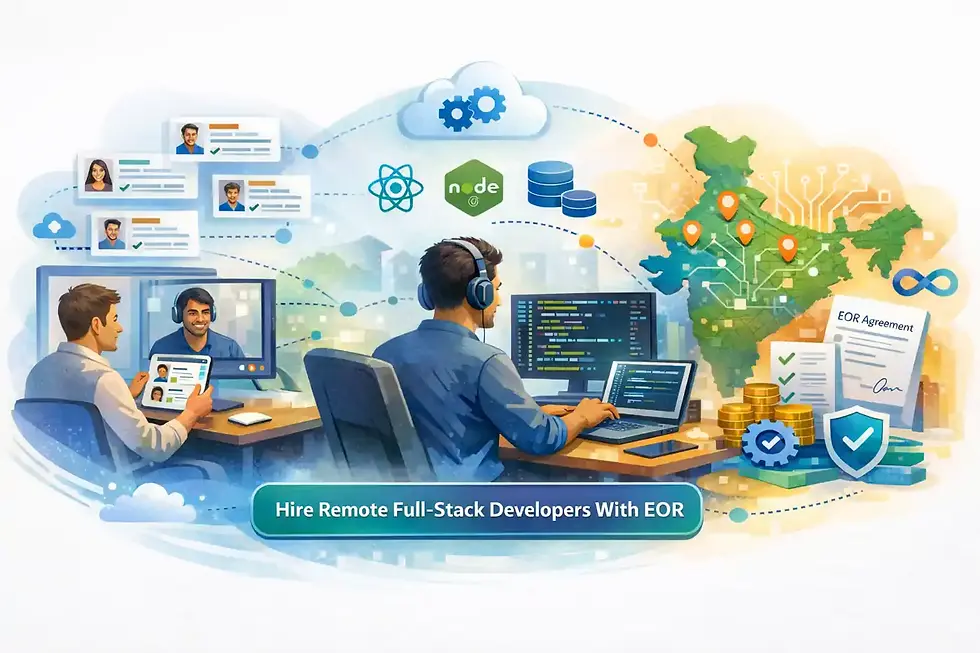
You have a product to build, a roadmap that is already behind schedule, and a leadership team asking why engineering velocity is stalling. Local talent in your home country is either too expensive or the pipeline is simply too thin to hire at the pace you need. India keeps coming up in every conversation, and for good reason.
But then the real questions start:
How do you hire legally without a registered entity there?
Who handles payroll in Indian rupees?
What about the Provident Fund, Professional Tax, and compliance with state-level labor laws? Before you know it, what started as a straightforward hiring decision has turned into a six-month legal and operational project that nobody signed up for.
This is exactly where the Employer of Record (EOR) model in India changes everything. Instead of waiting months to incorporate a local subsidiary, you can have your first full-stack developer hired, onboarded, and shipping code within weeks. The Employer of Record (EOR) takes on the legal employer responsibility, manages payroll, handles compliance, and lets your team focus entirely on building the product.
For companies hiring full-stack developers in India, whether you are setting up your first offshore team, scaling a Global Capability Center (GCC), or simply trying to move faster than your competitors, this is the hiring model worth understanding deeply.
Why Are Global Companies Actively Hiring Full-Stack Developers in India Right Now?
India produces one of the largest pools of engineering talent in the world, and the concentration of full-stack developers across cities like Bengaluru, Hyderabad, Pune, Chennai, and Delhi NCR is genuinely remarkable. What has shifted recently is not just the volume but the quality and depth of that talent. The developers you are hiring today are not proficient in just one layer of the stack. They are building with React, Next.js, and TypeScript on the front end, working with Node.js, Python, Django, FastAPI, and Go on the back end, and managing cloud infrastructure on AWS, GCP, and Azure without needing hand-holding on any of it.
Beyond technical capability, India's full-stack developer community has matured alongside the global product ecosystem. Engineers who have worked with SaaS companies, funded startups, and Global Capability Centers (GCC) bring product thinking, Agile fluency, and real experience working across time zones. For companies in the US, UK, Europe, the Middle East, Southeast Asia, and Australia, this alignment is no longer coincidental. It is structural, and it is why India hiring has moved from a cost-saving conversation to a genuinely strategic one.
The talent is there, the frameworks and stacks are battle-tested, and the product experience is real. The actual bottleneck for most companies is not finding the right developers. It is hiring them legally, paying them compliantly, and managing them at scale, all without setting up a full legal entity in India that can take anywhere from four to eight months and cost significantly more than most hiring managers anticipate.
What Does Employer of Record (EOR) Full-Stack India Actually Mean for Your Hiring?
When you use an Employer of Record (EOR) in India, the EOR becomes the legal employer of the full-stack developers you select. Your company retains complete control over the work, the role definition, the tools, the tech stack, the performance expectations, and the day-to-day management. Everything that involves Indian employment law, statutory compliance, and payroll sits with the EOR, leaving your internal team free to manage what matters most.
In practical terms, this translates to:
Your selected developer is hired under a compliant employment contract governed by Indian labor law
Monthly payroll is run in Indian rupees with all applicable deductions, including Tax Deducted at Source (TDS), Provident Fund (PF), and Employee State Insurance (ESI) where applicable
Professional Tax is deducted and remitted at the state level, since rates and applicability vary by state
Payslips, Form 16, and all statutory documentation are generated and maintained throughout the engagement
Your developer is covered under the applicable employee benefits structure, including gratuity provisions under the Payment of Gratuity Act
The complete employee lifecycle, from offer letter through to exit and full and final settlement, is managed within a compliant framework
What this does for your hiring timeline is significant. Instead of a six-to-eight-month entity setup process, you can have compliant employment in place within two to four weeks. For companies that are actively building or scaling, that speed advantage is not just operational. It is a competitive one.
How Do You Actually Find and Hire the Right Full-Stack Developers in India Through an EOR?
This is where many companies hit their second wall. They understand that the Employer of Record (EOR) handles compliance and payroll, but are still left wondering: who finds the developers? How do you validate technical fit for a role that involves React on the front end, Python or Node.js on the back end, PostgreSQL or MongoDB for data, and Docker or Kubernetes for containerization, without being physically present in India to run interviews?
The answer lies in working with a partner that covers both sides of the equation. A team that actively sources, screens, and presents candidates matching your technical requirements is very different from one that simply provides payroll infrastructure and expects you to handle recruitment independently. Understanding the difference between a developer who lists React on a resume and one who has built production-grade applications using React Query, Redux Toolkit, and server-side rendering in Next.js is what separates useful screening from a checkbox exercise. The same applies when evaluating senior full-stack engineers who are working with microservices on AWS Lambda or running CI/CD pipelines on GitHub Actions.
When the right process is in place, the hiring flow looks like this:
You share your role requirements, the tech stack, the seniority level, and your hiring timeline
Candidates are sourced from an active talent network across Bengaluru, Hyderabad, Pune, and other major tech hubs
Initial technical screening narrows the field, and a shortlist is presented that genuinely meets your criteria
You conduct your own technical interviews and make the final hiring decision
The offer, employment contract, onboarding documentation, and payroll setup are handled under the Employer of Record (EOR) model
Your developer joins your team, works in your tools, and reports to your leadership while remaining legally employed and payrolled through the EOR structure
This end-to-end approach removes the fragmentation that most companies experience when trying to stitch together a staffing vendor, a legal consultant, and a payroll provider across three separate relationships that rarely communicate with each other.
What Are the Most Common Compliance Challenges Companies Face When Hiring Developers in India?
Even companies that have hired in India before often find themselves struggling with compliance the moment they try to scale. India's labor law framework is layered in a way that catches many global employers off guard. There are central laws like the Employees' Provident Funds and Miscellaneous Provisions Act, the Payment of Gratuity Act, and the Maternity Benefit Act, alongside state-specific regulations and Professional Tax structures that differ between Karnataka, Maharashtra, Telangana, Tamil Nadu, and other states where your developers might be based.
Since the labor code consolidations are still being implemented across states at varying speeds, keeping pace with what is currently applicable requires active monitoring, not a one-time legal review.
Some of the compliance risks that companies most commonly underestimate include:
Misclassifying full-time developers as independent contractors to avoid employment obligations, which creates significant legal and financial exposure under Indian law
Failing to register for Employees' Provident Fund (EPF) once headcount crosses the applicable threshold, even when the team is fully remote and distributed across states
Not accounting for state-level Professional Tax registration and remittance when developers are based across different states, each with its own rates and filing calendar
Incomplete or non-compliant employment contracts that do not reflect Indian law requirements around notice periods, statutory leaves, and termination procedures
Absence of proper payroll documentation, including Form 16, that developers need for their own annual tax filings
Under the Employer of Record (EOR) model, these are not problems your team needs to navigate independently. The EOR maintains all registrations, runs compliant payroll, handles statutory filings, and keeps the employment structure audit-ready at all times. For companies building Global Capability Centers (GCC) in India or managing distributed engineering teams across multiple countries, this layer of compliance coverage is not optional. It is foundational.
Can You Use Employer of Record (EOR) to Build an Entire Full-Stack Engineering Team in India?
Absolutely, and this is increasingly how both growth-stage companies and established enterprises are approaching India hiring. The Employer of Record (EOR) model scales with your team, whether you are bringing on two full-stack developers to complement an existing product squad or building a fifty-person engineering function from scratch, all without requiring entity setup at any point.
For companies building engineering teams in India for the first time, a typical team architecture might look something like this:
Senior full-stack engineers who handle end-to-end feature development, architecture decisions, and code reviews across the stack
Mid-level developers contributing across front-end work in React or Vue.js and back-end services built in Node.js, Python, or Java
Junior developers being onboarded and ramped through structured mentorship within the existing team
DevOps or cloud engineers managing infrastructure on AWS or GCP, overseeing Docker, Kubernetes, and CI/CD pipeline operations
QA engineers ensuring test coverage across the full stack using tools like Selenium, Cypress, or Playwright
AnjuSmriti Global has supported companies across the US, UK, the Middle East, and Southeast Asia in building and scaling these teams under the Employer of Record (EOR) model. In one engagement, a SaaS company looking to establish a product engineering team in Bengaluru had estimated a nine-month timeline because of entity registration requirements. By combining Employer of Record (EOR) employment with end-to-end IT recruitment support, that same company had five full-stack developers hired, onboarded, and running on compliant payroll within six weeks of starting the process.
How Does the Employer of Record (EOR) Model Support Remote Full-Stack Teams Across Different Indian States?
One practical reality of hiring full-stack developers in India today is that strong talent is not concentrated in a single city. Your strongest candidates might be in Bengaluru, but equally capable engineers are based in Hyderabad, Pune, Chennai, Coimbatore, Kochi, and increasingly in smaller cities where competition for talent is lower and retention tends to be more stable. Managing a distributed team across states introduces complexity around Professional Tax, state-specific labor regulations, and payroll administration that is easy to underestimate until you are already in it.
The Employer of Record (EOR) model is built to absorb exactly this kind of complexity. Your remote full-stack team can be spread across multiple states, and the compliance requirements applicable in each location are handled without you needing to track them independently or maintain separate registrations in every jurisdiction.
For companies hiring remote engineering teams and wanting to give developers the flexibility to work from wherever they are most productive, this matters beyond just compliance. Opening your search beyond a single metro city also means you are not competing in one oversaturated market, which gives you access to developers who may offer a stronger technical fit and a more stable long-term employment relationship.
What Should You Look for When Evaluating an Employer of Record (EOR) Provider for Full-Stack Hiring in India?
Not all Employer of Record (EOR) providers are built the same, and the difference matters considerably when you are building an engineering team that needs to ship real product. Some providers offer payroll processing but not recruitment, leaving you to source candidates independently. Others cover compliance but have no capability to manage employee lifecycle events beyond the initial hire.
When building a full-stack development team and planning to manage them as an integrated engineering function, you need a partner that covers the complete picture.
Here is what the evaluation should cover:
Does the provider have genuine IT recruitment capability, or are they a pure compliance and payroll operation that expects you to arrive with candidates already in hand?
Do they understand the technical hiring landscape well enough to screen for skills like TypeScript proficiency, experience with GraphQL APIs, familiarity with cloud-native architectures, or hands-on background in microservices development?
How is the employee experience managed? Is there a dedicated HR point of contact for your developers, or is employee communication routed through a generic support ticket system?
What is their track record with India-specific compliance, covering multi-state payroll, Employees' Provident Fund (EPF) and Employee State Insurance (ESI) administration, and labor law updates?
Can they support your team through growth, handling lifecycle events like promotions, role changes, salary revisions, and exits in a structured and compliant way?
Do they provide Human Resource Information System (HRIS) support so your leadership has real visibility into attendance, leave, and workforce data without managing it all manually?
These questions help you separate providers offering a basic compliance wrapper from those who can genuinely function as your HR partner on the ground in India.
How Does Employer of Record (EOR) Full-Stack Hiring in India Compare to Setting Up Your Own Entity?
This is a question almost every company asks at some point, and the answer is genuinely nuanced. Both paths are valid depending on your scale, timeline, and long-term strategic intent. For most companies in the early-to-mid stages of building an India presence, though, the Employer of Record (EOR) path wins on nearly every dimension during the initial phase.
The comparison is worth walking through directly:
Entity setup in India typically takes four to eight months, involves company registration, GST registration, labor law registrations, and opening a local bank account, then requires ongoing compliance management and annual statutory filings once operational
Employer of Record (EOR) allows you to have compliant employment in place within two to four weeks, with zero entity setup cost and all compliance managed by the provider from day one
Setting up your own entity starts to make more financial sense once your India team reaches significant scale and you intend to establish a long-term legal presence, as is typically the case with companies building Global Capability Centers (GCC)
Employer of Record (EOR) is the practical choice for companies wanting to test the India market, hire specific technical talent quickly, manage remote engineering teams across time zones, or scale without the administrative overhead of running a local subsidiary.
Building Your India Full-Stack Team the Right Way
Hiring full-stack developers in India through the Employer of Record (EOR) model is not a workaround. It is the structurally correct approach for most companies at most stages of their India journey, offering legal and compliant employment without entity complexity, and real speed without sacrificing quality. When the framework also brings IT recruitment capability, HR lifecycle management, and a dedicated point of contact for employees, it delivers something more valuable than just compliance coverage. It gives you a genuinely integrated engineering team that can build, ship, and grow with your product.
AnjuSmriti Global manages the complete HR function for onsite and remote engineering teams across India and multiple countries. From IT recruitment and staffing through to Employer of Record (EOR) employment, payroll coordination, compliance, and employee lifecycle management, the goal is to serve as your HR partner from the first hire through to a mature, high-performing team.
If you are ready to hire full-stack developers in India and want to move without the delays of entity setup, share your hiring requirements here and we will respond with a practical plan tailored to your team, your tech stack, and your timeline.
Interesting Reads:
FAQs
1.What is an Employer of Record (EOR) and how does it help hire full-stack developers in India?
An Employer of Record (EOR) is a third-party organization that legally employs talent on behalf of global companies. It manages payroll, compliance, contracts, and statutory benefits while the company directly manages the developer’s work.This approach allows international teams to quickly hire full-stack developers in India without establishing a local entity or navigating complex employment regulations.
2.Why are global companies choosing the Employer of Record (EOR) model to hire full-stack developers in India?
Many global organizations prefer the Employer of Record (EOR) approach because it simplifies international hiring and significantly reduces administrative burdens. Instead of setting up a local office, companies can onboard highly skilled developers within days.This model is particularly useful for companies building remote engineering teams or expanding their Global capability center (GCC) strategy in India.
3.How does the Employer of Record (EOR) simplify compliance when hiring developers in India?
India has multiple labor laws, payroll regulations, and statutory compliance requirements that can be challenging for international companies. An Employer of Record (EOR) manages employment contracts, tax deductions, benefits administration, and labor law compliance.This ensures companies can hire full-stack developers in India confidently without risking legal or compliance issues.
4.Which cities in India are most popular for hiring full-stack developers through an Employer of Record (EOR)?
India has several thriving technology hubs where global companies recruit software talent through the Employer of Record (EOR) model. Cities like Bengaluru, Hyderabad, Pune, and Gurugram offer a deep pool of experienced full-stack engineers.Among these, Bengaluru remains a leading destination because of its strong startup ecosystem, advanced technology infrastructure, and large developer community.
5.Can companies scale engineering teams in India quickly using an Employer of Record (EOR)?
Yes, scalability is one of the biggest advantages of using an Employer of Record (EOR). Global companies can hire one developer or build an entire engineering team without dealing with entity setup or HR infrastructure.This flexibility makes it easier for companies to test new markets, expand product teams, or establish a Global capability center (GCC) in India.
6.What skills make Indian full-stack developers attractive to global companies?
Full-stack developers in India often possess strong expertise in modern frameworks such as React, Angular, Node.js, Python, and cloud technologies. Many also have experience working with international teams and agile development environments.Combined with strong problem-solving skills and competitive hiring costs, India has become a preferred destination for global engineering teams using Employer of Record (EOR) hiring models.
7.How does an Employer of Record (EOR) handle payroll and benefits for developers in India?
When hiring through an Employer of Record (EOR), the provider manages all payroll processing, statutory deductions, employee benefits, and employment documentation. This includes tax compliance, provident fund contributions, and employee insurance requirements.For global companies, this ensures developers receive compliant compensation while the company avoids administrative complexity.
8.Is the Employer of Record (EOR) model suitable for building remote engineering teams in India?
Yes, the Employer of Record (EOR) model is widely used by international companies building distributed engineering teams. It allows organizations to access India’s developer talent pool while maintaining full operational control over projects.This setup works especially well for remote-first companies that want to hire developers in cities like Bengaluru without opening a physical office.
9.How does the Employer of Record (EOR) model support Global capability center (GCC) expansion in India?
Many companies exploring Global capability center (GCC) expansion start with an Employer of Record (EOR) hiring model. It allows them to quickly onboard engineers, test operational feasibility, and understand the local talent ecosystem.Once the team grows and operations stabilize, companies can then transition to a full Global capability center (GCC) structure if needed.
10.What should companies evaluate before hiring full-stack developers in India using an Employer of Record (EOR)?
Organizations should consider factors such as developer skill availability, communication capabilities, compliance expertise of the Employer of Record (EOR), and scalability of the hiring model. Evaluating these aspects helps ensure smooth onboarding and long-term team growth.Many global companies also assess technology expertise and regional hubs like Bengaluru when planning to build engineering teams in India.
Comments