.png)


How to Keep Hiring in India During M&A with Employer of Record (EOR)

Updated: Jun 20
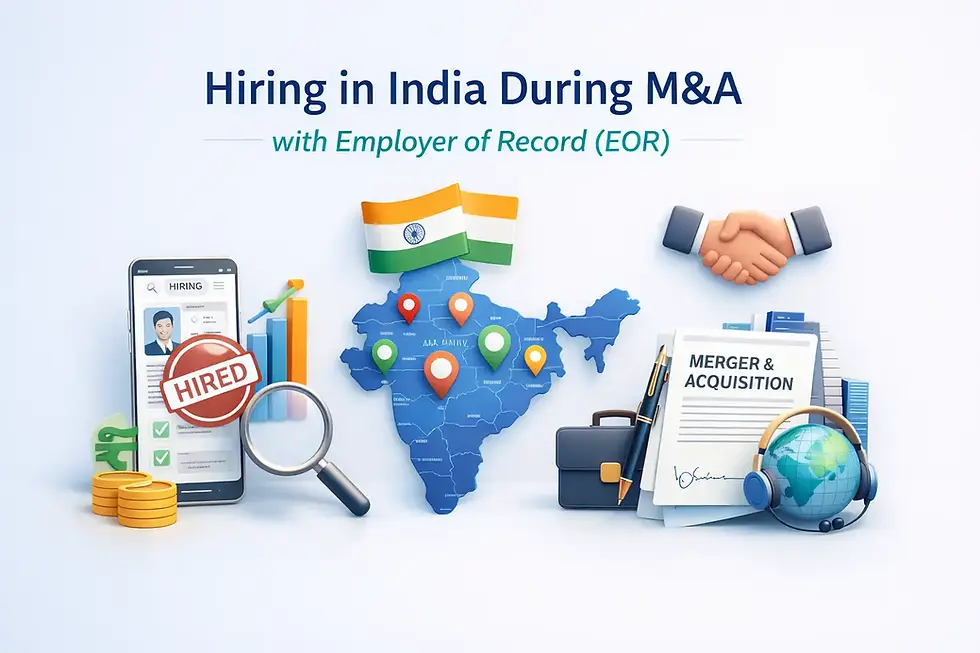
If your company just acquired an Indian team, or is being acquired, hiring is probably the last thing anyone wants to think about. Legal teams are buried in due diligence. HR is rewriting org charts. And the candidates you need to close this month are sitting in limbo because nobody can tell them which entity they would actually join. This is the real cost of M&A. Not the deal itself, but the six to nine months of operational fog that follows it. Roles freeze. Offers get pulled back. Strong candidates accept counteroffers elsewhere because your process could not move fast enough.Hiring in India during M&A with Employer of Record (EOR) solves this specific problem.
An Employer of Record (EOR) becomes the legal employer of your new hires in India while you retain full control over their work, reporting line, and day-to-day direction. There is no need to wait for entity restructuring, license transfers, or a finalized cap table before you bring someone on board. We have run this exact playbook for global companies mid-acquisition, and the pattern is consistent: the businesses that keep hiring through the transition come out ahead on talent, and the ones that pause lose candidates they cannot get back.
Why Does Hiring Stall During Mergers and Acquisitions in India?
Hiring rarely stops because anyone decides it should. It stops because the supporting infrastructure is in flux, and nobody wants to make a hiring decision on shaky ground.
In India specifically, the stakes are higher than in many other markets. Labour law compliance is state-specific, statutory contributions like provident fund and gratuity have strict timelines, and getting employment contracts wrong during a transition creates liability that surfaces months later, often during the next due diligence cycle.
Picture a German automotive company that has just signed an agreement to acquire an Indian auto-components supplier. The acquired entity's HR systems will not be fully merged for another two quarters, but the company still needs ten contract Java developers in Pune to keep a connected-vehicle project on schedule. Waiting for entity alignment is not realistic, and going without engineering capacity for two quarters is not acceptable either.
This is the gap where hiring decisions usually get postponed indefinitely. Common stall points include incomplete entity transfers, unclear benefits continuity for new joiners, payroll systems that are being migrated, and HR teams who are already stretched thin managing the integration itself. None of these problems are solved by waiting. They are solved by removing the dependency between hiring and entity readiness, which is exactly what EOR in India is built for.
How Hiring in India During M&A with Employer of Record (EOR) Keeps Recruitment Moving
The mechanism is straightforward. Instead of your acquired or restructuring entity issuing the employment contract, the EOR provider becomes the legal employer of record in India. Your new hire works for you, reports to you, and is fully embedded in your team. The EOR partner handles the paperwork side: drafting the compliant employment contract, registering the employee for provident fund and professional tax, processing statutory deductions, and running payroll on schedule.
This separation matters more during M&A than at any other time. If your India entity is being merged, dissolved, or newly formed, you do not want new hires legally tied to a structure that might not exist in its current form six months from now. Hiring in India during M&A with Employer of Record (EOR) decouples the employment relationship from the corporate transaction, so neither one blocks the other.
Onboarding through an EOR during a transition typically moves in days rather than months. A candidate can sign an offer, complete background and statutory documentation, and start work inside one to two weeks, often faster than an internal HR team mid-integration could manage on its own.
We have seen this play out with a Singapore-based holding company that acquired a controlling stake in an Indian SaaS business. Rather than waiting for the new holding structure to finalize, they used EOR to bring on a regional sales lead and three customer success hires within three weeks of signing. By the time the entity restructuring closed, those hires were already productive and fully integrated into the team.
Managing Compliance Risk Without Slowing Recruitment Down
Compliance is usually the reason hiring freezes during M&A, and it is also the reason an EOR makes sense as the fix rather than the obstacle.
India's employment compliance landscape is not a single national framework. Provident fund contributions, professional tax slabs, shops and establishments registrations, and gratuity rules can vary by state, and getting any of these wrong creates exposure that often does not surface until the next audit or, worse, the next acquisition. During an active M&A process, your legal and HR teams are already at capacity managing the deal itself. Adding new hire compliance on top of that is where mistakes happen.
An EOR partner absorbs this responsibility directly rather than building a temporary internal process to cover the gap. Functions typically handled include:
Drafting employment contracts compliant with the relevant state's labour law
Managing statutory contributions including provident fund, ESI, and gratuity
Processing monthly payroll and tax deductions accurately
Filing required statutory returns on schedule
Maintaining audit-ready employee documentation throughout the transition
For a UK fintech acquiring an Indian payments startup, this matters in a very specific way. UK compliance officers are used to PAYE and a single national framework, and they are often surprised to learn how fragmented Indian statutory compliance is across states. Routing new hires through an EOR means the company gets a single point of accountability for compliance instead of having to build that expertise internally during the exact window when the team has the least bandwidth to do it.
When Should a Global Company Use EOR Instead of Waiting for Entity Integration?
Not every M&A hiring need calls for the same approach, but there are three points in the deal lifecycle where EOR consistently outperforms waiting.
The first is the pre-close or pre-entity phase. If your acquisition has not yet closed, or your India entity has not been formally registered, you cannot legally issue employment contracts under that entity. EOR lets you make offers and onboard talent in parallel with the legal process instead of after it.
The second is the post-acquisition integration window. Once a deal closes, HR systems, payroll providers, and benefits administration typically take several months to consolidate. New hiring does not need to wait for that consolidation to finish. A UAE-based enterprise that acquired an Indian outsourcing firm used this exact approach, hiring Indian engineers on a full-time basis for eventual relocation to Dubai while the acquired entity's HR stack was still being migrated to the parent company's systems.
The third is growth that happens to fall during a transition. Business does not pause for due diligence. A Series B US SaaS company mid-acquisition of an Indian dev shop still needed to add fifteen backend engineers in Bengaluru within eight weeks to hit a product deadline, regardless of where the deal stood. EOR let that hiring continue on its own timeline.
What Are the Long-Term Advantages of Hiring in India During M&A with Employer of Record (EOR)?
Beyond getting through the transition itself, companies that use EOR during M&A often keep it as part of their longer-term India hiring strategy.
Speed to hire is the most immediate benefit. Candidates can be onboarded within one to two weeks instead of the one to three months that internal entity-based hiring can take during active integration. In a competitive market for engineering and product talent in Bengaluru, Pune, and Hyderabad, that speed difference is frequently what separates a closed offer from a lost candidate.
Cost predictability follows close behind. Companies avoid the legal, registration, and advisory costs of incomplete entity setup, paying instead a transparent per-employee EOR fee that scales with actual headcount.
There is also a flexibility benefit that outlasts the M&A event itself. An Australian company with an ongoing Python and data engineering shortage might use EOR specifically to test India as a hiring market without long-term entity commitments, an approach that started as an M&A workaround for one client and became their permanent India hiring model.
Conclusion
Mergers and acquisitions create enough uncertainty without letting hiring become another casualty of the transition. The companies that protect their hiring momentum during M&A are not the ones with the most resolved entity structures. They are the ones willing to decouple hiring from the deal timeline entirely. Hiring in India during M&A with Employer of Record (EOR) gives global companies exactly that option: a compliant, fast, and low-risk way to keep building their India team while the corporate side of the transaction works itself out. The talent market in Bengaluru, Pune, Hyderabad, and Delhi NCR does not wait for due diligence to finish, and with the right EOR partner, neither do you.
Interesting Reads:
FAQs
1.Can a global company hire in India before its acquisition or merger officially closes?
Yes. An Employer of Record can legally employ Indian talent on behalf of a global company even before a deal closes or a local entity is registered. This separates the hiring timeline from the legal and financial close of the transaction. Candidates can be onboarded, paid, and managed compliantly while due diligence and entity formalities continue in parallel. It is one of the most common reasons companies turn to EOR during active M&A.
2.Does using an EOR in India during M&A create any legal risk for the parent company?
No, when structured correctly, the EOR assumes the legal employer responsibilities, including contracts, payroll, and statutory compliance. The parent company retains operational control over the employee's work without holding the employment liability. This arrangement is widely used precisely because it reduces legal exposure during periods when entity structures are unsettled. Risk increases only if the wrong EOR partner is chosen or contracts are poorly drafted.
3.How long does it take to onboard an employee in India through an EOR during a transition period?
Most EOR onboarding in India takes between one and two weeks from signed offer to start date. This includes contract issuance, statutory registrations, and payroll setup. During an active merger or acquisition, this is typically far faster than onboarding through an entity that is still being restructured. Some EOR partners can move even faster for time-sensitive hiring needs.
4.What statutory contributions does an EOR manage for Indian employees?
An EOR typically manages provident fund contributions, employee state insurance where applicable, professional tax, and gratuity accrual on behalf of the employer. These obligations vary slightly by state and employee salary band. The EOR calculates, withholds, and remits these correctly each pay cycle. This removes the burden of tracking state-specific statutory rules from an internal HR team that is already managing integration work.
5.Can employees hired through an EOR later be converted to direct employees of the company?
Yes, this is a common and straightforward transition once a company's India entity is fully operational. The EOR provider typically facilitates a clean transfer of employment records, tenure, and statutory history to the new direct employer. Most companies plan for this conversion from the outset rather than treating EOR as a permanent arrangement. The transition is usually completed without any disruption to the employee.
6.Is EOR more expensive than hiring directly through a company's own India entity?
EOR typically carries a per-employee service fee on top of salary and statutory costs, which can appear more expensive on a per-head basis. However, it avoids the cost and time of entity incorporation, legal setup, and building an internal payroll and compliance function, especially when headcount is uncertain. For companies hiring fewer than fifty employees or hiring temporarily during a transition, EOR is usually the lower total-cost option. The calculation shifts once headcount and timeline reach a scale that justifies direct entity employment.
7.What happens to employees if the Indian entity being acquired changes ownership again during the EOR period?
Employees engaged through an EOR are not directly tied to the ownership structure of the entity that initiated the hire. Because the EOR is the legal employer, a change in ownership of the parent company does not automatically disrupt the employment relationship. This is one of the practical advantages of EOR during volatile or multi-stage M&A situations. Any changes to reporting lines or work assignments are handled separately from the legal employment arrangement.
8.Which industries most commonly use EOR for hiring in India during mergers and acquisitions?
Technology, SaaS, fintech, and engineering-heavy industries are the most frequent users of EOR during Indian M&A, largely because they need to move fast on technical hiring. Automotive and manufacturing companies acquiring Indian engineering or component suppliers also use this model heavily. Professional services and outsourcing firms use it when integrating acquired teams across multiple Indian cities. Any industry with an active or pending acquisition in India and a near-term hiring need is a reasonable fit.
Comments