.png)


What Is the Difference Between an Offshore Team and a GCC in India?

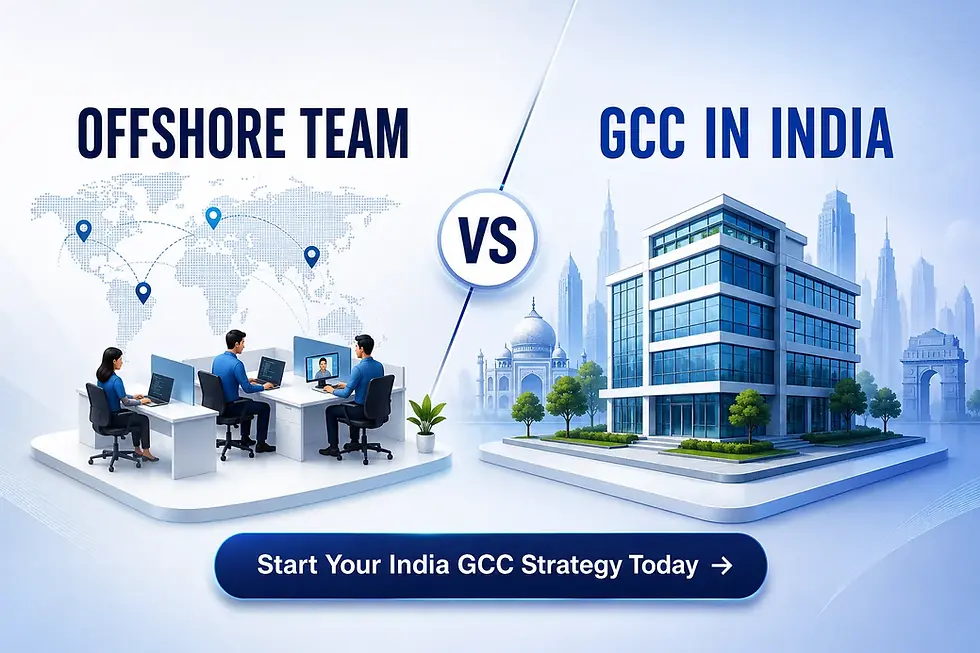
An offshore team in India is hired through a staffing or EOR partner with no separate legal entity required. A GCC, or Global Capability Center, is a company's own registered India subsidiary with its own office and leadership. The difference between an offshore team and a GCC in India comes down to who owns the entity, the IP, and the long term cost.
We get asked this question in nearly every founder call about India delivery. A GCC has to be incorporated under the Companies Act, 2013, before a single employee can join its payroll, a process that usually takes six to eight weeks even with a fast legal team. An offshore team skips that step entirely because a staffing partner is already the registered employer.
Bengaluru alone now hosts hundreds of GCCs from global banks, retailers, and SaaS companies, and most founders assume that trend means every India build should follow the same path. It rarely does.
What Is a GCC in India and How Is It Different From an Offshore Team?
A GCC is a wholly owned subsidiary that a global company sets up in India to run engineering, finance, or support functions for itself, not for outside clients. It hires its own employees directly, runs its own payroll, and reports into the parent company's leadership abroad.
An offshore team, on the other hand, is a group of professionals who work exclusively for your company but remain employed by a staffing or EOR partner in India. You get day to day control over their work without opening an entity, filing FEMA paperwork, or building a local HR function from scratch.
This is the core of the difference between an offshore team and a GCC in India: one is a legal entity you own outright, the other is a service you engage. Both can deliver the same output. The decision usually comes down to headcount, timeline, and how long you plan to keep the team in place.
Why Are Companies Choosing GCCs and Offshore Teams in India Right Now?
Hiring in India has shifted noticeably in the last two years. AI adoption inside GCCs and offshore teams alike has changed what companies ask for. Instead of pure headcount requests, we now get briefs for engineers who can build and evaluate AI agents, fine tune models on internal data, or manage cloud cost optimization across AWS, Azure, and GCP.
Cloud first architecture has also pushed more companies toward smaller, faster hiring cycles rather than large captive builds. A team of eight engineers running a cloud native product roadmap can now do work that once needed thirty people, which is part of why offshore team requests for lean, senior heavy squads have grown faster than large GCC builds this year.
Workforce expectations have shifted too. Candidates increasingly want hybrid arrangements and clear ownership of a product area rather than a purely execution role, and companies building GCCs are investing more in career pathing to compete with product companies for the same senior talent pool.
Which Indian Cities Have the Best Talent for GCCs vs Offshore Teams?
Bengaluru remains the strongest city for GCC scale hiring. It has the deepest bench of leaders who have already run compliance, finance, and HR functions inside a captive center, which matters because a GCC needs that leadership layer from day one.
Delhi NCR and Pune are where most of our offshore team placements happen. Talent here is used to working across multiple client accounts, which makes onboarding faster since these engineers are already comfortable adapting to a new company's tools and processes without a captive center's structure around them.
Hyderabad has built a strong base in product engineering, data science, and applied AI roles, pulled largely by enterprise software and pharma GCCs. Chennai and Ahmedabad are quietly strong in QA and ERP support, two skill sets many companies overlook when they default straight to Bengaluru.
Contract Hiring vs Full Time Hiring: How Each Model Works in India
Contract hiring means engaging a professional for a defined period or project, typically through a staffing agency or EOR, without adding them to your own payroll. This is the model behind almost every offshore team we build, since the flexibility to scale a team up or down without severance liability is one of the biggest reasons companies choose it.
Full time hiring means the professional is on your own company's payroll as a permanent employee, with statutory benefits like provident fund and gratuity governed directly by you as the employer. This is how every GCC hires, since a captive center exists specifically to build a long term, directly employed team.
Many companies use both models at once. It is common for a GCC to keep a small contract bench alongside its full time staff to absorb short term spikes in workload, while an offshore team occasionally converts a long tenured contractor to full time once a client decides to open its own entity.
Legal and Compliance Rules Behind the Difference Between an Offshore Team and a GCC in India
A GCC must be registered under the Companies Act, 2013, and many also register under the Special Economic Zones Act, 2005, or through the Software Technology Parks of India scheme to access export benefits. Each of these adds its own filing calendar, and missing a quarterly SEZ filing is one of the most common compliance slips we see in a company's first year.
An offshore team carries none of this because your staffing partner is already the compliant, registered employer. Your agreement with them is commercial, governed by contract law, not company law. The real difference between an offshore team and a GCC in India, from a compliance standpoint, is that one path puts the statutory burden on you and the other keeps it with your partner.
The mistake we see most often is companies assuming a switch from offshore to GCC later is simple. It requires a formal transfer agreement, fresh employment contracts, and continuity calculations for gratuity and provident fund, so we always recommend planning for that transition before the first offshore hire is even made.
GCC vs Offshore Team in India: Full Comparison Table
Factor | GCC (own entity) | Offshore team (via partner) |
Legal setup | Own subsidiary under Companies Act, 2013 | None, partner is the employer |
Time to first hire | Six to eight weeks | Two to four weeks |
Typical hiring model | Full time employment | Contract, convertible to full time |
Minimum team size for value | Around 50+ | Efficient from one person up |
IP ownership | Direct, in the entity's name | Assigned through contract |
Exit cost | High, entity wind up required | Low, notice period only |
Best fit | Long term, large scale, IP sensitive builds | Fast start, flexible size, shorter horizon |
This table captures the difference between an offshore team and a GCC in India on a single page, and it's worth screenshotting before your next internal review of India hiring plans.
Our Process for Helping Companies Choose the Right India Hiring Model
At AnjuSmriti Global, we start every conversation with headcount and timeline, not a job description. That single answer tells us whether contract hiring through an offshore team or a full time GCC build is the better fit before we look at a single resume.
For offshore mandates, we run a structured technical assessment matched to the client's actual stack, followed by a short paid trial sprint against real backlog work. For GCC focused clients, we help pre hire the India leadership layer, HR and finance, that the entity will need before it can hire anyone else.
One recent case involved a fast growing fintech company that wanted thirty engineers in Bengaluru through a GCC within a quarter, but its SEZ paperwork was still pending in month two while its product launch date could not move. We placed a twelve person contract team to hit the launch, with a conversion clause written in so they could transfer to full time once the entity cleared. Ten of the twelve converted without a single hiring gap.
Cost Comparison: GCC Setup Cost vs Offshore Team Hiring Cost in India
Based on the mandates we have closed recently, contract engineering rates in India run roughly eighteen to twenty five lakh rupees a year for mid level talent, thirty to forty five lakh for senior engineers, and fifty to seventy five lakh for leads, all billed as engagement cost rather than take home pay.
A GCC's full time packages for the same bands usually run ten to fifteen percent higher once employer provident fund contributions, gratuity accrual, and standard India benefits are added in. On top of compensation, a GCC also carries fixed costs an offshore team never sees: entity incorporation and legal work, a dedicated HR and finance function, and office lease, easily adding forty to sixty lakh rupees a year before a single engineer is hired.
Companies that choose the offshore route often reinvest that saved overhead into a larger starting team or a faster hiring timeline instead of carrying an idle India office function through its first year.
Conclusion
Offshore teams are increasingly being used as a deliberate first phase before a GCC, giving companies a working India team while they sort out entity paperwork, rather than treating the two models as a permanent either or choice. We are seeing more companies ask for a built in conversion clause upfront, something that almost never came up in briefs a few years ago. The difference between an offshore team and a GCC in India is not about which model is better. It is about which one matches your actual headcount and timeline today.
If you are weighing this decision for your own India plans, talk to our team and we will map out both cost scenarios against your real hiring plan.
Interesting Reads:
FAQs
1. What is the main difference between an offshore team and a GCC in India?
A GCC is a company's own registered subsidiary with full time staff on its payroll. An offshore team is hired through a staffing or EOR partner with no entity required. This changes cost, hiring speed, and who carries statutory compliance for the workforce.
2. Is contract hiring or full time hiring better for an offshore team in India?
Contract hiring is the standard model for offshore teams since it lets companies scale headcount up or down without severance liability. Full time hiring is used when a company later opens its own entity and wants to convert long tenured contractors permanently.
3. How long does it take to set up a GCC in India compared to an offshore team?
A GCC typically takes six to eight weeks to incorporate under the Companies Act, 2013, before the first hire can join payroll. An offshore team can onboard engineers in two to four weeks since no new legal entity registration is needed.
4. Can an offshore team in India be converted into a GCC later?
Yes, through a formal transfer agreement, fresh employment contracts, and continuity calculations for gratuity and provident fund. Planning this conversion clause into the original offshore contract avoids delays once a company is ready to incorporate its own entity.
5. Which Indian city is best for hiring a GCC team versus an offshore team?
Bengaluru has the deepest leadership bench for GCCs, especially HR and finance talent experienced in captive centers. Delhi NCR and Pune are stronger for fast offshore hiring, with engineers used to onboarding quickly across multiple client accounts and tools.
6. Does a GCC cost more than an offshore team in India?
Above roughly fifty employees, a GCC becomes cost efficient since entity overhead spreads across a larger headcount. Below that size, incorporation costs and a dedicated HR and finance function usually make an offshore team the cheaper option per engineer.
7. Who owns the intellectual property in an offshore team compared to a GCC?
A GCC owns IP directly since the entity is the employer. In an offshore team, IP is assigned to the client through the staffing contract, which is why a clear IP assignment clause matters before any work begins on a project.
8. Are companies using AI and cloud skills differently in GCCs versus offshore teams?
Both models now hire for AI and cloud skills, but offshore teams are more often used for smaller, senior heavy squads working on cloud native products. GCCs tend to build larger, longer term teams around AI platforms tied to the parent company's core roadmap.
Comments